
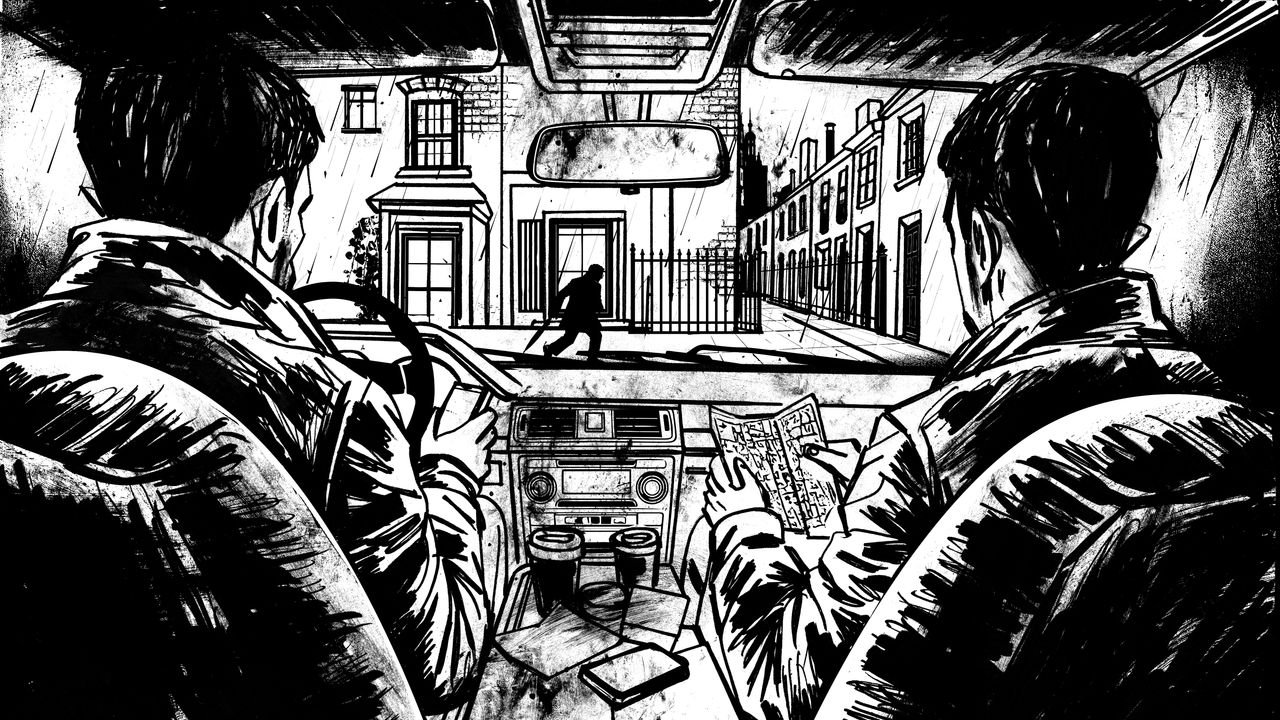
On a Friday in March, 2024, at around 3 P.M., Zeraati was leaving home for his weekly commute to Iran International’s studios. As he walked to his car, a nineteen-year-old Romanian man, Nandito Badea, came up to him and asked him for “three pounds.” At the same time, another Romanian, David Andrei, approached Zeraati from behind. One of them grabbed Zeraati while the other plunged a knife into his right leg three times. The two men ran, laughing, to the blue Mazda that was waiting for them, and Stana, who was driving, sped away. Zeraati lay collapsed in the street. Neighbors who overheard the scuffle arrived to help. A construction worker fashioned a tourniquet out of a tool belt to stanch Zeraati’s bleeding. Meanwhile, the three Romanians ditched the van, chucked their clothing into a garbage bin, and ordered a taxi to Heathrow Airport. They boarded a flight to Geneva and then another to Bucharest.
The plot against Zeraati is part of a widening campaign by the Iranian government which involves hiring criminals—Russian mobsters, Hells Angels bikers, and even Swedish teen-agers—to attack its detractors and sow fear among Iranians in exile. Because these operations draw from the criminal underworld, the Iranian regime can deny any involvement. “Hired criminals are cheap, and they know how to blend in,” Colin Clarke, the executive director at the Soufan Center, a global-security think tank, told me. “And Iran doesn’t seem to care if these guys get caught or can’t get the job done.” Even a foiled plot can spread fear among the diaspora. “Sometimes terrorism isn’t about body counts. It’s about who is watching.”
The Iranian regime has been killing troublesome exiles since the Islamic Revolution, in 1979. Its agents have been accused of murdering dozens of people living abroad. One of the most dramatic attacks took place in Berlin in 1992, when Iranian agents gunned down a group of Kurdish opposition leaders while they were dining at a Greek restaurant. Police arrested the murder suspects. German prosecutors said that the men were sent by senior members of the Iranian regime, including the Supreme Leader. Later, an international arrest warrant was issued for Iran’s intelligence minister, Ali Fallahian.
The German prosecution ushered in a period of relative quiet. The pace of plots picked up in 2009, following nationwide protests against the regime. Authoritarian governments “fear their own people,” Ray Takeyh, an expert on Iran at the Council on Foreign Relations, told me, and that fear “becomes much more acute during periods of vulnerability.” Iran has increasingly relied on hybrid threats as it has confronted a series of of humiliations: a U.S. drone strike, in 2020, that killed Qassem Suleimani, the leader of Quds Force, I.R.G.C.’s élite special-forces-and-intelligence unit; another wave of nationwide protests in 2022; the near-destruction of Iran’s overseas proxies; and an almost uninterrupted cycle of attacks from Israel and the United States since last June.
“The more setbacks Iran experiences at home and in the region, the more attractive these fairly cost-free operations become,” Matthew Levitt, a senior fellow at the Washington Institute for Near East Policy, told me. Levitt maintains a digital map that tracks Iranian-backed plots abroad since the country’s revolution. Over the past five years, he has recorded more than two hundred—nearly double the number documented from 1979 to 2021. Many have targeted dissidents or journalists whom the regime accuses of aiding its enemies and fomenting unrest in Iran. “Unless Western governments find a real way to increase the costs, the regime will continue to get away with kidnapping, conducting surveillance, and ultimately trying to murder people on their soil,” Levitt told me.



