
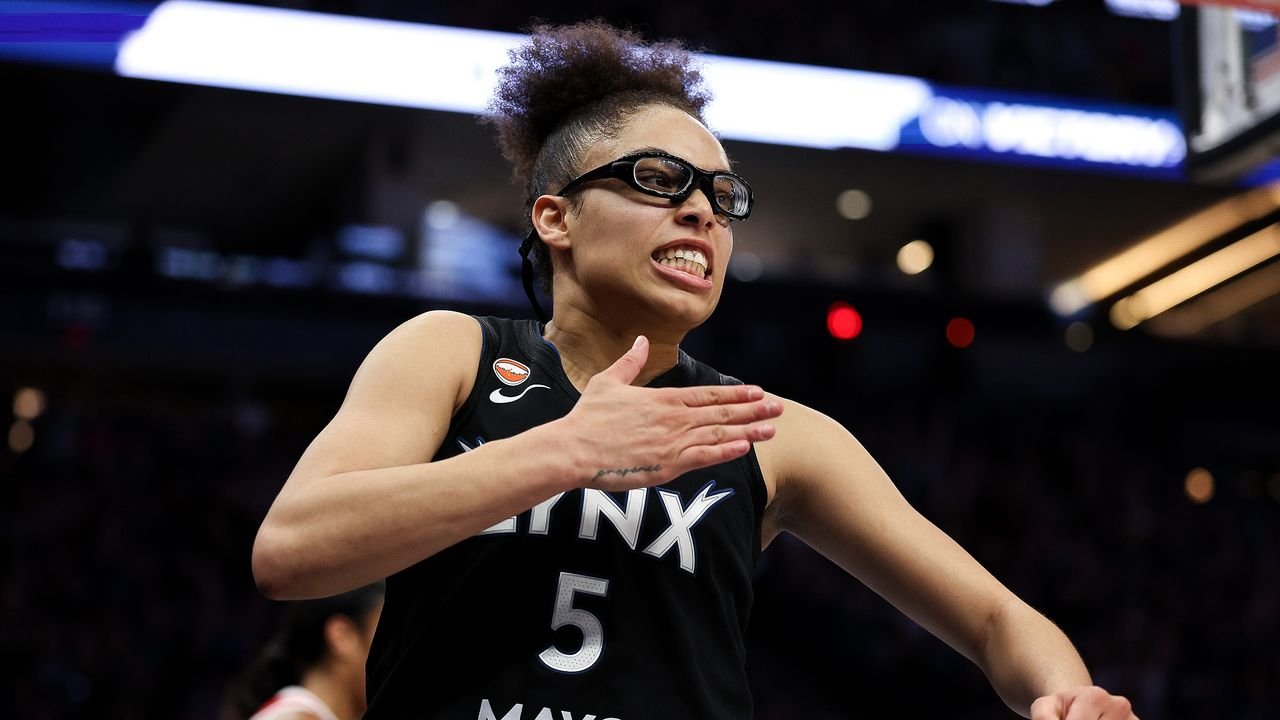
Olivia Miles, the rookie point guard for the Minnesota Lynx, wears a pair of bug-eyed sports goggles, black and bulbous, sometimes held in place by a thick strap that runs through her luxuriant Afro. They’re nobody’s idea of cool but hers, which has made them the coolest thing in the W.N.B.A. right now. She wears them for the usual reasons—she got her first prescription as a young child—but also because they suit her. They tell a story, not only about a young person who does things her own way, irrespective of what’s expected, but also about her singular court vision.
Lynx fans have taken to calling her the Spectacle, which is the perfect nickname for her. She has retro playground tricks and a modern unicorn’s hyperefficiency—an ability to create a good shot, whether for herself or for a teammate, from beyond the three-point arc or in the paint, anywhere on the floor. When you watch her, that’s what stands out: the uncanny anticipation, the in-stride no-look passes, the pick-and-rolls that make defenses reel, the quick shivers that shake defenders to make space for a three-pointer, the drives past astonished bigs in the paint—ending with a basket that looks less like a traditional layup than a ballerina’s jeté.
She’s big for a traditional point guard—five feet ten—and is a dynamic athlete, a former star soccer player in high school. She has one of the best handles in basketball. But her game is built around her eyes. She uses them to guide her teammates into space, to misdirect defenders, to drag her opponents into screens. Miles sells glasses, literally—she has an endorsement deal with GlassesUSA—but she also sells the idea of glasses. Her goggles clarify her game. They make it easy to see.
Miles has a shot at becoming the first rookie to win M.V.P. since Candace Parker did it in 2008. She already has a case for being the best player on the best team in the league—and, night after night, is the most fun to watch. So why isn’t she the biggest story of the league this season?
Professional sports exist to tell stories, and those stories exist to sell things. The fact that sports leagues are businesses is what makes possible their professionalization, and what allows for business is the exchange of money.
Perhaps that should be uncontroversial. But the stuff that sports sells—the jerseys, the Coca-Colas, the sweatshirts—is ancillary. Play, by definition, doesn’t produce anything tangible or useful. (If it did, it wouldn’t be play.) What games produce instead are experiences, ever-shifting kaleidoscopes of feelings. And it’s hard, and maybe wrong, to put a price on feelings, or to decide whose feelings are worth the most. That’s one reason there are so many arguments over the value of a team, or an athlete, or sports more generally, as more and more money chases something essentially priceless—or misappropriated, depending on your view.



