
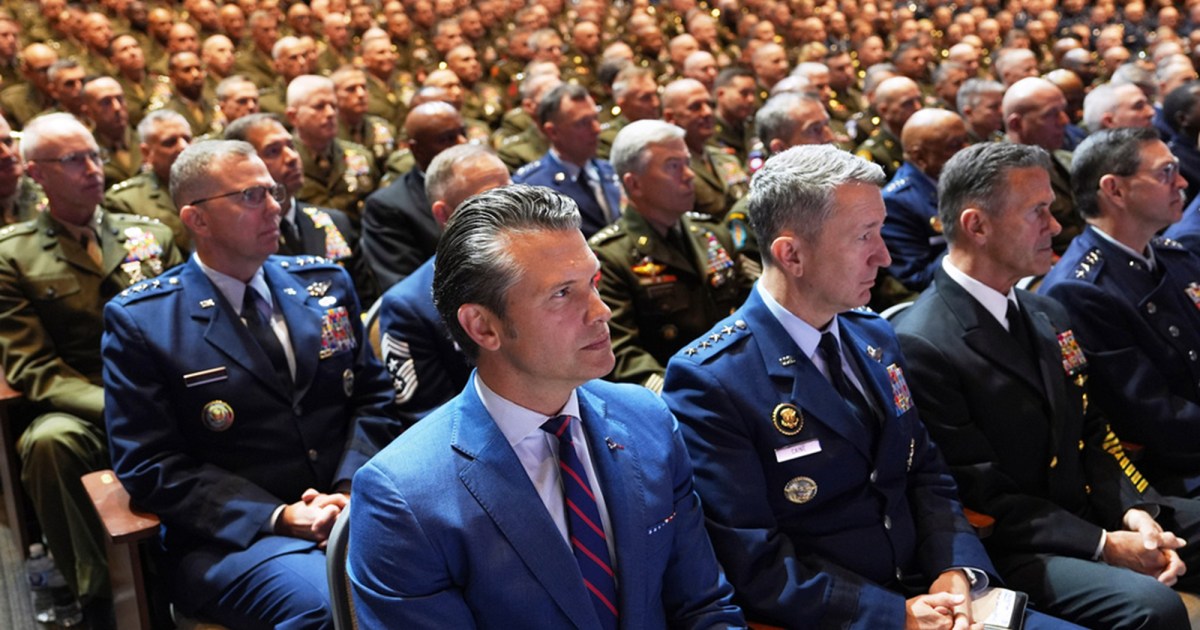
Defense Secretary Pete Hegseth with top military commanders. The Pentagon’s chiefs have privately warned him the Iran war is unsustainable, according to a classified assessment reported by the Washington Post.Evan Vucci/AP
Defense Secretary Pete Hegseth’s top military brass has now privately warned him directly: His war in Iran is unsustainable and is draining America’s ability to defend itself from threats elsewhere—and at home.
On Sunday morning, the Washington Post published a scoop describing a classified assessment by the heads of the Army, Navy, and Air Force, as well as top commanders from across three continents, contained in a twice-monthly report called the Secretary of Defense Orders Book.
The pain point, according to the reporting, is that President Trump wants to keep all his options open, including the ability to attack Iran again—extending a large deployment of troops kept at the ready and limiting the ability to train and run missions elsewhere. That prompted the concern, formally known as a “non-concur,” from Hegseth’s commanders, according to the Post:
As President Donald Trump has pressured Tehran to reopen the Strait of Hormuz and accept several U.S. provisions for ending the stalemated conflict, he has been adamant that all options remain available to him — including further military action. Consequently, U.S. Central Command, the headquarters responsible for prosecuting the Iran war, has kept a force of more than 50,000 troops on alert for months in case the president orders additional attacks.
It was the chief of naval operations who provided the bleakest assessment, as deployments of personnel and vessels have been extended for months—warning that just a quarter of the Navy’s destroyer fleet is ready to deploy, representing a big decline from prewar levels, according to the Post.
The Pentagon told the Post it does not discuss these sorts of private assessments.
On Day 10 of the Iran conflict, Trump declared the war “very complete, pretty much.” It’s now many months later, with no deal, no end date, and a $37.5 billion price tag, according to Hegseth’s July testimony to Congress. Last week we documented the ongoing whiplash in our video below—from demands for unconditional surrender, to negotiations, to this week’s “Operation Economic Outcast,” a sanctions campaign that amounts to a tacit admission that six months of bombing didn’t get the job done.
Watch:



