
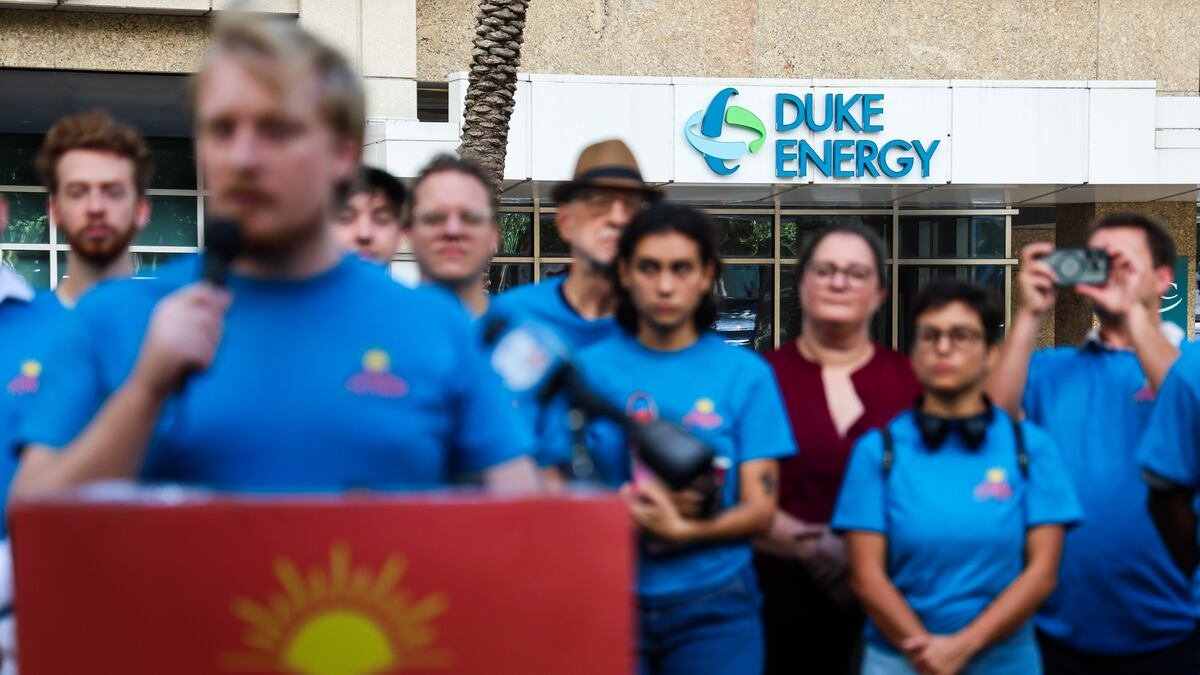
Clean-energy organizers on Wednesday rolled out a new campaign in St. Petersburg to put a proposal about leaving Duke Energy on the 2028 ballot. But by the time their news conference began, Duke Energy had beaten them to the punch.
The day before, Duke publicized a report it had commissioned that concluded it could cost St. Petersburg between $2.7 billion and $4.1 billion to split off from Duke Energy and form a city-run electric utility.
The conclusion from the analysis was clear, Duke said: It would be “unaffordable and irresponsible” for the city to drop its services.
“Our residents deserve a clear understanding of the costs, risks, and long-term implications of this unprecedented proposal,” company spokesperson Ana Gibbs said in a statement. “A government takeover could cost as much as $4 billion, and our customers would ultimately be asked to shoulder the burden through higher taxes and increased fees or worse, a reduction in public services.”
Here are three things to know about where this cost estimate comes from.
1. The consultant Duke hired has a history of similar analyses
To complete the report, Duke hired consulting firm Concentric Energy Advisors. Duke also hired them in Clearwater, when officials there were considering dropping their services. There, Concentric’s estimate far exceeded an appraisal done by a city-hired firm.
For utilities in a similar situation, Concentric is a common choice. In at least four other states, utility companies hired Concentric in communities considering ditching their services, and the firm arrived at soaring cost estimates. From San Diego to Decorah, Iowa, to Pueblo, Colorado, Concentric’s estimates were higher than those found in studies commissioned by the local governments, the Tampa Bay Times previously reported. But the eye-popping figures were repeated frequently in political ads, local activists said, confusing voters.
On Wednesday, the St. Petersburg organizers said Concentric’s track record shows why residents should be skeptical of the $4 million figure.
“They shouldn’t be taken seriously,” said Jason Scott, a lead organizer with local grassroots group Dump Duke. “They’re an industry ally, and they’ve been used across the U.S.”
Duke has defended Concentric’s methodology in the past, saying the firm has deep experience in the utility industry and that its analyses about the costs of city takeovers are only a fraction of its business.
2. A St. Petersburg split would be particularly ‘complex,’ report says
The Concentric analysis, which spans nine pages, does not dig into how leaving Duke Energy would affect residents’ electric bills.
It does provide a breakdown of how it arrived at its multibillion-dollar estimates. According to its calculations, which Concentric calls “preliminary,” if St. Petersburg were to drop Duke’s services, it would need to add “substantial new utility infrastructure,” including 150 miles of distribution lines, 16 miles of transmission lines and four substations.
Because the grid in St. Petersburg is “highly integrated” with neighboring areas, the city and Duke could have to “reconstruct portions of the existing system to maintain service reliability” in St. Pete Beach, Treasure Island, Gulfport, Tierra Verde and surrounding portions of Pinellas County, the report says.
“It’s all made up to try to increase the cost as high as possible,” said Scott of Dump Duke.
If St. Petersburg took over utility operations, the city would buy the existing infrastructure within certain boundaries, not build an expensive new grid, he added. Additionally, there are state regulations that prohibit “uneconomic duplication” of utility services that hurt customers.
In its estimates, Concentric also included expected legal fees, condemnation proceedings, support services, engineering and consulting services, transaction costs and initial cash reserves to start a new utility.
“Creating a new municipal electric utility in the City would be operationally, financially, legally, and organizationally complex,” the Concentric analysts concluded.
3. A preview of what’s to come
Duke’s messaging strategy offers a glimpse at what lies ahead as the fight plays out in St. Petersburg. Past efforts by local governments to take over the grid from corporate utilities have resulted in dramatic and bruising political battles.
When a ballot question about leaving corporate utilities in Maine went before voters in 2023, for example, the power companies poured tens of millions of dollars into blanketing the airwaves with ads and hiring an army of political consultants. The ballot measure failed.
One of those consultants appears to have been hired to work for a pro-Duke canvassing group in Pinellas County, the Times previously reported.
The Tampa Bay Times launched the Environment Hub in 2025 to focus on some of Florida’s most urgent and enduring challenges. You can contribute through our journalism fund by clicking here.



