
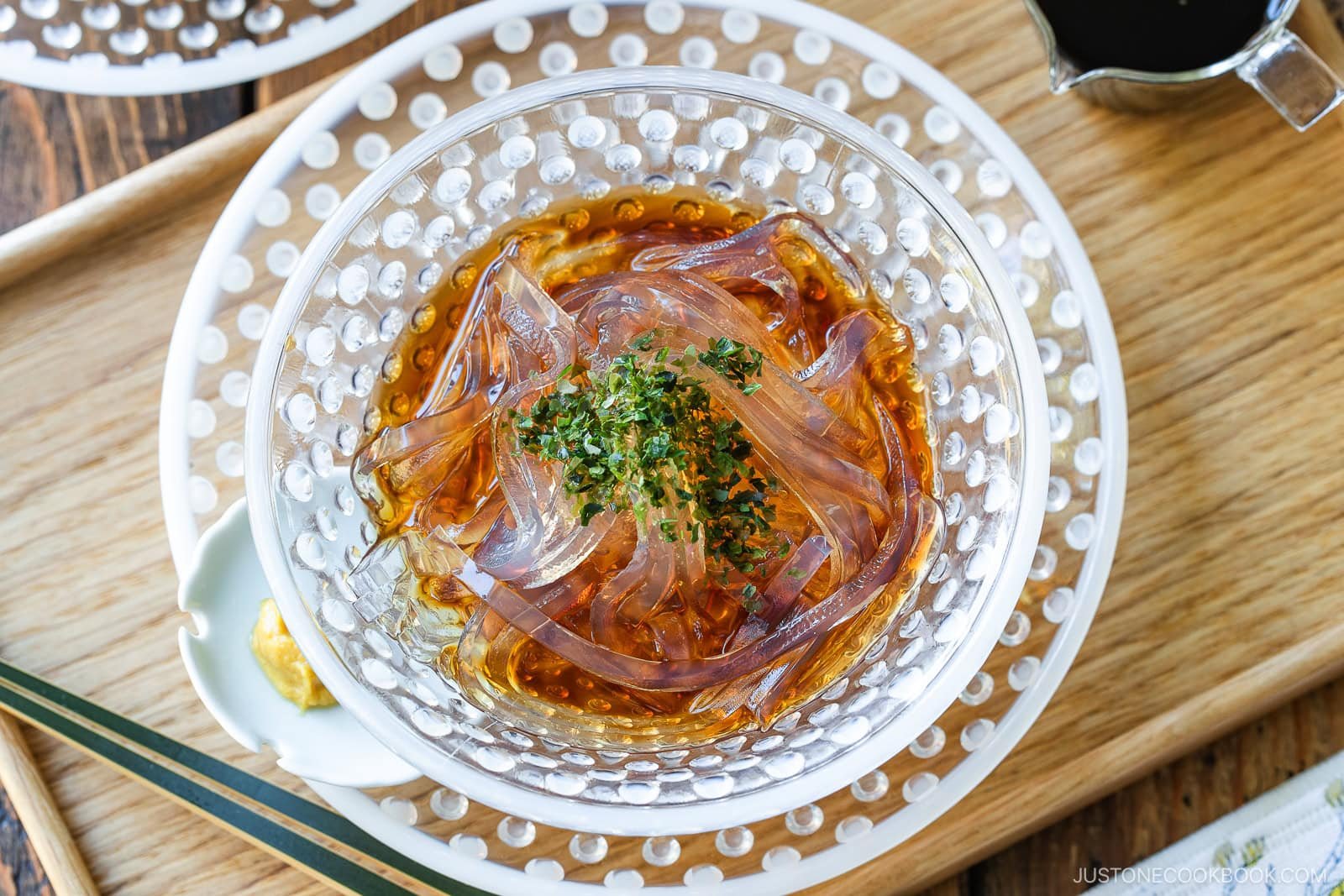
Tokoroten at a Glance
Tokoroten (ところてん) is a traditional Japanese summer snack of clear, noodle-like strands cut from kanten (seaweed) jelly. I press mine through a wooden tentsuki, the way tokoroten shops do. The strands are firm and slippery with a clean, cool bite and almost no flavor of their own—the savory or sweet sauce carries it.
Why You’ll Love It
- Pressed with a tentsuki – One push sends the whole block through, so every strand comes out square and even instead of knife-sliced.
- A full two-minute boil – Anything less and the kanten never fully dissolves, so the jelly sets watery, grainy, and too crumbly to press.
- Both regional styles – Kanto’s vinegar-soy nihaizu and Kansai’s kuromitsu and kinako, so one batch covers a savory lunch or a sweet dessert.
- Kanten sets on the counter – Unlike gelatin, it firms up at room temperature in about an hour, then chills to a clean, snappy bite.
My Recipe Story
A few readers had asked me for a tokoroten recipe, and it sat on my list for a long while. Then Naomi, our JOC Community Manager, told me about growing up in Shikoku and making it with her mom from real tengusa seaweed. I loved that story, and once we started carrying the tentsuki press at JOC Goods, we decided to make a batch using ingredients you’d actually find here in the U.S.
It turned out to be easier than I expected. There is something genuinely satisfying about that first push on the press, when the strands come out clean and even. I give both sweet and savory sauce. Mr. JOC goes straight for the sweet version with kuromitsu (brown sugar syrup) and kinako, and I reach for the cool, tangy vinegar-soy one.
If you love cooling Japanese foods, try my Cold Miso Soup, Hiyayakko (Japanese Cold Tofu), and Hiyashi Chuka (Cold Ramen) next!

Key Ingredients for Tokoroten
Kanten (agar) powder and water make the Japanese jelly noodles. Soy sauce, rice vinegar, and optional alcohol-free mirin topped with aonori and karashi mustard for a savory version, while kuromitsu (black sugar syrup) and kinako (roasted soybean flour) top for a sweet dessert or snack.
- Kanten (agar) powder – A semi-translucent firming agent made from flavorless seaweed. Kanten gives jelly a firm yet light texture so it maintains its shape and has a toothsome bite. I use 4-gram stick packets from the Japanese grocery store, or find it on Amazon.
- Aonori (dried green seaweed) – These fine flakes smell green and briny the moment they land on the cold noodles, and since the tokoroten itself tastes of almost nothing, that aroma does a lot of the work. I did not expect it to bring out such nice flavor, and now I would not skip it. Substitute shredded nori (kizami nori), which is milder and a little toastier.
- Kuromitsu (brown sugar syrup) – A sweet, dark syrup made from unrefined Okinawan black sugar. Kuromitsu has a deep, slightly bitter flavor like molasses, toffee, and caramel, but with more complexity. Find it in Japanese grocery stores or on Amazon, or make Kuromitsu at home.
- Nikiri mirin – An alcohol-free mirin (sweet rice wine). Boiling or flaming removes the harsh alcohol bite, so it works in cold dressings. Soy sauce and rice vinegar alone make nihaizu (二杯酢); adding nikiri mirin to it makes it sanbaizu (三杯酢), which is milder and less sharp. I use sanbaizu.
Find the printable recipe with measurements below.
How to Make Tokoroten
- Make the kanten jelly. Mix the kanten powder and water in a saucepan. Bring to a gentle boil, then simmer for 2 minutes until the powder dissolves. Pour into a nagashikan (mold with a removable bottom insert) or glass container, cool for 1 hour, and cover with plastic wrap. Refrigerate for 3 hours or overnight until firm and cold.
- Unmold the jelly. Run a knife along the edges of the pan to loosen the jelly. Lift the insert and jelly together and place on a work surface. Unmold the jelly onto a cutting board if using a glass container.
- Cut the jelly into blocks. Slice into rectangular bars that fit the chamber of the tokoroten press (tentsuki), using the pressing stick as a guide. Trim the blocks 1–2 cm shorter than the chamber.
- Press the blocks. Push the kanten blocks through the tokoroten press with the pressing stick to make uniform, noodle-like strands.
- Top and serve. Divide the tokoroten among individual bowls. For the savory version, pour on the vinegar-soy sauce, sprinkle with aonori seaweed, and add karashi hot mustard on the side. For the sweet version, dust with kinako and drizzle with kuromitsu.


Nami’s Recipe Tips
Before you start, here are a few things I’ve learned along the way to make perfect Tokoroten every time.
- Whisk the kanten powder in cold water – Mix well before heating until no clumps remain. Otherwise, the clumps may not dissolve during cooking.
- Dissolve the kanten completely – This is the step to watch. The liquid turns clear well before the kanten is actually dissolved, so trusting your eyes is what ruins a batch. Keep it bubbling for the whole 2 minutes. Undissolved kanten sets watery and grainy and crumbles in the press, and you do not find out until three hours later.


- Wet the mold first – A thin film of water between the mold and the jelly is what lets the block slide out whole. Dry metal grips it, and you end up cutting it free with a knife.
- Pop the surface bubbles – I touch them with the flame of a butane kitchen torch or utility lighter for a translucent look. A spoon or a toothpick works too.
- Cover with a paper towel – The refrigerator drips condensation onto the surface otherwise. Plastic wrap alone traps that moisture; the paper towel is what absorbs it.


- Match the blocks to the press – The pressing stick is the exact width to cut to, and I get 4 blocks from the 6-inch (15 cm) side of my pan. Measure your chamber once before cutting anything, though: every tentsuki is a slightly different size, and a block cut to the wrong measurement will not press cleanly no matter how well the jelly set.
- Wet the press – Run this traditional tool under cold water before pressing to help the kanten blocks glide smoothly.
- No tokoroten press? – A knife works. Cut the jelly into thin, noodle-like strips, though they come out flatter and less even, and you lose the square cross-section that gives tokoroten its particular slipperiness.

Make Ahead Tips
- Make the kanten jelly a day ahead – It needs at least 3 hours in the refrigerator anyway, so setting it the night before leaves only the cutting and pressing on the day.
- Mix the vinegar-soy sauce ahead – It takes two minutes, so I make it while the jelly is setting and it’s ready when the tokoroten is.
- Make the nikiri mirin the day before – It has to cool completely before it goes into the sauce, so doing it early saves waiting around.
Storage Tips
To store: Transfer the tokoroten to an airtight container and store in the refrigerator for up to 3 days. Tokoroten does not freeze well. Add sauce or toppings right before serving.


Regional and Homestyle Variations
Here are more toppings to enjoy on tokoroten from different regions and households across Japan.
- Katsuo dashi. Serving in bonito stock is popular in Kochi and Ehime prefectures in Shikoku.
- Mentsuyu (noodle soup base). Similar to soba dipping sauce, this variation is common in Kanto-area households.
- Ponzu. Japanese citrus dipping sauce is a popular home substitute for vinegar-soy sauce.
- Soy sauce + rice vinegar + grated ginger. A typical preparation in Tohoku in eastern Japan.
- Miso. Try sweet vinegar miso, red miso, or su-miso (vinegar miso).
- Soy sauce + rice vinegar + aonori/nori + ground sesame + karashi mustard. A seaside flavor with sesame richness popular in Yamaguchi.
What to Serve with Tokoroten
Pair these dishes and beverages with your sweet or savory tokoroten.
- Shiratama Dango – Chewy and bouncy, these mochi-like dumplings pair with sweet tokoroten for a textural contrast.
- Mugicha – Chilled Japanese barley tea is caffeine-free and refreshing on a hot day.
- Salmon Nanbanzuke – Serve marinated and chilled fried salmon with savory tokoroten for a light lunch.
- Cold Brew Green Tea – Cool down and energize with a crisp, smooth cup over ice.


FAQ
What is tokoroten?
Tokoroten is said to have come to Japan from China with the kentōshi, the official missions to the Tang court, and has been eaten here for around 1,200 years. It was served with vinegar-soy sauce from early on—what we now call Kanto style. The sweet Kansai version with kuromitsu came later.
What does tokoroten taste like?
Tokoroten noodles have almost no flavor on their own. What you taste is the topping, and those vary a lot from region to region and household to household.
What is the difference between Kanto vs Kansai tokoroten styles?
Kanto-style (Tokyo area) tokoroten uses a tangy and refreshing sauce called nihaizu made with soy sauce and rice vinegar. This is the most common style in Japan nationwide. Kansai-style (Osaka area) tokoroten serves it sweet with kuromitsu (black sugar syrup).
Can I make tokoroten with kanten or agar-agar powder?
Yes. My recipe uses 1 stick packet (4 g) of kanten powder—it’s pre-measured, melts evenly in water, and is the easiest form for beginners. One kanten bar (8 g) or 24 kanten threads (8 g) work too. Agar powder also works at 4 tsp, though the texture comes out slightly different.
I’d love to hear how yours turned out! 💛 Please leave a star rating and comment below to share your experience. Your feedback not only supports Just One Cookbook but also helps other home cooks discover recipes they can trust.
Tokoroten (Japanese Jelly Noodles)
Servings:
For the Tokoroten Noodles
For the Savory Version (Vinegar-Soy Sauce)
To Make the Vinegar-Soy Sauce (for the savory version)
- Whisk 2 Tbsp soy sauce and 2 Tbsp rice vinegar in a small bowl to make nihaizu (vinegar-soy sauce). If you wish, add 2 Tbsp nikiri mirin (boiled/alcohol-free mirin) to make the milder, less sour sanbaizu.Nami’s Tip: See my tutorial on How to Make Nikiri Mirin.
To Unmold the Kanten Jelly
- Take the firm, chilled kanten jelly out of the refrigerator. Run a knife along the edges of the mold to loosen the jelly. Lift the insert and jelly together and set them on a work surface. Nami’s Tip: If you’re using a glass container, unmold the kanten jelly onto a cutting board.
To Cut the Jelly Blocks
- Cut the blocks: Cut the kanten jelly into rectangular blocks that fit the chamber of the tokoroten press. Use the pressing stick as a guide for the width. A 15×13.8 cm (6 x 5½-inch) nagashikan yields 4 blocks from the 15 cm side. Trim the length: Cut the blocks 1–2 cm shorter than the chamber. Skip this if you’re using a nagashikan like mine.Nami’s Tip: A block that is too long stops the pressing stick from pressing cleanly. Too short or too narrow, and it wobbles instead of forming neat strands.Wet and load the press: Run the tokoroten press under running water so the blocks slide through smoothly. Use the flat blade of a knife to transfer a block into the moistened chamber.Nami’s Tip: No tokoroten press? Cut the kanten jelly into thin, noodle-like strips with a knife.
To Press and Serve
- Pass the kanten blocks through the tokoroten press into individual bowls; each block makes about 1 serving.Finish the sweet version: Dust the tokoroten with kinako (roasted soybean flour) and drizzle with kuromitsu (brown sugar syrup).Finish the savory version: Pour vinegar-soy sauce (nihaizu or sanbaizu) into the bowls, sprinkle aonori seaweed on top, and serve Japanese karashi hot mustard on the side.Nami’s Tip: Dissolve the karashi mustard into the vinegar-soy sauce first, then mix it through the tokoroten before eating.
About agar-agar powder: Outside Japan, agar-agar and kanten are the same seaweed gel. Use it by weight—the same 4 g. Measuring by spoon, that’s roughly 1½ to 2 teaspoons, but gel strength varies by brand, so a scale is more reliable.
To use a kanten bar: Rinse the kanten bar and break it into pieces. Soak the pieces in water for 30 minutes to help them dissolve faster. Squeeze out the water before using.
To set 2 cups (500 ml) of liquid, you will need:
- 1 stick packet of kanten powder (4 g);
- 1 kanten bar (8 g); or
- 24 kanten threads (8 g).
Did you make this recipe?
Tag @justonecookbook on Instagram so we can see your delicious creation!



