
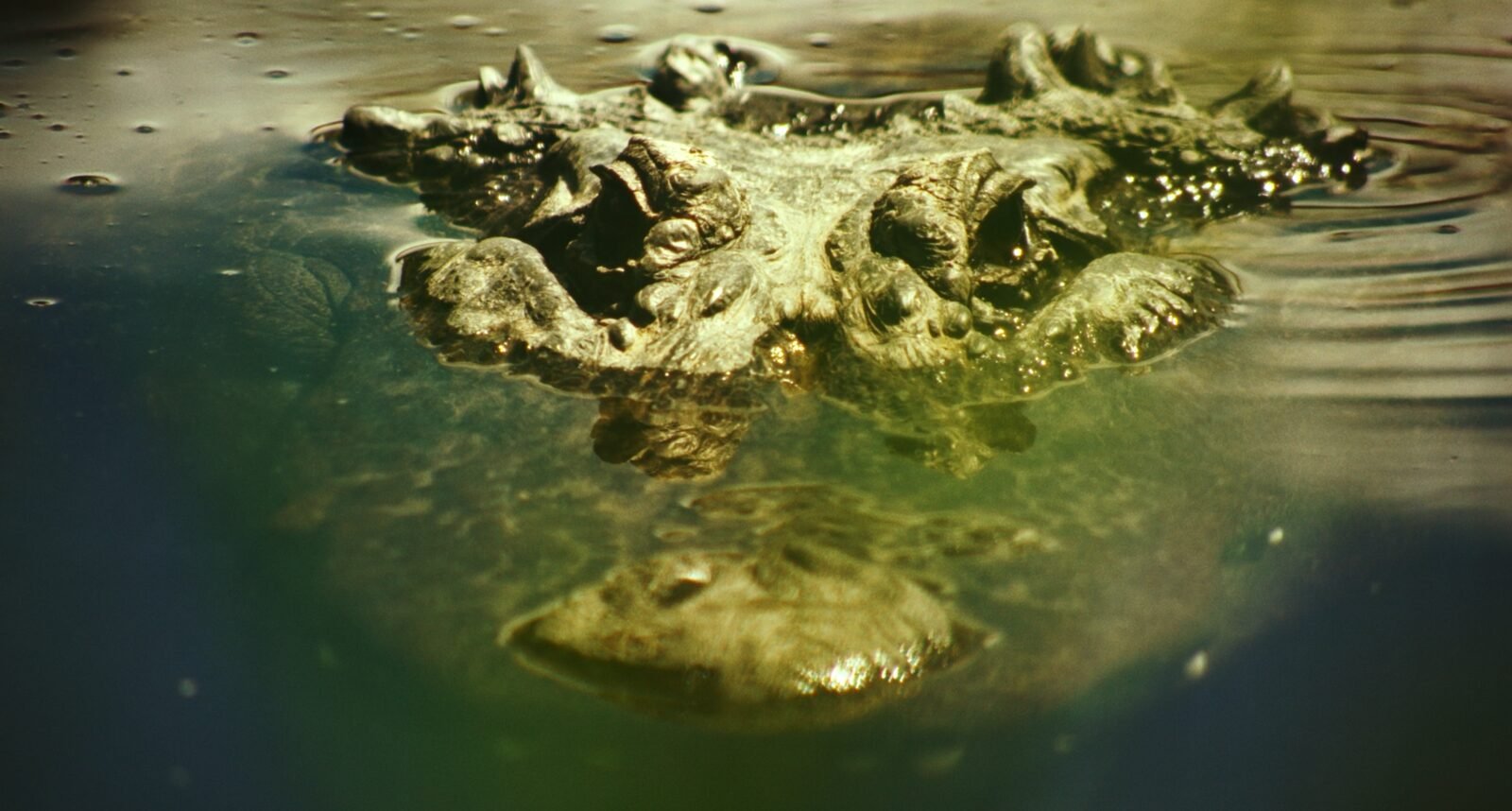
Freddie Gluck, director of the dreamy new documentary short “Gatorville,” has noticed something that makes him different from other young filmmakers: “I’ve barely watched movies. It’s not my obsession.”
He makes films because “what I’m really obsessed with is meeting people in real life, creating relationships with people who I never would have made relationships with.”
That’s exactly what happened with “Gatorville.” The 26-year-old asked to film at a reptile sanctuary, Colorado Gators, after driving past it on countless family road trips as a kid. The owners agreed, having hosted many nature shows in the past.
But instead of making another show about reptiles, Gluck and his director of photography and best friend, Matteo Moretti, ended up closely following the owners’ kids. “Gatorville” features hypnotic voiceovers from 10-year-old Bodhi and his 14-year-old sister, Lily, as they contemplate life among the gators.
Making the documentary introduced Gluck not only to Bodhi and Lily, but also to someone else he might not have encountered if not for the film: acclaimed screenwriter, novelist and poet Kirsten “Kiwi” Smith, whose credits include 10 Things I Hate About You, The House Bunny, and Trinkets. Legally Blonde, one of many films she co-wrote with Karen McCullah Lutz, has gained renewed appreciation with the arrival of the Prime Video prequel series Elle.
Smith was one of the jurors at the entrancing Ouray International Film Festival, which celebrates inspired, rulebreaking indie cinema in a tiny, storybook former mining town in a remote box canyon of the Colorado Rockies. Gluck’s film played as part of the Colorado block, and while it didn’t fit neatly into any of the awards categories, all the jurors (including one from MovieMaker) agreed that its unique approach deserved more attention. So Smith offered to interview Gluck, and we joyously accepted.
Here are Smith and Gluck discussing rules, cinematic moments in everyday life, and a shared history with blond hair.—M.M.
Kiwi Smith Talks With Freddie Gluck About ‘Gatorville’
Kiwi Smith: I loved your film, and saw it in a packed theater at the Ouray International Film Festival. We were blown away — everyone in the theater was. It’s such an exquisite work of art and it made me really curious to know more about you. You went to high school in Colorado?
Freddie Gluck:So I’m from Boulder, Colorado, and I went to Boulder High School, and then went to college at University of Rochester. I played college golf, started as a finance major in college, and then went through a breakup, dyed my hair blond, and became a studio art major. So I had a full life swap in college.
Kiwi Smith: When you dyed your hair blond and did a full life swap, what were your first baby steps into that world of studying art, film, cinematography?
Freddie Gluck: I feel like I never took a lot of baby steps. I’ve always been the type of person just to go and do it and see what happens and be ready for it to fail. Like in college I made some bad films.
Kiwi Smith: What’s a bad film to you?
Freddie Gluck: I’m very specific on what types of films I want to make, and with that comes a very specific style, specifically within documentary. I like to follow a certain amount of rules in the process that kind of opens up the world into a more interesting, less sit-down-interviewee classic documentary style. I think the best films that I enjoy now are fully verité documentaries that are just very fly on the wall, which “Gatorville” is not, but it’s trending hopefully in that direction.
Kiwi Smith: What are the rules that you mentioned?
Freddie Gluck: No sit-down interview frames. I did one interview for “Gatorville” — everything else was just audio. … Generally, I want to shoot everything on a tripod. I want to use all the same lenses, and one camera.
All these rules are more for the process of allowing somebody to trust you, and not showing them that you’re so focused on the craft of a film. … I’ve made these rules to make stuff feel less like a film and more like a journey with the people we’re making this film with.

Kiwi Smith: You said you don’t really watch movies. What kind of media or art do you take in for inspiration?
Freddie Gluck: I really, really enjoy photo books.
Kiwi Smith: Do you read any poetry? I felt like in “Gatorville,” there’s such a strongly poetic quality, not only to the visuals, but to the voiceover as well. Did that come from like anything being written or scripted, or was that narration all from Lily and Bodhi themselves, just riffing?
Freddie Gluck: Yeah, that was just them riffing. Nothing audio-wise was written. There were a couple scene ideas that were structurally concepted, like the shot at the end of the film.
Matteo Morettiand I go into all of our projects genuinely curious about the people we’re meeting, irrelevant of if we could make a film about them or not. If it just becomes five days that we spend with somebody, then that’s fine as well, but I think Lily and Bodhi started to see us as equals to them, and I think especially for a kid, they don’t often get to share what they’re feeling and feel like it’s being taken seriously or or respected in a way that maybe an adult saying something would would provide. We spent a lot of time with them. We went to the hot springs with them. I volunteered at their haunted house, so I was running around dressed in a scary pig costume. We did a lot that made them feel like we were all kind of just friends.
The thing I most enjoyed about this is the 21 days spent with Matteo, and if it ended there, I’d be completely fine. It feels like a vacation just to go make something with the people you love and appreciate. … I want to do what makes me happy, and I don’t know if grinding toward this “career” is going to bring me joy in the long run.

Kiwi Smith: You’re not like hustling out there, networking, doing that whole thing.
Freddie Gluck: I did some of that for a couple years, and I just got tired, and I felt like I wasn’t being my genuine self, and I was having to put on a facade that wasn’t realistic to who I am as an artist. Maybe that’s why I like photo books, because these people just go experience the world, and they take photos of it, and it feels like a very genuine artistic endeavor, where you’re meeting people and experiencing different lifestyles. Some of my favorite photo books are from people who are like mechanics, but they just take photos of being a mechanic for 30 years. Probably my favorite photo book is A Period of Juvenile Prosperity, by Mike Brodie, who train-hopped for like 20 years of his life, and picked up a camera and just started shooting the life he was living.
Kiwi Smith: What did you do today?
Freddie Gluck: Oh man, I went to the DMV because I need to get my car registered in California, and it’s not fun, and it’s way more expensive than Colorado.
Kiwi Smith: Did you take any pictures there? It’s illegal, probably.
Freddie Gluck: I did not, but I did take some pictures at Best Buy. I had to get more ink for my printer, and I saw this couch outside Best Buy with a bouquet of flowers and a worn pair of pants on it. So that was my picture today.
“Gatorville” is now making the festival rounds. You can learn more at gatorvillefilm.com.
Main image: “Gatorville,” courtesy of the filmmaker.



