
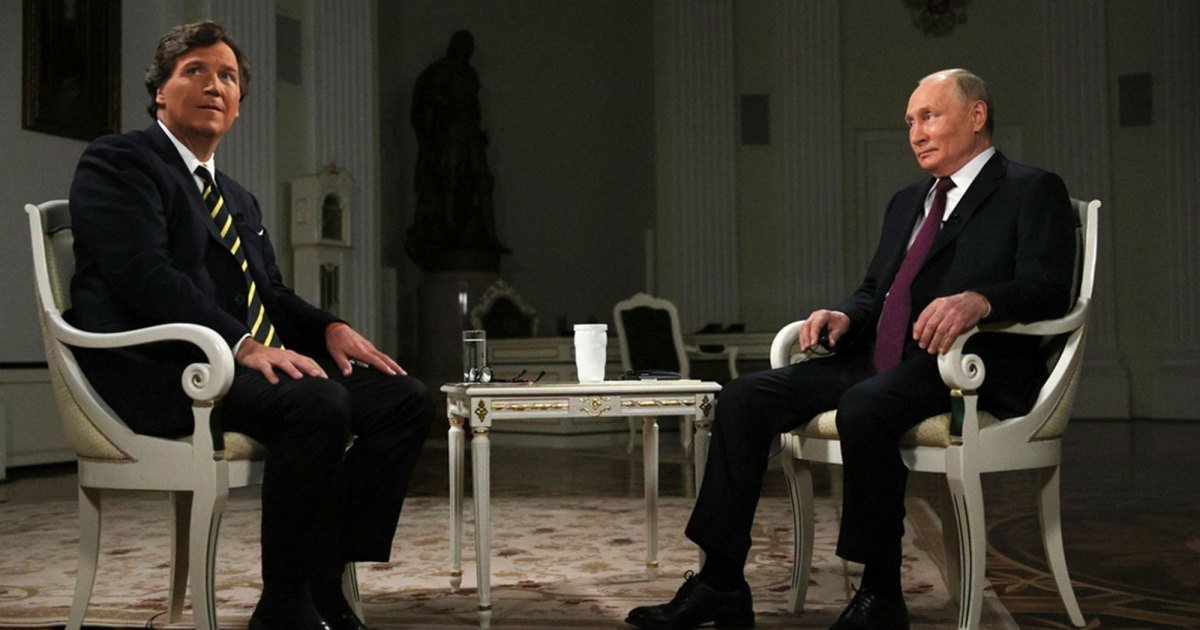
Tucker Carlson interviewing Vladimir Putin at the Kremlin on February 6, 2024. Kremlin Pool Photo via AP
My new book, How Russia Won: Donald Trump, Vladimir Putin, and the Fight for America (HarperCollins), was published this week. It covers how Russia has mounted multiple influence and disinformation operations against US elections (often to help Trump) since 2016 and how Trump, the GOP, MAGA, and right-wing media have aided and abetted this attack by denying it’s occurring.
The book is an attempt to reclaim the Trump-Russia narrative in the face of Trump’s decadelong crusade to brand it a “hoax.” Putin has been waging a twilight war against the United States and the West, and Trump and his crew have unilaterally surrendered, and there are now signs Moscow intends to meddle in the midterms to assist Trump.
Below is an excerpt of the book from Chapter 14 (“Useful Idiots”) that first appeared in my Our Land newsletter and that shows how MAGA and many on the right came to be fans of Putin, a repressive and murderous tyrant and war criminal. This is a major development within the conservative movement that has not drawn sufficient attention.
But first, a video promoting the book, narrated by the inestimable Nick Offerman:
Tucker Carlson began his nightly Fox News show on February 22, 2022, talking about Vladimir Putin. A few days earlier, President Biden had revealed that the United States possessed intelligence indicating the Russian leader planned to invade Ukraine imminently, and Carlson was furious that Putin was being demonized. He railed:
Since the day that Donald Trump became president, Democrats in Washington have told you you have a patriotic duty to hate Vladimir Putin. It’s not a suggestion. It’s a mandate. Anything less than hatred for Putin is treason. Many Americans have obeyed this directive. They now dutifully hate Vladimir Putin. Maybe you’re one of them. Hating Putin has become the central purpose of American foreign policy. It’s the main thing that we talk about… Very soon that hatred of Vladimir Putin could bring the United States into a conflict in Eastern Europe…What is this really about?
Why do I hate Putin so much? Has Putin ever called me a racist? Has he threatened to get me fired for disagreeing with him? Has he shipped every middle-class job in my town to Russia? Did he manufacture a worldwide pandemic that wrecked my business and kept me indoors for two years? Is he teaching my children to embrace racial discrimination? Is he making fentanyl? Is he trying to snuff out Christianity? Does he eat dogs? These are fair questions. And the answer to all of them is no…So why does permanent Washington hate him so much?
Carlson dismissed the ongoing Russia-Ukraine conflict as a mere “border dispute.”
This soft-on-Putin stance was not surprising. During Trump’s first impeachment in 2019, Carlson had huffed, “Why do I care what’s going on in the conflict between Ukraine and Russia?! And I’m serious. Like, why do I care? And why shouldn’t I root for Russia? Which I am.”
Carlson deployed Russia denialism to justify his support for Putin.
A week after that declaration, Carlson doubled down and said he opposed the sanctions the United States had imposed on Russia for its annexation of Crimea. “I think we should probably take the side of Russia if we have to choose between Russia and Ukraine,” he remarked. And he tied his pro-Putin fervor to the Trump-Russia scandal. Referring to journalists who had challenged the Ukraine-did-it conspiracy theory about the 2016 election, he exclaimed, “Putin, for all his faults, does not hate America as much as many of these people do.”
He went on: “Russia didn’t hack our democracy. The whole thing was a talking point, a ludicrous talking point, invented by the Hillary Clinton campaign on or about November 9, 2016, to explain their unexpected defeat in the last presidential election.” Carlson had deployed Russia denialism to justify his support for Putin.
Now, with Putin on the verge of launching an all-out war against Ukraine to seize territory and prevent his neighbor from joining NATO, Carlson was on the side of the Russian dictator. His comments encapsulated the titanic shift that had occurred in recent years within the conservative movement. During the Cold War, a core principle of Republicans and conservatives was opposition to the Soviet Union. The GOP had long crusaded against the Red Peril. Ronald Reagan in 1983 decried the Soviet Union as “the Evil Empire.” For decades, the hawks dominated within the Republican Party. In 2012, GOP presidential candidate Mitt Romney called Russia America’s “number one geopolitical foe.”
After Trump faced accusations of colluding with Russia’s attack on the 2016 election, his supporters came to see Putin, the enemy of their political enemies, as, if not a friend, then at least not an enemy.
But Trump—and America’s culture wars—had changed all that. While campaigning in 2016, Trump repeatedly displayed his affection for Putin and praised the Russian for being “strong” and for speaking well of Trump. Many of Trump’s followers were swept along.
After Trump faced accusations of colluding with Russia’s attack on the 2016 election—accusations he and his propagandists characterized as the evil fantasies of the Democrats, the media, and the Deep State—his supporters came to see Putin, the enemy of their political enemies, as, if not a friend, then at least not an enemy. After all, if Putin was the Democrats’ boogeyman, he couldn’t be all that bad.
Other factors contributed to the Right’s embrace of Putin. The conservative movement had long been a home for so-called America First isolationists who now viewed (as did far-left anti-interventionists) assaults on Putin as provocations that could lead to US involvement in an overseas conflict. Some within this camp considered the extension of NATO toward Russia and attacks on Putin to be the handiwork of imperialists and neoconservative hawks angling for war and the expansion of US hegemony. And Putin’s staunch opposition to gay and transgender rights, his purported advocacy of “traditional values,” and his support for the Orthodox Church, a mainstay of cultural conservatism, resonated with certain Americans. The measures that the religious right in the United States was pushing in state legislatures—anti-transgender bills and so-called Don’t Say Gay legislation—echoed Russian laws.
During Obama’s presidency, right-wingers hailed Putin’s toughness, largely as a dig at Obama. “People are looking at Putin as one who wrestles bears and drills for oil,” Sarah Palin, the former Republican vice presidential candidate, told Sean Hannity on Fox News. “They look at [Obama] as one who wears mom jeans and equivocates and bloviates.” The conservative cable channel promoted a side-by-side image of Obama wearing a helmet while riding a bicycle and Putin bare- chested on a horse.
Far-right commentator and former GOP presidential candidate Pat Buchanan, who feared the end of “White America” and the death of “Christian America,” looked to Putin for inspiration. “Is Vladimir Putin a paleoconservative?” he wrote in The American Conservative in 2013. “In the culture war for mankind’s future, is he one of us?” In 2014, Buchanan hailed Putin’s illegal annexation of Crimea as part of the Russian’s overarching goal to turn Moscow into “the Godly City of today and command post of the counterreformation against the new paganism.” He opined, “In the culture war for the future of mankind, Putin is planting Russia’s flag firmly on the side of traditional Christianity.” For Buchanan and other Christian nationalists, Putin was a global commander in the culture wars.
Mainstream Republicans—a shrinking band—still considered Putin a threat and Russia a strategic adversary. But a significant slice of the Right had jumped on Trump’s pro-Putin bandwagon. During the 2016 campaign, conservative commentator Dinesh D’Souza tweeted that what Trump admires about Putin “is the way Putin—unlike someone else we know—LOVES his country & FIGHTS for its interests.”
According to Gallup, Putin’s favorable rating among Democrats dropped from 15 percent to 10 percent between 2015 and 2017, yet with Republicans, it increased dramatically from 12 percent to 32 percent.
The following year, right-wing author Ann Coulter, picking up on the Buchanan vibe, declared, “In 20 years, Russia will be the only country that is recognizably European”—apparently meaning white. Christopher Caldwell, a prominent right-wing commentator, gave a speech at Hillsdale College in which he said, “If we were to use traditional measures for understanding leaders, which involve the defense of borders and national flourishing, Putin would count as the preeminent statesman of our time.”
Putin had originally leaned into conservative values to bolster his domestic support from tradition-minded Russians unsettled by the rapid changes following the collapse of the Soviet Union. He then took this pitch international and positioned himself as a leader against the decadent and relativist modern values rooted in the West—a stance that resonated within the American right.
Despite his military aggression and the brutal and thuggish repression he imposed on Russia—locking up rivals and critics, rigging elections, shutting down the opposition, suppressing the media, eliminating an independent judiciary, invading neighboring countries, murdering foes—he won support and a degree of admiration within MAGA. According to the pollster Gallup, Putin’s favorable rating among Democrats dropped from 15 percent to 10 percent between 2015 and 2017, yet with Republicans, it increased dramatically from 12 percent to 32 percent. The Americans warmest to Putin were Christian nationalists.
By the time Putin ratcheted up his threats against Ukraine in early 2022, he had won over a chunk of American conservatives, with some MAGA figures declaring they cared not a whit about a military attack on Ukraine.
Rep. Matt Gaetz, a Florida Republican, tweeted, “I’m more concerned with the US-Mexico border than the Russia-Ukraine border. Not sorry.” Michael Flynn, Trump’s former national security adviser who had become part of the QAnon movement, said of Putin, “The guy’s a very strong leader. He’s been in charge for a long time. And he’s not going to put up with the nonsense he’s seeing in Europe.” JD Vance, then a GOP candidate for Senate in Ohio, remarked, “It’s ridiculous we’re focused on this border in Ukraine…I don’t really care what happens to Ukraine one way or another.” And Charlie Kirk, leader of Turning Point USA, the pro-Trump youth group, took Putin’s side and echoed the Russian talking point that many in Ukraine desired a Russian intervention: “It feels as if Putin is going into places that want him. They have voted overwhelmingly to be part of it. It is a family dispute that we shouldn’t get in the midst of, that’s for certain.”
Putin’s efforts to covertly assist Trump in 2016 were still paying off. As Moscow prepared for war, pro-Trump voices in America were either on Putin’s side or contending the coming invasion meant little for the United States. They were ensuring that partisan politics would shape—and possibly hamper—the US response to a full-scale Russian invasion.
What a propaganda triumph for Putin: the former American president referring to the invasion force Putin had assembled on the Russia-Ukraine border as peacekeepers.
In this fraught pre-invasion period, Trump couldn’t resist praising the Russian leader. During a radio interview, he extolled Putin for the “smart” move of sending “the strongest peace force I’ve ever seen” to the Ukraine border to threaten Kyiv. “This is genius,” Trump said. “Putin declares a big portion of the Ukraine—of Ukraine—Putin declares it as independent. Oh, that’s wonderful…He used the word independent and ‘We’re gonna go out and we’re gonna go in and we’re gonna help keep peace.’ You gotta say that’s pretty savvy.”
What a propaganda triumph for Putin: the former American president referring to the invasion force Putin had assembled on the Russia-Ukraine border as peacekeepers. Rep. Liz Cheney, a Wyoming Republican, tweeted, “Former President Trump’s adulation of Putin today—including calling him a ‘genius’—aids our enemies.”
With war almost at hand, MAGA strategist Steve Bannon and Erik Prince, the onetime head of the controversial Blackwater private security firm, had a jocular exchange on Bannon’s podcast about their fondness for the Russian leader. “Putin ain’t woke,” Bannon declared. “He’s anti-woke.” Prince replied, “The Russian people still know which bathroom to use.” Bannon countered, “How many genders are there in Russia?” Two, Prince answered. “They don’t have the pride flags,” Bannon said.
On the day of the invasion, Bannon echoed Putin’s propaganda, telling his listeners and viewers, “Ukraine’s not even a country. It’s kind of a concept.” He added, “It’s just a corrupt area where the Clintons have turned into a colony where you can steal money out of.” Carlson pushed the same Putin-friendly talking point: “Ukraine is not a democracy. It has never been a democracy in its history, and it’s not now. It is a client state of the Biden administration.” No surprise, his remarks were promoted on Russian state television. (Several days earlier, Putin had called Ukraine a “puppet” of the United States.)
At the Conservative Political Action Conference underway at this time, Lauren Witzke, a conservative media personality, QAnoner, and recently failed GOP candidate for the US Senate in Delaware, summed it up: “Here’s the deal. Russia is a Christian nationalist nation. They’re actually Russian Orthodox…I identify more with Putin’s Christian values than I do with Joe Biden.”
On February 24, 2022, Putin launched extensive air strikes and a ground invasion against Ukraine from the north, south, and east. His goal was to decapitate the Ukrainian government and conquer the country within ten days, but Ukrainian forces mounted a stiff resistance. As Russia pummeled civilian targets, both sides hunkered down for what would become a long, bloody, and costly conflict.
Despite the death and destruction caused by Putin, prominent conservatives and Trumpers defended, justified, or supported the Russian assault.
At CPAC, Trump decried the Russian attack as “appalling” and “an outrage and an atrocity,” and he insisted it would not have happened if he had been in the White House. But he also called Putin “smart” and said the Russian leader was “playing Biden like a drum.” At a competing conference in Florida of white nationalists—which was addressed by Rep. Marjorie Taylor Greene, a Georgia Republican—Nick Fuentes, a white supremacist, Holocaust denier, and Hitler fan boy, solicited applause for Russia’s invasion and whipped up the crowd to chant, “Putin! Putin! Putin!”
Despite the death and destruction caused by Putin, prominent conservatives and Trumpers defended, justified, or supported the Russian assault. Religious right leader Pat Robertson emerged from retirement to declare that Putin “is being compelled by God” to invade Ukraine. Arizona state Sen. Wendy Rogers, a Republican and fanatical 2020 election denier, slammed Ukrainian President Volodymyr Zelenskyy as “a globalist puppet for Soros and the Clintons.” (Globalist was a common code word used by antisemites to disparage Jews.) Rep. Madison Cawthorn, a North Carolina Republican, remarked, “Remember that Zelenskyy is a thug. Remember that the Ukrainian government is incredibly corrupt and is incredibly evil and has been pushing woke ideologies.”
Greene signal-boosted one of Putin’s most noxious talking points: Ukraine was run by Nazis, and the war had been initiated to rescue the Ukrainian people from these fascists. (This was a bonkers assertion, especially since Zelenskyy was Jewish.) She tweeted, “NATO has been supplying the neoNazis in Ukraine with powerful weapons and extensive training on how to use them. What the hell is going on with these #NATONazis?” In an interview, she was a cheerleader for Putin: “There is no win for Ukraine here. Russia is being very successful in their invasion.”
Non-MAGA remnants in the GOP were sticking with Ukraine. Senate Majority Leader Mitch McConnell dismissed Cawthorn and Greene as “a few lonely voices off to the side,” and told CBS News, “The vast majority of the Republican Party writ large, both in the Congress and across the country, are totally behind the Ukrainians.” But much of MAGA was lost. Appearing on the podcast of a white supremacist and Holocaust denier, Witzke declared, “Everybody affiliated or standing with Ukraine is either transgender, a Satanist, or a straight-up Nazi.”
I hope that whets your appetite for How Russia Won. You can learn more about the book or order it here. And you can find it wherever you purchase books.



