
According to Einstein’s theory of general relativity, gravity does not discriminate.
Matter, antimatter – it’s all the same as far as gravity is concerned, and it all should fall in exactly the same way.
So far, scientific investigations into this phenomenon broadly agree. Gravity doesn’t care what you’re made of – it finds you attractive regardless.
Well, sorry friends, but physics doesn’t make the rules; it just describes them. In this case, gravity’s universal approach to attraction is known as the weak equivalence principle.
There are some regimes that have been a bit too wacky to test. But now physicists have opened the door to a new probe in the antimatter regime.
They’ve built and tested a muonium beam – a stream of exotic, antimatter-containing ‘atoms’ that could finally let physicists watch how gravity acts on them before they disappear.
“We have taken an important step towards carrying out an exciting experiment on this topic,” says physicist Anna Soter of ETH Zürich, corresponding author of a paper published in Nature Physics.
“We want to measure the gravitational interaction of the muon.”
To do that, however, the researchers need muonium – a bizarre, short-lived atom-like particle consisting of a positively charged antimuon paired with a negatively charged electron, making the whole thing electrically neutral.
The antimuon is the antimatter counterpart of the muon, a fundamental particle similar to an electron but around 200 times more massive. That means almost all of muonium’s mass comes from its antimatter component.
This makes muonium very different from the antimatter physicists have already subjected to gravity.
In 2023, CERN’s ALPHA experiment showed that antihydrogen – an antiproton paired with a positron – falls towards Earth in a way consistent with ordinary matter.
That was pretty groundbreaking, but protons and antiprotons aren’t fundamental particles. They’re composite objects made of quarks. The antimuon, on the other hand, is an elementary particle belonging to the second generation of fundamental particles.
So a gravity experiment involving muonium would enter free-fall territory that no other experiment has been able to probe.
“The exotic muonium is very well suited to this because it is a neutral atom,” Soter explains. “After all, to make something fall, you need something neutral.”
There’s just one tiny little kink in the hose.
Muonium only lasts for about 2.2 microseconds before it decays. That’s not a lot of time in which to take a measurement.
But what muonium lacks in longevity, the researchers figured they could compensate for with volume – a veritable firehose of muonium particles, traveling in a tightly controlled beam, mostly in the same direction and at roughly the same speed.
“As muonium atoms have such a short lifetime, we need to start with a large number so that enough survive long enough to be measured after falling for a few microseconds,” Soter says.
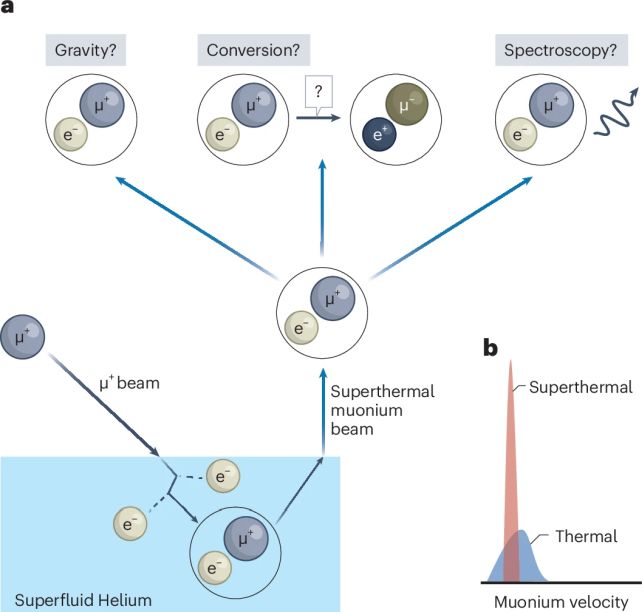
Existing muonium sources aren’t very good at that. They produce diffuse “thermal” beams, spraying atoms over a wide range of angles and velocities. So the researchers came up with another plan – firing antimuons into a layer of superfluid helium cooled to about 0.2 Kelvin.
When the antimuons enter the helium, they rapidly lose energy, coming to a stop just beneath its surface. There, an antimuon can pick up an electron that was left in its wake as it blasted through the helium, forming muonium.
Then the superfluid does something extremely useful.
Muonium doesn’t really like being inside superfluid helium. The interaction between the two gives the muonium extra energy, effectively driving the newly formed ‘atoms’ towards the surface.
When they reach it, they burst out into the vacuum above at a speed determined largely by that energy boost – in contrast to the random thermal motion that makes conventional muonium sources such a hot mess.
The result is a remarkably orderly stream of muonium, shooting out at around 2.2 kilometers per second with a much narrower velocity spread. Around 8 percent of the antimuons sent into the helium ultimately emerged into the vacuum as muonium.
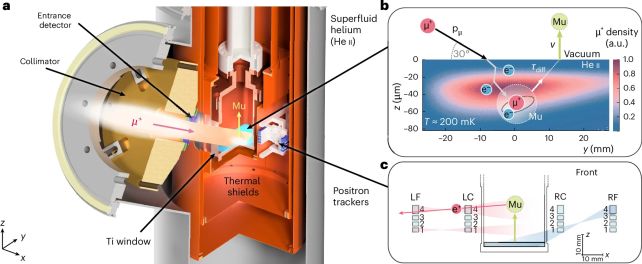
Detectors positioned above the helium allowed the researchers to reconstruct the paths of the muonium atoms from the particles produced as they decayed. Those measurements revealed the narrow, fast-moving beam they had hoped to produce.
But the experiment isn’t quite ready to measure what gravity does to the particles.
For one thing, the beam is currently pointing in the wrong direction.
The superfluid helium spits the muonium vertically upwards. To measure its acceleration under gravity, the researchers need the particles to travel horizontally, giving gravity a chance to tug them ever so slightly downward during their fleeting journey.
The team is already working on a way to turn the beam sideways. The next piece of the puzzle is an interferometer that can measure that incredibly tiny gravitational displacement.
The proposed device would send the muonium through three extremely fine gratings spaced just millimeters apart. Thanks to the weirdness of quantum mechanics, the particles also behave like waves, producing an interference pattern as they pass through.

If gravity acts on muonium as expected, its downward pull should shift that pattern by a minuscule amount. By measuring the shift, the researchers can determine muonium’s gravitational acceleration.
With their new beam, the researchers estimate they could eventually measure that acceleration to about 1 percent.
Related: Physicists Just Found a Quirk in Einstein’s Predictions of Spacetime
They hope to test the method with the atomic beam by the end of this year, with the actual gravity experiment potentially following within two or three years.
Then, we’ll see whether muonium misbehaves under gravity. If so, it could point to the existence of a fifth physical force in the Universe. But even if not, Soter says, her team will have done something magnificent.
“I simply want to measure, for the first time, whether the equivalence between gravitational and inertial mass also applies to the second generation of particles – this alone is quite an inspiring piece of work,” she says.
Poor old Einstein – dead for more than 70 years, and he still has to take exams.
The research has been published in Nature Physics.
This article was fact-checked by Fiona MacDonald and edited by Fiona MacDonald. While we pride ourselves on our process, we are only human. If you spot a mistake, please let us know.



