
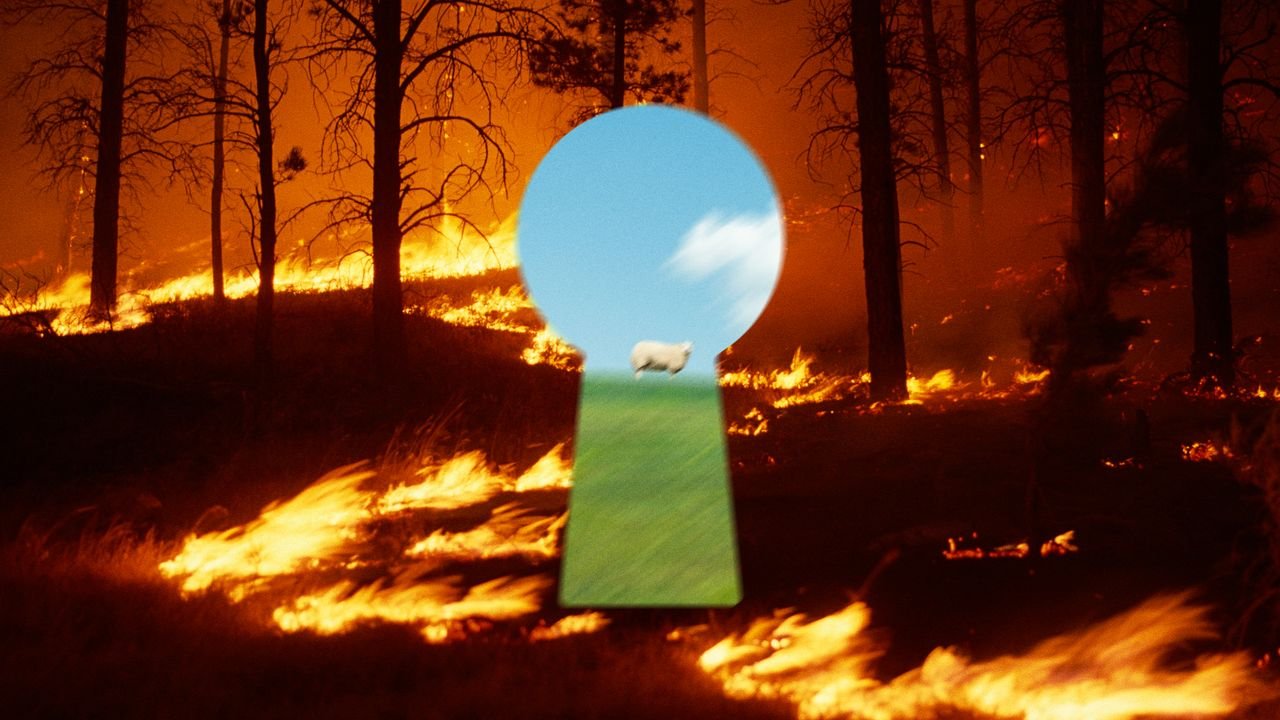
The strategy of “prescribed grazing”—deploying livestock to reduce fire risk, or to accomplish other goals—is gaining momentum in California. The state’s wildfire-resilience plan calls for scaling up the approach. Wildfire-preparedness initiatives have increasingly brought livestock into public parks and nature preserves. The University of California Cooperative Extension set up a no-frills website called Match.Graze to help connect landowners with ranchers, also known as graziers, who have livestock for hire. Keiser alone has helped create around thirty community-grazing coöperatives; many have received grant support from the LandSmart Grazing Program, a publicly funded conservation initiative for which she is a consultant.
In 2024, Marx, Hill, and several neighbors hired a grazier to bring goats and sheep to nineteen properties in Bennett Ridge. “It was very stressful,” Marx told me. A wet winter and spring helped grasses grow unusually tall, and that slowed the grazier down; by the time he got to the neighborhood, the grasses were “so high and so dry” that some anxious homeowners had given up on grazing and brought in weed-removal firms. But, this year, twenty-two properties participated—many of them twice. In March, after significant winter rains, a different grazier named Paigelynn Trotter, the owner of Coastal Land & Livestock, trucked in three hundred and forty cashmere goats. After setting up temporary paddocks out of portable, electric-net fencing, Trotter’s crew shuffled the animals from one area to the next in the course of a month. The goats ate their way through verdant grasses, woody shrubs, and invasive weeds such as Italian thistle and foxtail barley, entertaining their hosts all the while. “It’s way better than TV,” Hill recently told me. He recalled watching goats climb onto the lower branches of trees so that they could devour leaves and twigs.
Sonoma County had a rainy late spring, so the vegetation rebounded and began drying out, leaving behind more kindling for fires. Coastal Land & Livestock returned in early June with six hundred sheep, rented from Kaos Sheep Outfit. To see them at work, I drove up from my home, near the Bay Area, passing vineyards and climbing a narrow, winding road into the subdivision. When I arrived, the docile ewes had already chomped through half a dozen parcels.
Hill, a graying seventy-one-year-old with bushy eyebrows, drove me around in an all-terrain vehicle. The sheep had recently been sheared, giving their woolly coats a sculpted, Cubist look. I watched as they foraged through dry vegetation, sometimes sticking their faces into tall, prickly thistles and coyote brush. A gentle hubbub of rustling, munching, and occasional bleating filled the air. “It’s amazing, huh?” Hill said, chuckling happily.
The next morning, at seven-fifteen, I returned to see Trotter’s team move four hundred sheep about half a mile up the road. The ridge was shrouded in coastal fog; a few members of the grazing co-op had gathered to help. Trotter, who was wearing a lemon-yellow hoodie, with brown hair tied back in a bun, reminded me of a coach who was reviewing the day’s game plan.
To steer large numbers of sheep and goats, shepherds can apply “pressure” by standing in the right places, Trotter explained. Their goal was to escort the mob to their next dining spot—i.e., the end zone—while keeping them on the road. She would be positioned along the flock’s left flank while one of her employees, a woman in a turquoise sweater, covered the right; another would manage the tail end of the herd with help from a young border collie. Trotter’s husband, a farmer, was to block traffic by driving ahead in their gray pickup truck; their five-year-old son and infant daughter were along for the ride.



