
For all the defiant rhetoric of its officials, Iran is hurting more than it has since Iraq’s brutal invasion in 1980, which dragged on for eight years and killed hundreds of thousands of Iranians without changing anything politically or on the ground. Its economy has shrunk by ten per cent since the start of this war. Its oil exports have declined by more than eighty per cent. Its currency, the rial, which traded at around six hundred thousand to the dollar a year ago, has plummeted. Now a single dollar is worth 2.3 million rials. Inflation hit almost eighty-five per cent last month. Electricity cuts are common. New U.S. sanctions on all major Iranian airlines just went into effect. Tehran’s leverage today is not holding the world’s third-largest oil reserves but instead controlling access to the Strait of Hormuz, the waterway through which roughly twenty per cent of global energy transits, including much of the oil and gas products of the neighboring Gulf countries.
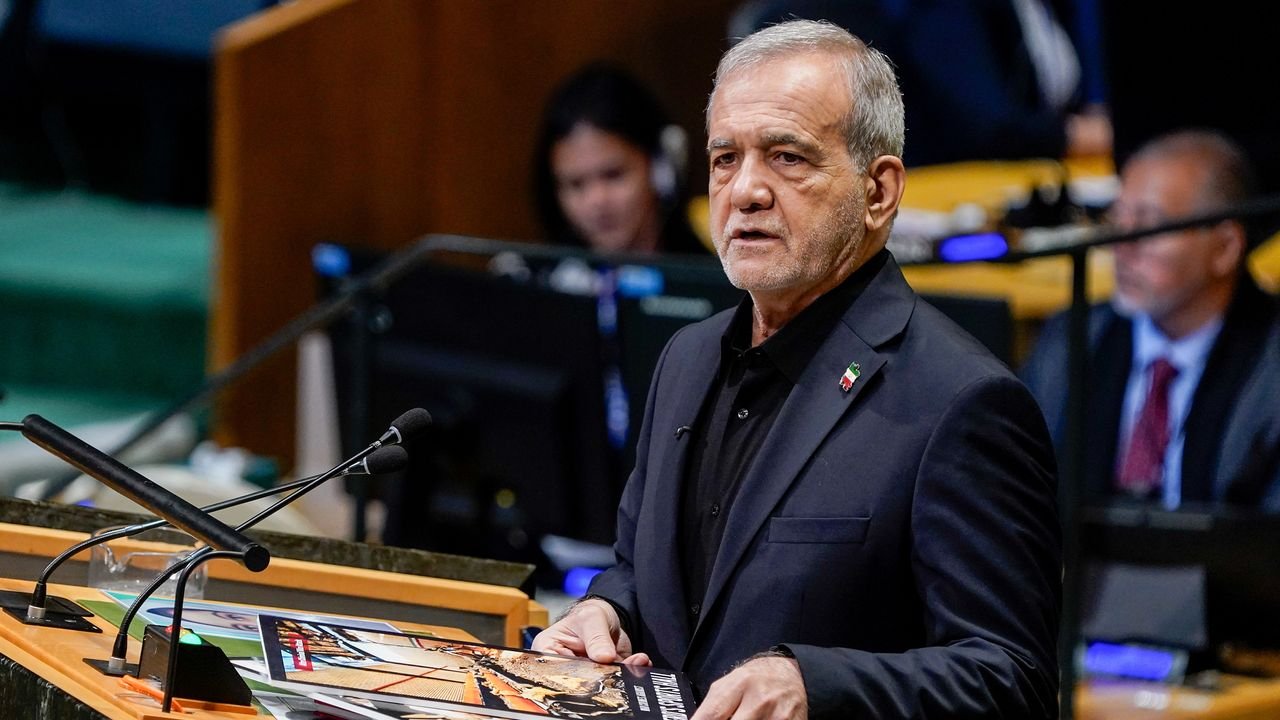
The Iranian government has been forced to implement sweeping cost-cutting measures, which were reflected in Pezeshkian’s bare-bones visit. For decades, Iranian Presidents have reserved three or four floors at a fancy hotel, priced in the stratosphere during the week of the UNGA. This time, he stayed at the town house of the Iranian Ambassador. His meetings were held in a small conference room. No ballroom with crystal chandeliers, no elaborate floral arrangements at draped tables. The U.S. State Department banned Iranian diplomats from “buying wholesale club memberships or luxury goods,” warning by tweet, “New York-area retailers: be on guard, don’t become complicit in these violations.” There seemed little chance of that on this trip.
“Iran wants a deal because its economy is reeling under crushing U.S. sanctions,” Robert Malley, who was a lead negotiator of the 2015 nuclear deal under President Barack Obama, and who also attended the briefing by Pezeshkian and Araghchi in New York, told me. But the two sides have learned different lessons from past negotiations. In his view, Iran believed the first ceasefire “was good in principle,” but that, given U.S. unreliability, it should front-load any future deal with concessions, such as economic relief, before agreeing to reopen the strait. “The problem is that the Trump Administration drew a very different lesson,” he said. It viewed the first deal as “inherently flawed,” and concluded that “Iran should first be strangled economically to force it to concede. With such diametrically opposed assessments, it’s unfortunately hard to imagine an agreement emerging anytime soon.”
But the U.S. has also taken big hits. The war has so far cost some forty-four billion dollars, the Pentagon reported to Congress in early September. Outside estimates put the expense at well over a hundred billion dollars. The average price for a gallon of gas is around $4.50, and $6.50 for diesel. Some critical U.S. bases in the Middle East are no longer viable because Iran has effectively targeted them, the former C.I.A. director and Army general David Petraeus told the Cipher Brief last month. Among them is Al Udeid Air Base, in Qatar, the forward headquarters of U.S. Central Command for operations in countries including Iran, Iraq, and Afghanistan. The conservative Hudson Institute reported this month that the U.S. has had some success in taking out Iranian missiles and their launchers, but that “Tehran’s decentralized drone ecosystem can regenerate more rapidly.” The nature of warfare in the Middle East has changed faster than the U.S. can keep up.
The obstacles—for this or any future negotiations—are many. Pezeshkian faces criticism from hard-liners who oppose any diplomacy. Kayhan, an ultraconservative newspaper associated with the Supreme Leader’s office, said that “New York is not a place for smiles and negotiations.” An editorial warned, “Care must be taken that no signal is given during the New York trip that could be interpreted by the enemy as weakness on the Iranian side.” It instead called for the General Assembly to be a “court for U.S. crimes.” The Fars News Agency, which is associated with the Revolutionary Guards, said that Pezeshkian should not have gone to New York at all. The Presidency in Iran is a dangerous job. Since the 1979 Revolution, all who have held the role have faced dark fates, from impeachment and political isolation to travel bans and house arrest. Some have been silenced from even speaking to the media or appearing in public.



