
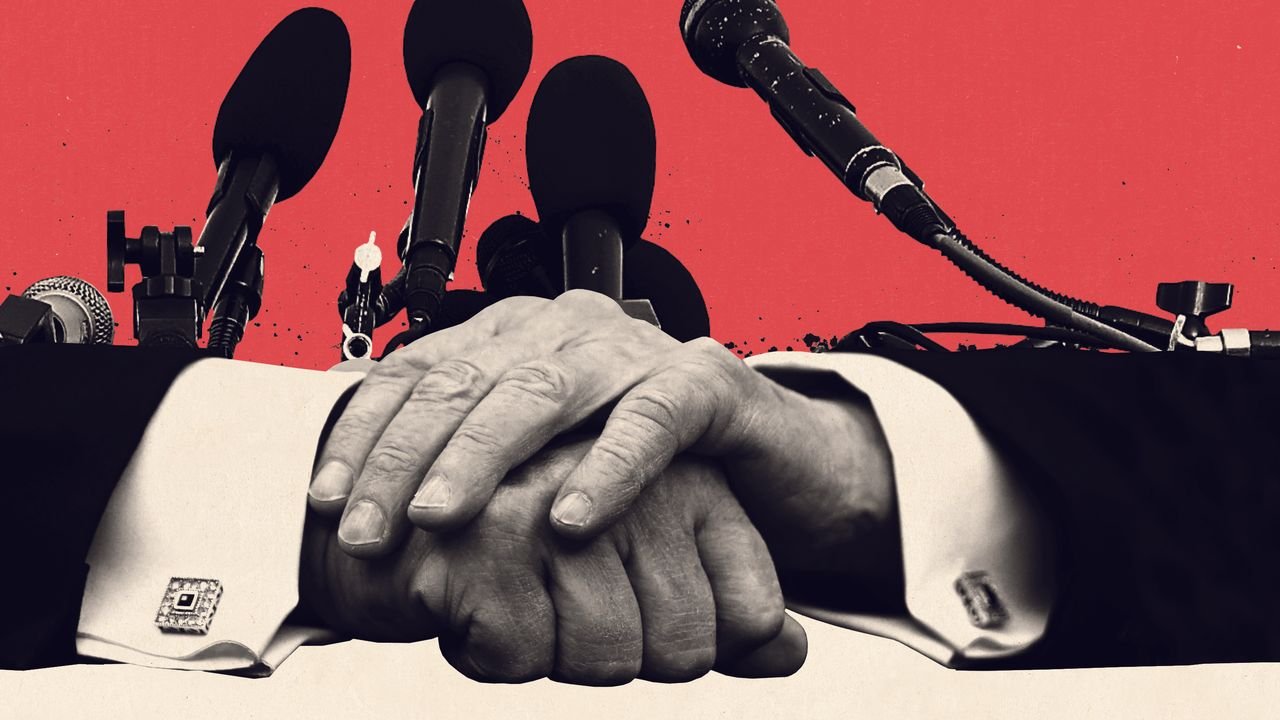
Donald Trump’s decision, on September 18th, to summarily revoke White House access from three major news outlets—CNN, Politico, and MS NOW—is consistent with the mercurial, paranoid, and inscrutable style that has defined his political career but has been particularly prominent in his second term. Since Trump returned to the Presidency, his Administration has tended to justify its most belligerent actions by claiming national-security concerns or by couching said actions as an attempt to root out fraud. Earlier this year, the Times noted that Trump had cited “national security” as justification for acts as disparate as halting the development of wind farms off the East Coast, stripping union rights from federal employees, and continuing the construction of his behemoth ballroom. (He is now making the same argument regarding his colossal arch.) Accusations of fraud have been the reasoning for doge’s evisceration of the federal workforce, ice’s occupation of Minneapolis, and, just last week, the removal of three-quarters of a million people from the Affordable Care Act rolls. In a frenzied attempt to retrofit a rationale for Trump’s abrupt press ban, the White House turned to some version of both of these arguments.
Last Monday, the three news outlets filed suit, claiming that the ban violated their First Amendment rights. Dozens of other media organizations, including the Times and Condé Nast, which owns The New Yorker, filed an amicus brief in the case. Other outlets refused to participate in pool coverage of the President’s events, in solidarity with their banned peers. On Tuesday, the Department of Justice responded by claiming, in a brief, that the organizations had “threatened national security and spread falsehoods.” Further, it asserted that access to the White House is “a privilege,” not a right. Embarrassingly, the same day, the White House sent Politico a letter citing its reporting on the Iran war, which noted the concerns of an anonymous source, as an example of compromising national security. That source, Status reported, was Vice-President J. D. Vance, on a background briefing, highlighting yet another instance in which the right hand was unaware of what the right hand was doing.
In a Truth Social post announcing the ban, Trump had complained that “Media Outlets shouldn’t be able to constantly write or report FICTION and LIES when they’re covering the President of the United States.” This isn’t exactly an accusation of defrauding the public, but it pretty clearly charges the banned organizations with, at a minimum, misleading it. That said, even Trump seemed to know that he was on shaky ground, preëmptively arguing that the U.S. district judge hearing the case, Timothy J. Kelly, whom Trump himself had appointed, was an unfriendly draw for the Administration’s claims.
The ban followed the now familiar path of Trump’s potentially illegal or unconstitutional acts. As with his attempts to slap his name on the Kennedy Center and his effort to overrule the language of the Fourteenth Amendment, by curtailing birthright citizenship, that path typically travels from absurd idea to absurd (but nonetheless concerning) act, to a legal response that becomes another case study in which we evaluate the extent to which the judicial system is capable of reining in the arbitrary impulses of an aspiring autocrat.
Trump’s concerns about the current case, at least in the short term, proved warranted. Shortly after midnight on Thursday, Kelly imposed a fourteen-day suspension of the ban. That morning, the journalists were still denied entry, so Kelly issued a 12:30 p.m. deadline for compliance, and their access was restored. Meanwhile, China’s President, Xi Jinping, had arrived in Washington for his first state visit in eleven years. Photographers on the scene reported that Trump joked that China has the “friendliest press corps.” (According to Reporters Without Borders, China ranks a hundred and seventy-eighth out of a hundred and eighty nations in press freedom.) That evening, some of the journalists were again denied access.
It’s worth recalling the degree to which this debacle typifies Trump’s political behavior. During the 2016 election, he withheld campaign-event credentials from Univision, BuzzFeed, the Washington Post, and Politico. During his first term, he routinely blocked critics and news organizations from his Twitter feed, which resulted in a lawsuit and a district-court ruling that his actions were unconstitutional. In 2018, the Administration denied access to Jim Acosta, then a reporter for CNN. (Kelly also ruled in that case, requiring the White House to restore Acosta’s access.) Last year, the White House denied access to the Associated Press, for refusing to defer to Trump’s preferred designation for the body of water generally known as the Gulf of Mexico. In that instance, the district judge Trevor N. McFadden, another Trump appointee, ruled that “under the First Amendment, if the Government opens its doors to some journalists . . . it cannot then shut those doors to other journalists because of their viewpoints.” He added, “The Constitution requires no less.” The President has sued ABC News, the Wall Street Journal, CBS News, the Pulitzer Prize Board, the Washington Post, and the Times, for hundreds of millions of dollars. His behavior cannot be called unexpected at this point. What was noteworthy this time, however, was the way that the press responded.



