
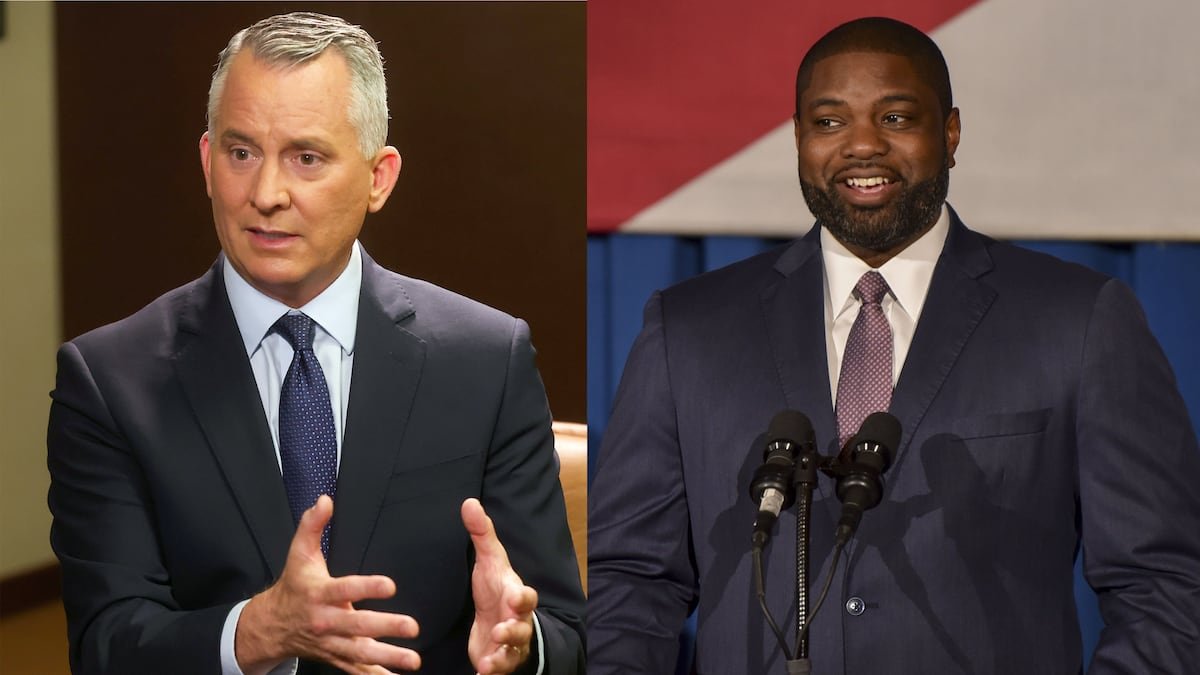
Florida voters confront starkly different futures in this year’s governor’s race.
Republican U.S. Rep. Byron Donalds has laid out a vision where the state continues to cede its role to the private sector in education, development and social services, but expands its role in local governance, immigration and law enforcement.
The Democrat, former U.S. Rep. David Jolly, has laid out a view for Florida where the government’s role would be restored to levels not seen since his party held power in the state more than 30 years ago.
Here’s a rundown of their top policy differences.
Education
Ever since GOP Gov. Jeb Bush took office in 1999, Florida has steered more and more tax dollars to privately run schools. School choice has become a $4.5 billion industry across the state.
That expansion would continue under a Donalds administration. He and his wife, Erika, are nationally recognized school choice advocates who once managed a Collier County charter school together. They talk about breaking the “public school monopoly.” Billionaire Jeff Yass gave $11 million to the Donalds campaign because the congressman was a “school choice warrior,” a spokesperson for the investor told the Tampa Bay Times.
Donalds supports bonus pay for “top performing” teachers and free tutoring for third graders struggling with reading.
Jolly, meanwhile, said charter and private schools need more oversight and transparency.
“There’s a crisis in our choice schools. There are no rules,” he told the Times in September.
He proposes that any school accepting public money should follow the same rules as public schools. (Earlier this year, the Florida Education Association sued the state, claiming that Florida’s funding of privately run schools was unconstitutional because traditional public schools must follow 1,400 pages of law compared to 20 pages for charter schools and nearly nothing for private schools.)
More broadly, Jolly envisions a “10-year renaissance” in public education, during which Florida would vastly increase spending, possibly through tourist tax revenue, to pay for early childhood education, mental health services, food programs, better school buildings and higher teacher pay.
“We pay our teachers dead last in the nation,” Jolly said. “It’s a moral wrong.”
Home rule
Republicans once regarded the power for local communities to govern themselves as a bedrock principle.
No more. They put a measure on the Nov. 3 ballot that would cut $12 billion a year in property taxes, the lifeblood for local governments, without consulting with those counties and cities. They audit local spending in search of waste and fraud. They’ve preempted local governments from enforcing rules, such as on gun control. Gov. Ron DeSantis has removed local officials he deemed unfit for office.
Jolly, a former Republican, calls this approach flawed. He doesn’t support the local government audits. He’d try to eliminate the preemptions. Removing local elected officials from office, he said, is an overreach.
“My guiding principle is local control,” Jolly said. “What I see in Tallahassee is what I call Big Government conservatism. If you’re a conservative county, they leave you alone. If you’re not, then they inject conservatism as they see it.”
Donalds, who served in the state House from 2016 to 2020, said he would expand the audits from Florida’s Department of Government Efficiency, or DOGE, and send Amber-alert-style texts when a new one is available. Only by cutting waste can Florida become more affordable, he said.
“Everybody likes DOGE,” Donalds told supporters on primary night. “Those audits are going to stay. They’re not going anywhere.”
Donalds would target local and state governing bodies alike, he added. “There are no sacred cows.”
He’s also proposing to put every permit — including those for businesses, buildings and roads — on a state website with a ticking clock, forcing local offices to approve projects on time.
In August, he said he supported DeSantis’ removal of Hillsborough County State Attorney Andrew Warren and would do the same to sheriffs or state attorneys who weren’t enforcing the law.
Healthcare
As voters continue to cite affordability as their top concern, rising healthcare costs are a pinch point along with housing, gas, food and electric bills.
Florida, one of the few states that did not expand Medicaid, ranks 49th in costs associated with emergency treatments that could be avoided with preventative care, according to the Commonwealth Fund, a nonpartisan healthcare research organization.
Jolly attributes that low ranking to Florida’s lack of primary health care.
“We’re a state that should scale up the direct delivery of healthcare in all 67 counties, regardless of the ability to pay,” he said in Miami in June.
That goes beyond expanding Medicaid, which he supports. How exactly Jolly would pay for this expansion on the front end is unclear, but he says it would eventually pay for itself because healthier people would produce more for the economy.
An opponent of Medicaid expansion, Donalds aims to lower healthcare costs through transparency and fraud prevention. He takes a similar approach with insurance. During a St. Petersburg campaign stop in August, he said he would require all hospitals and doctors’ offices to post real cash prices for the top 20 services they provide.
“When everybody knows what everybody else is charging, a funny thing happens,” Donalds said. “People start competing on price, and prices stabilize, and in some respects they come down.”
He would require that patients get the same discounted rates that hospitals get after negotiating with large insurance companies, and says he’d ensure insurance companies approve common treatments within three days.
Donalds is a champion of President Donald Trump’s One Big Beautiful Bill Act, which provided overtime, tip and enhanced deductions for millions of workers and seniors but also dropped 247,000 Florida kids from food stamps and passed work and volunteer requirements for Medicaid.
“Our government is going to be working with the Trump administration to make sure that there is no fraud” in Medicaid and food stamps, he told a gathering of Republicans in June. “The people who actually qualify are the ones who will use it.”
Growth
Donalds is bullish on Florida. He says the state continues to lure tax refugees from places like New York and California. Many of the arrivals are titans of industry, he said, who will grow the state’s finance, aerospace, defense and tech sectors.
“We’ve got to make sure the roads are being built and expanded efficiently,” he told supporters this summer in Ybor City. “We have to make sure there’s housing for the people who want to call Florida home into the future.”
Donalds says he’ll bring back comprehensive planning to coordinate this large-scale growth, but he hasn’t said how. He’s spent more time discussing a competing concept, what he calls “slashing government red tape.”
“We talk so much about the cost of housing, but 30% of the cost of a new home is government,” he said in St. Petersburg in August. “It’s not a roof. It’s not the wires that get put in the wall. It’s not the appliances. It’s government. We are going to modernize permitting and planning in the state of Florida to push down costs.”
Jolly also says the state must bring back comprehensive growth management, reviving many of the tools from a 1985 law that required local governments to protect natural resources and invest in roads, schools and other infrastructure.
Unlike Donalds, Jolly isn’t convinced that Florida remains a top destination anymore. He said residents are leaving because of the cost of living and divisive policies.
He thinks Florida can grow, but only after significant investment in transportation, social services and housing.
“We are at the breaking point in our economy for too many people,” Jolly said.
Data centers
Donalds supports data centers, but only if they follow Florida law. It requires data centers to produce their own electric power so utility customers don’t pay more, to use reclaimed water so they don’t drain water supplies and to be set at least a mile from homes. He also wants local governments to continue to decide zoning and permitting for data centers.
“We will enforce strict setbacks for residential neighborhoods,” Donalds said in September. “Protect our pocketbooks, protect our communities, and protect our environments or no data centers. Period.”
Jolly said he would issue an executive order delaying the construction of large data centers for one year. After studying the impacts of data centers, he would decide what to do next.
“I would not rule out a permanent ban,” he said.
State Guard
After DeSantis reactivated the State Guard in 2022 to respond to natural disasters and emergencies, its initial budget of $5 million quickly climbed to hundreds of millions. Meanwhile, concerns grew about safety and cost overruns at the new agency.
Jolly says he would do away with the State Guard, calling it an unnecessary vanity project for DeSantis. Donalds said the State Guard is “valuable” and something that Florida needs.
“As close as we are to Central and South America, we need a guard dedicated to Florida to protect not just Floridians when it comes to natural disasters, but in the worst possible event that we need to secure our borders,” Donalds said in September.
Immigration
Under DeSantis, Florida and its local governments have carried out 40% of the arrests nationwide conducted under the federal program that pairs local and state police with U.S. Immigration and Customs Enforcement.
Jolly said he would undo DeSantis’ mandate that local law enforcement cooperate with the federal government’s immigration policies. He said he’d review the agreements before deciding whether to suspend them.
“I do think we’re seeing a violation of due process across the state, and I think the governor has a responsibility to address it,” Jolly said.
Donalds says he supports DeSantis’ approach on immigration and that he’d continue to have state and local police work with federal authorities to deport noncitizens, even if they haven’t committed a crime.
“We cannot hold all these people in the United States,” Donalds said on Fox last year. “And if you have a job site where that many illegal aliens are on the job site, what that’s also doing is depressing the cost and the value of labor of the American people, and so yeah, we’re going to have to go through this process. There’s a lot of people that have to go home.”
Insurance
Jolly proposes creating a statewide catastrophe fund, saying it will lower insurance costs for homeowners. Under the plan, hurricane and wind coverage would be removed from the private sector and put into a fund managed by the state. He says the fund would cut premiums by 60% to 70%.
That fund needs more than $30 billion, which Jolly said could be financed with tourist taxes, real estate fees or collecting taxes on insurance companies that he says they avoid paying.
Donalds has aggressively attacked Jolly’s plan, calling it socialism. (Jolly has fired back, calling a Donalds ad criticizing the plan “all lies.”)
Donalds proposes modest fixes to the state’s insurance system. Like most Republicans, Donalds believes that lawsuits against insurance companies drive up rates, so he supports much of the tort reform legislation that’s been passed in recent years to eliminate fraudulent claims.
Donalds also wants an insurer “scorecard” that would provide consumers accurate information on what carriers charge and how fast they pay claims. As in healthcare, he said he believes transparency will foster fairness in the marketplace and drive down prices.
Hope Florida
After a grand jury report leaked, questions remain about how the DeSantis administration steered millions of taxpayer dollars through the Hope Florida Foundation to a political committee run by the governor’s then-chief of staff.
While Jolly said he wants to reopen the investigation into the Hope Florida scandal, Donalds said it’s already been investigated and is not an issue voters are thinking about.
.subtext-iframe{max-width:540px;}iframe#subtext_embed{width:1px;min-width:100%;min-height:750px;}
fetch(“https://raw.githubusercontent.com/alpha-group/iframe-resizer/master/js/iframeResizer.min.js”).then(function(r){return r.text();}).then(function(t){return new Function(t)();}).then(function(){iFrameResize({heightCalculationMethod:”lowestElement”},”#subtext_embed”);});
• • •
Tampa Bay Times Election Coverage
- How David Jolly won the Democratic nomination for Florida governor
- How Byron Donalds won the Florida GOP nomination for governor
- 5 takeaways from the St. Petersburg mayoral primary results
- While other progressives lost in Florida, Angie Nixon won. Why?
- 3 reasons why Byron Donalds could win Florida’s governor’s race
- 3 reasons why David Jolly could win Florida’s governor’s race



