
Hillsborough County school board members considered a proposal Tuesday to ban partisan political activity from school board property and require the school board to be notified by email about visits from elected officials.
But after a thorny conversation about how a policy might work without running afoul of First Amendment rules, the board decided to push any policy changes to next spring.
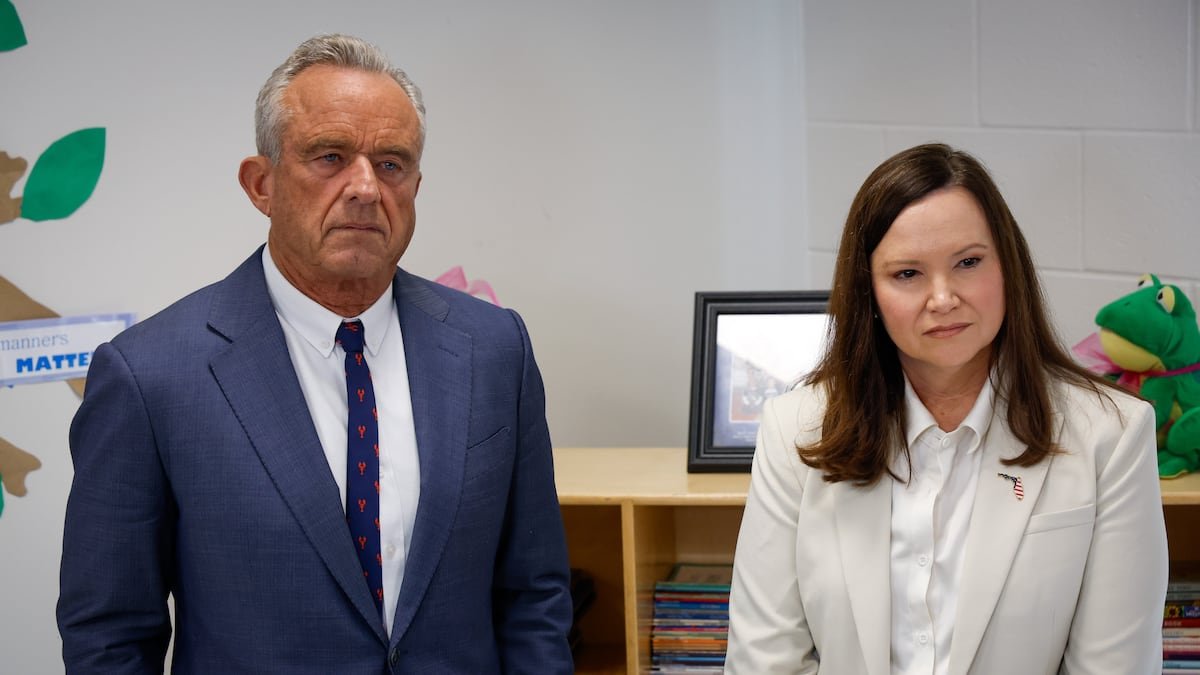
The policy was introduced by board members Nadia Combs and Lynn Gray, following a media spectacle when U.S. Health Secretary Robert F. Kennedy visited two schools. Sen. Ashley Moody and Rep. Laurel Lee, who are running for re-election, were present, and Kennedy fielded questions from reporters about his opinions on vaccinations and other issues.
“It comes down to us being put in this vice,” Gray said. “I feel like there has to be a very pure policy that is fair to both sides, and I think the genesis is the timing. Right now, this is sensitive times. Will the presidential election be sensitive? You betcha.”
The optics of a political visit during the election cycle, she said, “were not really that inviting.”
Combs said legislators often highlight the work of the district, and help to secure federal and state funding. She said she was not trying to limit access but keep the topics discussed nonpartisan.
Board member Jessica Vaughn suggested requiring a formal request, vetted by the district, for any visits from elected officials; and moving press conferences off school properties.
“I think that we should have a form that vets that, that asks the people why they want to come, what their mission is, what they’re hoping to learn, to make sure that they understand that our schools aren’t a place to campaign or to host press conferences,” she said.
Superintendent Van Ayres countered that most visits are not unplanned.
“We have not had a local elected official that just popped into a school,” he said. “They’ve all been fantastic to work with. … If there’s a form that needs to be filled out to hold as a record, I think on the staff side, we’d be fine with it. I just want to be clear that (when it comes to) our local officials, I have not seen one experience where they’ve just popped into school or just shown up.”
He added he wished to seek “some clarity around what the exact will of the board is and what you expect from myself and my staff when a local elected official requests a visit to us.”
Board member Patti Rendon said she thought the terms partisan and nonpartisan should be defined by the policy.
“Some people may feel differently about one thing or the other, and that doesn’t necessarily mean it’s partisan or it’s not,” she said. “But there may just be different opinions, and even on the same side of the fence. So I think that’s very important, that identification.”
Board attorney Jim Porter advised the board to be conscious of First Amendment rules.
“You all have to be careful as a board not to prohibit speech that you don’t like, and so that’s where it goes into the definition of partisan,” Porter said. “So a topic could be controversial, but just because the board doesn’t think it’s a good idea, you can’t censor that. So I think that that has to be built into this.”
Combs said she hoped that after November’s elections, the issue might not seem as problematic.
“Who knows?” she said. “Hopefully, in a few months things will die down (and) we just focus on educating our students and not politics.”
The Tampa Bay Times Education Hub reports on Florida’s schools and universities and the students they serve. You can contribute to the hub through our journalism fund by clicking here.



