
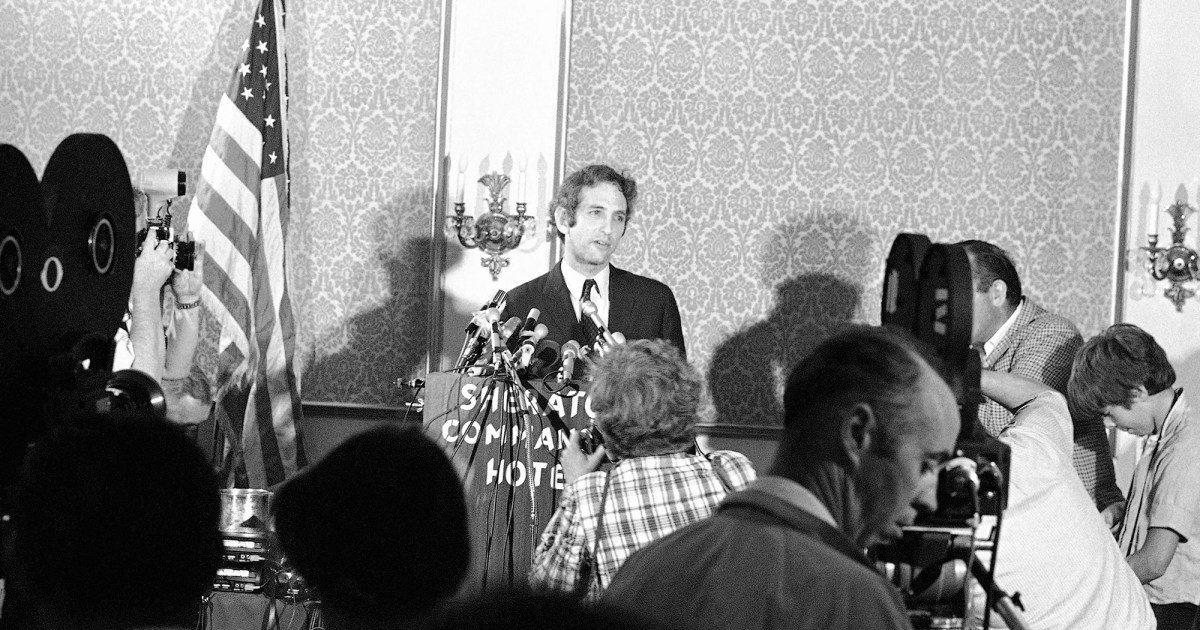
Daniel Ellsberg, under indictment for leaking Pentagon secrets to the press, addresses reporters in Cambridge, Massachusetts, in July 1971.AP
Daniel Ellsberg’s ninth and final book, Truth and Consequence, was published this spring, three years after his passing, and this is a fitting moment—a time of political upheaval much like the one in which Ellsberg first made his mark—to commemorate this remarkable and neglected American hero.
The book is a collection of reflections and reminiscences lovingly assembled by Daniel’s son Michael Ellsberg and longtime aide Jan R. Thomas. Much of it pivots off his signature role in the 1971 leak of what became known as the Pentagon Papers, a top-secret history of the US war in Vietnam that he had helped write as a RAND Corp. analyst.
The Pentagon Papers were a searing 20-year record of governmental incompetence and duplicity, and thanks to the ensuing Supreme Court battle between The New York Times and the Nixon Administration, their publication is remembered as a dazzling triumph of an independent press. But as the new book shows, Ellsberg was always much more than a Vietnam-era renegade. He also used his stature as an analyst and activist—he estimated he was arrested some 90 times—to call attention to the plight of the whistleblower and the looming menace of nuclear war, both immensely worthy causes that we have largely consigned to the outback of our national conscience.
I got to know Ellsberg in the Teens, toward the end of his life, when I became dean of the UC Berkeley Graduate School of Journalism. I was surprised to discover that, although he lived not two miles from campus, this key figure in a defining moment of US journalism history had no relation to our program or anyone else’s, near as I could tell. I still don’t know why that was, but he accepted my invitation to join the school’s advisory board and, even better, stepped up in successive years as a keynote speaker at our orientations for incoming master’s students.
At a time of unrelenting attacks on media independence by the federal government, the Pentagon Papers affair is a powerful reminder of what the press uniquely can do.
There, he shone. He was already well into his 80s, slender and straight-backed, and wearing a dark suit and tie—a rarity on the Berkeley campus. He spoke softly, without notes, recalling with precision events and names our students had no prayer of recognizing: Robert McNamara, Dean Rusk, the Tet Offensive. Yet our students were riveted. Instead of heading for the exits when Ellsberg was done, they stayed behind to ask questions, and listened as he remembered.
He steered well away from claims that his Pentagon Papers leak hastened the end of the war, although that was a refrain in some of the obituaries that followed his death in 2023. Ellsberg never believed any such thing. The papers reflected a historical record that ended nearly three years before they were leaked. They didn’t cover the subsequent and no less disgraceful management, by President Richard Nixon and Secretary of State Henry Kissinger, of a war that wouldn’t end for nearly four more years. The students were drawn, I believe, not by proximity to somebody who’d made journalism history, but to what they perceived as a man of humility and moral courage.
Ellsberg’s explanations for his actions were always somber and self-effacing. He’d decided to leak the Pentagon’s mortifying secrets to follow the example of Bay Area antiwar activist Randy Kehler, who’d told Ellsberg he was going to prison rather than cooperate with the draft. That Ellsberg’s unprecedented disclosures prompted clandestine measures by the White House—which included creating the infamous “Plumbers Unit” that spawned the failed Watergate break-in and fatally undermined the Nixon Presidency—was a consequence he neither sought nor anticipated, and he never accepted credit for bringing Nixon down.
As he told Amy Goodman on Democracy Now! in 2019, “My message to [young people] is: Don’t do what I did. Don’t wait until the bombs are actually falling or thousands more have died before you do what I wish I’d done years earlier, in ’64, or even ’61 on the nuclear issue, and that is reveal…the dangerous truths that are being withheld by the government at whatever cost to yourself, whatever risk that may take. Consider doing that because a world’s worth of lives may be at stake.”

The self-portrait that emerges from the essays and reflections in Truth and Consequence is of a man both brilliant and haunted. His parents, ethnically Eastern European Jews, became what he described as “fanatical Christian Scientists”—Ellsberg never saw a doctor until he went to boarding school at the age of 12. He was a gifted musician, and his mother steered him with an obsessively heavy hand toward a life she imagined for him as a concert pianist. From an early age she kept him home from school so he could devote his afternoons to practice, four to six hours a day, eight hours on Saturdays.
That was his routine for a decade until, at age 15, he performed Beethoven’s Third Piano Concerto with musicians hired for the occasion from the Detroit Symphony. His mother then moved him to a more demanding and knowledgeable music teacher who, after an introductory lesson and what seemed to be a careful inventory of his background, musical knowledge and performing skills, declared that Ellsberg had great talent but no future as a professional pianist.
It was a heartbreaking verdict for his mother but an emancipatory moment for him. He carried on playing for the new teacher, but his mother was devastated. Two months later, she and Ellsberg’s young sister were killed in a car crash, and his father, who was driving, was seriously hurt. After that, apart from a music theory class in college, Ellsberg didn’t touch the piano again for 25 years.
In The New York Times’ retelling of the story, Ellsberg is denied agency: It was “How Neil Sheehan Got the Pentagon Papers.”
He returns often to the legacy of his abandoned musical path, not with regret at having disappointed his mother but in wonderment at her coercive powers, which trapped him in a decade of servitude to her dream. He was shamed by his compliance, a prelude to the eager obedience he would observe later in his career among people of dazzling intellectual capacity who nonetheless enthusiastically carried out policies they recognized were murderous, futile, and morally indefensible.
Ellsberg graduated from Detroit’s prestigious Cranbrook School and majored in economics at Harvard before joining the Marines, where he served for three years, was commissioned a lieutenant, and rose to command a rifle company. After a year in England at Cambridge University, he returned to Harvard and finished his PhD in economics, distinguishing himself in the arcane field of game theory with a breakthrough concept now known as the Ellsberg Paradox, which describes the inclination of people to avoid choices whose odds of success are ambiguous.
I had never heard of the paradox until Ellsberg mentioned it in passing one day, noting that it was considered enough of a conceptual innovation to be the subject of scholarly conferences. Still, his work and notable Harvard national security connections brought him to the attention of the influential think tank known as the RAND Corp., where he started as a summer consultant in 1958, soon after the Soviet sputnik launches triggered a panic over the intensifying nuclear rivalry and the incoherence of the strategic doctrine of deterrence.
Ellsberg divided his intellectual efforts for RAND, the Pentagon, and the State Department over much of the next decade between nuclear strategy and the deepening disaster in Vietnam. (Much of the latter is recounted in his riveting 2002 book, Secrets: A Memoir of Vietnam and the Pentagon Papers.)
At a time when the news media’s independence and civic value are under unrelenting assault by the federal government, the Pentagon Papers affair is a powerful reminder of what the press uniquely can do. It was an instance of unquestionable public illumination that exposed the lethal deceptions of a generation of top leaders, exposure that no institution of civil society other than the press could ever have delivered. True, the news media claim an undeservedly heroic role in engineering the disclosures that were actually driven by Ellsberg and his helpmates, but in the final analysis the media did come through—in all, 19 newspapers published material Ellsberg originated, even while a criminal prosecution seemed inescapable.
It’s chilling to wonder now—when most of those newspapers have withered or died in the drought of the digital age, whistleblowers serve years behind bars (Ellsberg spent not a single night in jail), and the Trump administration has unleashed regulatory and commercial pressure on news media for ideological sins far less egregious than frontal defiance over an ongoing war—whether the Pentagon Papers would have ever seen the light of day.

Even if today’s New York Times still found the courage to publish, the likelihood of finding another 18 news organizations to join in is far from certain. And with Trump and his minions suing CBS and its compliant parent company over the editing of a political rival’s TV interview, routinely threatening to revoke broadcast licenses over comments that displease him, demanding the dismissal of on-air talent he deems insufficiently supportive, ousting news outlets he doesn’t like from the Pentagon and White House, and using investigative resources to undermine the business fundamentals of media owners, the range of reprisals that would undoubtedly be used to punish resistance on a Pentagon Papers scale is almost unimaginable.
Getting the story out wasn’t easy even back then, and the treatment Ellsberg endured from his supposed allies was far from gentle. In a 2015 interview, Neil Sheehan, lead writer on The New York Times’ Pentagon Papers coverage, described how the papers came to be published, a story Sheehan embargoed until after he died. It was impossible to discern from his remembrance how hard Ellsberg had worked over the previous two years to find a way to make the papers public, first laboriously photocopying the thousands of pages and then appealing repeatedly to a roster of antiwar senators in hopes of getting the material entered into the Congressional Record. Finally, in frustration, he approached Sheehan, a Times stalwart whom he knew in Vietnam, and to whom he had leaked stories previously.
But in The Times’ retelling, Ellsberg is denied agency: It was “How Neil Sheehan Got the Pentagon Papers,” which were framed as a “blockbuster scoop” and “arguably the greatest journalistic catch of a generation.”
In fact, Ellsberg had invited Sheehan to review and take notes from his copy of the papers but refused to give him a copy until he had assurances that The Times intended to use them fully. Sheehan ignored those conditions and surreptitiously made his own photocopies with the help of his wife, New Yorker writer Susan Sheehan. Times staffers worked on those copies for weeks, and Sheehan lied repeatedly about the paper’s plans, leaving Ellsberg and his wife, Patricia, to scramble on the eve of publication to hide boxes of incriminating documents.
The Supreme Court’s June 1971 ruling in New York Time v. United States blocked the Nixon administration’s attempt to halt publication of the papers but did nothing to prevent Ellsberg and his co-defendant, Anthony Russo, from being tried for violating secrecy laws—a prosecution that was thrown out only after the court learned of the White House Plumbers’ burglary of Ellsberg’s psychiatrist’s office. During the two-year prosecution process Ellsberg and Russo got no financial support from the media they had helped.

Ellsberg was always puzzled by the ambivalence, even hostility, that news outlets characteristically show toward their gutsiest and most determined sources. One of his admirers, Wikileaks founder Julian Assange, who had turned over extremely newsworthy material to The Times and other news organizations in 2010, was thanked with an especially venomous New York Times Magazine cover story, authored by the paper’s own executive editor, Bill Keller, describing Assange, among other things, as petulant, ill-tempered, and foul-smelling. I once asked Ellsberg why the media often treats whistleblowers so harshly.
“They don’t trust us,” he said.
Still, others have followed Ellsberg’s example in exposing unwarranted secrecy, and many suffered consequences incomparably worse than he did. Assange was pursued by US law enforcement and intelligence agencies for 14 years, enduring various forms of confinement before his case was essentially discarded and he was repatriated to Australia; his source, Chelsea Manning, served seven years in prison, including a year in solitary, before her 35-year sentence was commuted, and later served yet another year for refusing to testify against Assange. Yet it is almost invariably the Pentagon Papers and Daniel Ellsberg that these and other whistleblowers point to when they explain and justify what motivated them. A global consciousness about high-level deception and the duty of citizens to expose it claims Ellsberg as its historical and moral forebear.
Regarding nuclear weapons, “we’re in a more dangerous situation than any time in my lifetime,” Ellsberg told The Times two months before his death.
When it comes to whistleblowing, Ellsberg’s legacy flourishes. But the second focus of his career-long engagement remains orphaned. It wasn’t Vietnam, he wants us to understand, that accounted for his most consuming fears.
In his 2017 book, The Doomsday Machine, Ellsberg says that between fall 1969 and August 1970 he had photocopied the entire top-secret contents of his safe at RAND, perhaps 15,000 pages, of which the Pentagon Papers constituted only 7,000. Most of the documents he was risking his career to expose consisted of notes and documents involving what he believed was the greatest threat to humanity, nuclear weapons, the prospects for their use, and, most harrowing, the government’s ramshackle and entirely inadequate measures to prevent their unintended use.
Some of that purloined material aligned with things he’d witnessed as a RAND employee during the early 1960s, inspecting nuclear weapons at US Air Force forward operating bases in the Northern Pacific. That firsthand reporting, his basis for The Doomsday Machine, was decades old by the time the book was published, but the details were enthralling and pertinent, and the likelihood that nuclear war could be unleashed at a preposterously low level of command authority remained terrifyingly plausible. The estimates Ellsberg coaxed from the heads of US military officers as a 30-year-old analyst during the Kennedy administration pegged the expected death toll from America’s Single Integrated Operational Plan for General Nuclear War at more than 600 million people in the Soviet Union, China, and Europe. That excluded the incalculable harm to the United States, and the global nuclear winter that might well follow.
The fundamental strategic conundrum Ellsberg addressed was unchanged in 2017 and is sullenly unchanged now: Nuclear weapons are unimaginably lethal and inherently, irremediably unsafe. The logic of deterrence requires a certainty that anyone who uses them in a military confrontation will themselves be destroyed. But deterrence could be assured only if America’s weapons are sure to be launched while the capability to use them remains—that is, when an enemy attack is believed, not proven, imminent.
The possibility of a catastrophic error is inescapable. It was narrowly averted during the 1962 Cuban missile, Ellsberg noted in Doomsday Machine, only thanks to a single, hesitant Soviet submarine skipper who did not launch a nuclear-tipped torpedo he had been authorized to use. The hair-trigger possibility of preemptive first use is inextricable from the guaranteed destruction that deterrence rests upon.
Like Marlon Brando’s rogue colonel in Apocalypse Now, Ellsberg “was being groomed for one of the top spots in the corporation.”
When Ellsberg copied those 15,000 pages of top-secret RAND documents in late 1969 and early 1970, his initial priority was to publicize those pertaining to the nuclear program. Antiwar activist Kehler, whose draft resistance had inspired Ellsberg, told him he believed there were few new revelations in the Vietnam War materials, whereas the documents regarding the nation’s shocking lack of nuclear safeguards were new and harrowing. Still, Ellsberg calculated that the Pentagon Papers would have the most immediate impact—“It’s where the bombs are falling right now,” he recalls saying.
So, he entrusted the notes and documents on strategic weapons controls to his brother, with the expectation that he would make them public after the Pentagon Papers leak ran its course. Ultimately, through a series of mishaps, the RAND nuclear weapons files were lost or destroyed. It was only after what Ellsberg deemed largely equivalent material was declassified that he finally was able to write the book.

Nuclear weapons are once again the ghost at the banquet. They are mentioned repeatedly in connection with Ukraine, when the possibility was raised that Russia would move so-called tactical weapons to Belarus as a warning to NATO, and with Taiwan, around the decades-old question of whether the United States would stand by its willingness to use nukes to deter a Chinese invasion. Also the Middle East, where, for the second time this century, the US has gone to war using fears of weapons of mass destruction—most recently Iran’s nuclear program—as a rationale. And the United States has embarked on an unparalleled $1.7 trillion reconstruction of its aging nuclear arsenal, a vast project undertaken before a mostly slumbering media and a wholly ignorant public, with no national debate of any kind.
“We’re in a more dangerous situation than any time in my lifetime,” Ellsberg told The New York Times two months before he died. The doomsday clock maintained by Bulletin of the Atomic Scientists—the group created by Alfred Einstein, Robert Oppenheimer, and the founding wizards of the atomic age—that indicates the likelihood of nuclear war now stands at 85 seconds to midnight (detonation), the closest it has been since the clock debuted in 1947.
In short, Ellsberg’s inability to rein in humanity’s gravest threat became an abiding source of disappointment. But the darkness at the heart of his conclusions in Truth and Consequence has less to do with policy than with people—with the endless corruptibility of the elite class of disciplined, loyal, and committed professionals he trained alongside, collaborated with, and then, for much of his life, fought against.
It’s important to remember that Ellsberg was, early in his professional life, close to the pinnacle of national power, a man with the ear of the country’s top officials. Like Kurtz, the Special Forces colonel who went rogue in Apocalypse Now, “he was being groomed for one of the top spots in the corporation.” But then he watched his peers stumble and fall. He witnessed their failure to meet the moral challenges before them, to wrongly trust their own consciences as sources of principled authority as opposed to their corrupted reflections of the dubious missions they were rewarded to pursue—their failure to put their souls ahead of their careers.
“Do not give decent, well-intentioned humans at the apex of large, hierarchical organizations instruments of mass destruction that may be wielded as solutions to narrow, parochial, egotistical, short-run problems, which challenge their perceived success or position of control,” Ellsberg pleads in the conclusion of his final published work. “These men are all too likely to discover, in such circumstances of duress, that the long-run strategic interests of their nation and humanity demand and compel their use of all instruments at their command.”



