
Reporting standards
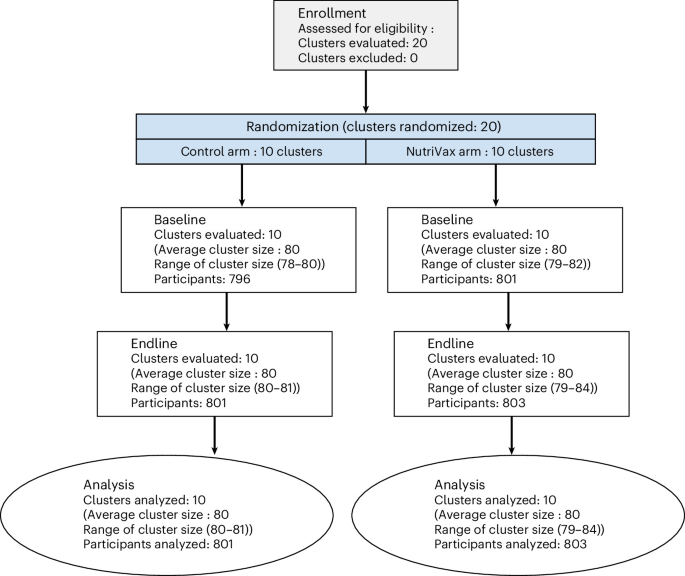
The trial is registered at ClinicalTrials.gov (NCT06387511) and is reported in accordance with Consolidated Standards of Reporting Trials (CONSORT) for cluster-randomized controlled trials and CONSORT 2025 and CONSORT–Children and Adolescents (CONSORT-C) 2026 checklists43.
The full NutriVax protocol was published previously42.
Study design and setting
The NutriVax-Measles study was an open-label, pragmatic, superiority, two-arm, parallel, cluster-randomized trial evaluating the NutriVax strategy (intervention) against routine NPI (control) services in Yobe State, northern Nigeria.
Cluster randomization was used because the intervention was delivered at the health facility level, with SQ-LNS co-delivered alongside routine immunization services, whereas its effect was assessed at the population level in the community, making individual randomization inappropriate. The trial used a pragmatic design to generate population-level evidence under real-world conditions that could inform decision-making in clinical practice and policy settings while retaining the methodological strengths of a randomized controlled trial. When systematically designed and appropriately conducted, pragmatic trials can enhance external validity and support the generalizability of findings to routine practice and to other settings with similar healthcare and program characteristics44,45.
Yobe State is characterized by high prevalence of global acute malnutrition (14.2%) and severe acute malnutrition (3.7%) among children 6 months to 5 years of age; low coverage for MCV1 among children aged 12−23 months, both card verified (29.9%) and card verified or caretaker recall (59.8%); and a high proportion of zero-dose children (39.6%)22.
The trial was conducted in Karasuwa and Nguru Local Government Areas, which face a precarious security situation because of activity by non-state armed groups, community violence and kidnappings. Each Local Government Area comprised 10 administrative health zones, referred to as wards, which represented the smallest administrative units used for planning and implementing health activities at health facilities and in communities. Both Local Government Areas were predominantly rural, with some peri-urban centers. Cluster eligibility was defined at the ward level: wards and their respective catchment populations within Karasuwa and Nguru Local Government Areas were eligible for inclusion, with no exclusion criteria. All 20 wards were included as clusters, enabling real-world implementation while minimizing the risk of contamination between study arms. At the time of the trial, no SQ-LNS distribution programs were planned or ongoing in the study areas.
Randomization and masking
Clusters, stratified by Local Government Area, were randomly assigned in a 1:1 allocation ratio to either the control arm or the NutriVax arm, so that each Local Government Area had five control and five intervention clusters. Randomization was conducted via a public lottery held separately in each Local Government Area in the local language and in the presence of MoH officials, village heads and national investigators. For each cluster, arm allocation was randomly drawn by a community representative. Randomization was stratified by Local Government Area to ensure balanced allocation and to account for differences in population, geography and sociocultural factors affecting healthcare utilization.
Because cluster allocation was conducted through a public lottery, no additional allocation concealment mechanism was used. All clusters assigned to the NutriVax arm were eligible for the SQ-LNS distribution program, whereas clusters assigned to the control arm did not receive SQ-LNS through the trial. No exceptions to this allocation were made.
Staff in charge of data collection were blinded to cluster allocation until completion of the baseline survey and were independent of the intervention delivery team. Caregivers and MoH and field implementation staff could not be blinded after implementation. Baseline results were masked to investigators and to MoH and field implementation staff to avoid influencing intervention delivery.
Procedures
Across all clusters, health services were delivered through PHCCs and health posts, which provided essential services, including treatment of malnutrition, health promotion and immunization, in accordance with MoH guidelines and policies. The Nigerian routine immunization schedule (Extended Data Table 2) was implemented by MoH staff at PHCCs, with one per cluster, and at health posts, the numbers of which ranged from zero to four across clusters. Facilities held 1−2 immunization sessions per week, during which vaccines were administered by routine MoH staff.
During immunization sessions, the child’s vaccination card or history was reviewed to determine whether any scheduled vaccines were due. When a caregiver accepted the vaccination, MoH staff administered the vaccine. Catch-up doses for early childhood vaccines, including pentavalent doses, were provided for children older than 14 weeks in line with Nigerian MoH policies. MCV1 was scheduled at 9 months of age; MCV2 was scheduled at 15 months of age. (For children who did not receive MCV1 on schedule, MCV2 was scheduled at least 4 weeks after the first dose was administered.)
Nutrition services were routinely available across all study clusters, independent of the trial intervention and in accordance with national guidelines. Vitamin A supplementation was provided during vaccination sessions at 6 months and 12 months of age. This was the only preventive nutritional supplementation routinely delivered in the study setting at PHCCs and health posts. Screening for acute malnutrition at PHCCs and health posts and within communities was part of routine essential primary healthcare activities and was conducted by MoH staff according to national guidelines across all clusters. Children diagnosed with acute malnutrition were referred for nutritional treatment and received therapeutic or supplementary lipid-based foods according to the severity of malnutrition at PHCCs. These routine nutrition services were available to children in both the control and NutriVax clusters, and access to treatment for acute malnutrition did not differ between study arms.
In each of the 20 clusters, 10 trained community mobilizers per cluster conducted sensitization sessions at PHCCs and within communities throughout the study period. Ten additional community mobilizers were added 3 months after implementation began. Sensitization sessions followed standardized operating procedures and promoted vaccination and Infant and Young Child Feeding (IYCF) practices. Vaccination messages were aligned with the MoHʼs routine plans in Nigeria, including the Nigeria Strategy for Immunization and Primary Health Care System Strengthening 2018−2028. These messages emphasized vaccines already received, remaining doses required for full protection, return schedules and management of expected minor adverse effects. Key messages on IYCF practices were based on United Nations Childrenʼs Fund (UNICEF)-validated materials and highlighted nurturing care, age-appropriate feeding during the first 2 years of life, dietary diversity and continued breastfeeding. MoH staff and community mobilizers received financial incentives in all clusters.
In each NutriVax cluster, SQ-LNS distribution was organized at PHCCs on immunization days by two trained distributors assigned to each PHCC. Eligible children were aged 6−22 months and were residents of a NutriVax cluster, without known SQ-LNS allergy. Children with acute malnutrition were not eligible to receive SQ-LNS and were referred instead for nutritional treatment according to national guidelines. They could enter or re-enter the SQ-LNS program after recovery if they remained age eligible. Caregivers of eligible children received a 1-month supply of SQ-LNS, corresponding to one sachet per day. A 3-month supply could be provided to caregivers with limited access to PHCCs or living in hard-to-reach areas. Supplementation continued until the child reached 23 months of age or had completed 12 months of supplementation, whichever occurred first. Participation was voluntary, and receipt of SQ-LNS was not conditioned on receiving a scheduled vaccine. All caregivers first entered the vaccine circuit, where the childʼs vaccination card or vaccination history was reviewed to determine whether any scheduled vaccines were due. When a vaccine was due and accepted, routine MoH staff administered the vaccine according to the national immunization schedule, either at the PHCC or at a health post, depending on facility catchment area. If a caretaker declined vaccination after counselling by a healthcare professional to address concerns, an eligible child could still receive their SQ-LNS ration at the PHCC. Thus, supplementation was not denied on the basis of vaccine refusal.
During standardized sensitization sessions, communities were informed about the services available in their cluster according to trial allocation. In NutriVax clusters, these sessions included additional messages on SQ-LNS eligibility criteria and appropriate use, both at PHCCs and within communities.
Participants
Outcomes were assessed using a population-based endline cross-sectional survey conducted after 10 months of intervention exposure and 12 months after the baseline cross-sectional survey that had been completed before the intervention was implemented. Eligible participants were children aged 12−23 months at the time of each survey, living in the study area and with oral informed consent obtained from the parent or legal guardian. There were no exclusion criteria for the baseline survey. For the endine survey, the only exclusion criterion was participation in the longitudinal survey (see details on the other components of the trial below). Both cross-sectional surveys were conducted following the WHO reference manual for vaccination coverage cluster surveys21. Enrollment in each cross-sectional survey used a three-stage cluster sampling design, based on the estimated population of children aged 12−23 months per settlement (that is, per random units) obtained from the 2024 Yobe State MoH immunization microplanning database. In stage one, 100 settlements of 203 were randomly selected (50 per arm and five for each cluster) using the probability proportional to size sampling method. For each cluster, the cumulative estimated population of children aged 12−23 months per settlement was calculated, and the sampling interval was determined by dividing the total cumulative population by the number of settlements to be selected (n = 5). The first sampling step was generated as a random number (using R software) between 1 and the sampling interval value. In stage two, households, defined as groups of individuals sharing food and livelihood under a recognized head of household, were sampled systematically following the Multiple Indicator Cluster Surveys (MICS) methodology and templates. Large settlements with more than 900 households were divided into four segments, and those with more than 480 households were divided into two segments, with the support of community guides. Sampling intervals were calculated by dividing the estimated number of households to be visited by the number of households required to reach the target of eligible children (an anticipated non-response rate of 10.9%)22. A random starting point was selected in each segment, and households were visited sequentially according to the sampling interval until the required number of eligible children was reached. Stage three was applicable where households contained more than one eligible child aged 12−23 months, the oldest child being included under such circumstances.
Detailed, standardized operational procedures and training modules were developed based on the MICS manual and tools for household mapping and selection, ensuring consistent application of the sampling plan across all clusters by trained research teams. Prior to each survey, local community leaders informed community members about the survey and its objectives. Community guides assisted with mapping, locating and facilitating access to households in each selected settlement.
Outcome measures
The primary outcome was coverage of MCV1 verified by vaccination card. Prespecified secondary outcomes included timeliness of card-verified MCV1 (that is, within 1 month of a child’s 9-month birthday) and coverage of other routine vaccines based on vaccination card or caregiver recall; the first and third doses of pentavalent; MCV2, the second dose of MCV; timeliness of MCV2 among children aged 15 months or older; yellow fever; and meningitis. It also included zero-dose status according to the WHO/Gavi definition (that is, having received no dose of a diphtheria−tetanus−pertussis-containing vaccine, which corresponds to the absence of pentavalent 1 vaccine); zero-dose ‘vaccine-never’ status; and fully vaccinated status. Vitamin A uptake served as an additional secondary indicator of child health service utilization because it is commonly delivered alongside routine immunization and is recorded on the Nigerian vaccination card.
Post hoc secondary outcomes assessed vaccine card retention; card-verified vaccination: MCV2 among children aged 15 months or older, pentavalent 3 and zero-dose (WHO/Gavi definition); timeliness of MCV1 based on card or caregiver recall; combined card-verified zero-dose and acute malnutrition status; and combined zero-dose and acute malnutrition status based on vaccination card or caregiver declaration. Post hoc secondary outcomes assessing vaccine coverage based on vaccination card and the combined status of being zero-dose and acutely malnourished were added to complement the prespecified analyses. They were included to provide a more comprehensive assessment of vaccination coverage objectively verified by vaccination card and to characterize the double burden of being zero-dose and acutely malnourished.
Uptake of SQ-LNS was recorded at endline in both arms
Vaccination data were primarily obtained from vaccination cards, or from caregiver recall when cards were unavailable (except for meningococcal vaccine), using standardized WHO questionnaires, which include prompts based on route of vaccine administration and anatomical injection site (for example, Bacillus Calmette−Guérin (BCG) scar on the upper arm, pentavalent injections in the thigh and oral polio drops)21. Data were collected by trained research assistants under supervision and entered directly into REDCap (version 16.1.4) on tablet devices, with offline functionality.
NutriVax-Measles embedded other populations and data collection methods, the results of which will be presented elsewhere: (1) a longitudinal 12-month follow-up household cohort of children aged 6−12 months at inclusion with last participant included before the intervention began; (2) two cross-sectional qualitative acceptability and feasibility surveys including parents/legal guardian of children aged 6−23 months, community representatives, community health workers and healthcare providers, one after 3−4 months of implementing the intervention and one during the last 2 months of the study; (3) a cost survey of caregivers of children from the longitudinal cohort; and (4) a health facility cost survey of a randomized subsample of health facilities42.
Sample size
Sample size, considered for cross-sectional population-based surveys, was calculated for the primary outcome assuming 30% baseline measles 1 coverage22, a conservative intracluster correlation of 0.2 (ref. 21), a 5% type I error, 90% power and 5% missing data, thus requiring 78 children per cluster per survey (total of 1,560 per cross-sectional survey) to detect a 10-pp difference in MCV1 coverage between baseline and endline46. Analyses followed intention-to-treat principles, including all randomized clusters and all participants with available endpoint data. Descriptive analyses were stratified by study arm, Local Government Area, Local Government Area-by-arm, sex and sex-by-arm (Supplementary Tables 7−10).
Statistical analysis
The statistical analysis plan can be accessed on ClinicalTrials.gov (NCT06387511).
The primary analysis of the primary outcome used mixed-effects logistic regression with study arm and cluster-level baseline coverage as a fixed effect and cluster as a random intercept. Children without a vaccination card were classified as unvaccinated, and children with a vaccination card but no recorded MCV1 were also considered unvaccinated. Sensitivity analyses excluded children aged 21−23 months and adjusted for Local Government Area. Post hoc sensitivity analyses additionally adjusted for settlement distance to PHCC (in kilometers) and a binary variable of whether the settlement was directly served by a PHCC for immunization at endline, to account for cluster-level variability in geographic access to PHCCs (Supplementary Tables 11−13). Effects were reported as cluster-specific ORs with 95% CIs and P values derived from profile likelihood. An additional post hoc sensitivity primary analysis estimated marginal ORs from population-averaged predicted probabilities, with 95% CI and P values estimated by bootstrap.
A secondary analysis of the primary outcome employed a DiD mixed-effects logistic regression with study arm, period and their interaction as fixed effects, cluster-level baseline coverage as a fixed effect and cluster as a random intercept. Effects were expressed as (1) cluster-specific ORs with 95% CIs derived from profile likelihood and P values obtained from likelihood ratio tests and (2) pp differences with 95% CIs and P values derived from parametric bootstrap (Supplementary Table 4). Mean bootstrap DiD pp estimates were calculated as a robustness measure. A post hoc sensitivity analysis additionally estimated marginal ORs derived from population-averaged predicted probabilities.
ICCs were estimated as latent ICCs from the random-intercept variance on the logit scale and as observed ICCs on the probability scale using 1,000 predictive simulations of the logistic mixed-effects model, with 95% CIs from the 2.5th and 97.5th percentiles. ICCs were reported overall and by study arm. To inform the design of future cluster-randomized studies, we reported between-cluster variance estimates from the mixed-effects model (assuming a within-cluster variance fixed at π2/3 on the logistic scale, as recomended for these models47) and summarized empirical distributions of cluster-specific outcome rates at baseline and endline using the median (IQR) and range.
Secondary outcomes were analyzed similarly. Secondary outcomes based on vaccination card or caregiver recall were calculated by including children with the vaccine recorded on their vaccination card as well as children without a vaccination card whose caregiver reported that the vaccine had been received. P values were adjusted using the Benjamini−Hochberg procedure to control the false discovery rate at 5% for the cluster-specific OR estimates from secondary outcomes analyses (Supplementary Table 14). For secondary outcomes for which cluster-specific ORs were estimated, post hoc sensitivity analyses additionally estimated marginal ORs from population-averaged predicted probabilities.
Finally, we explored outcomes stratified by SQ-LNS uptake among children in the NutriVax clusters. This was a post hoc, non-randomized analysis.
All tests were two-sided, with a type I error rate (α) set at 5%. All analyses were performed in R (version 4.4.3).
Protocol deviations
To limit the number of comparisons included in the Benjamini−Hochberg procedure used to control the false discovery rate at 5%, the prespecified outcomes of coverage of the first dose of pentavalent vaccine (pentavalent 1) based on vaccination card data or caregiver recall were reported descriptively (Table 2) but were not included in the multiplicity-adjusted analyses. Post hoc, we instead prioritized vaccine card retention outcome and vaccination outcomes objectively assessed using vaccination card data: card-verified zero-dose status (absence of pentavalent 1 vaccination); card-verified MCV2 among children aged 15 months or older; card-verified pentavalent 3 and meningitis vaccination; and the combined outcome of zero-dose and acute malnutrition, assessed using vaccination card data alone or vaccination card data combined with caregiver recall.
Regarding vitamin A uptake, the protocol prespecified the assessment of receipt of the first dose at 6 months and the second dose at 12 months, based on vaccination card or caregiver recall. However, caregiver recall data did not allow to precisely distinguish the first and second doses or to determine the age at which those vitamin A doses were received. Consequently, we reported instead the proportion of children who had ever received at least one dose of vitamin A.
Safety and adverse events
The NutriVax intervention involved the co-delivery of SQ-LNS with routine immunization services, in accordance with national guidelines and the national action plan for nutrition. All preventive and curative care and follow-up procedures continued to be provided according to national guidelines, both at community level and at health facilities, throughout the trial. No additional clinical procedures or treatments were introduced as part of the study. During the baseline and endline cross-sectional household surveys, caregivers were asked about their childʼs current morbidity and if any hospitalization occurred within the 3 months preceding the interview.
Ethics approval
Prior to trial implementation, the study objectives, trial design, cluster allocation and SQ-LNS distribution procedures were reviewed and approved by State and Local Government Area health authorities as well as community representatives during formal meetings. Ethical approval was obtained in Nigeria from the Yobe State MoH and the Human Services Health Research Ethics Committee (MOH/GEN/747/Vol. 1) and in France from the National Institute for Health and Medical Research (INSERM) Ethics Evaluation Committee (24-1091-20240402/IRB0000388). At the cluster level, a study participation agreement was signed by the MoH PHCC manager responsible for each ward catchment area (corresponding to a cluster for the trial), after reviewing the investigator file, including the protocol and study procedures. Oral informed consent21 was obtained from parents or guardians prior to participation in both baseline and endline household cross-sectional surveys; no individual-level data were collected at health facilities.
At the time of the trial, SQ-LNS was not part of the routine standard of care, and no SQ-LNS distribution programs were planned or ongoing in the study areas. Although SQ-LNS has recognized nutritional benefits and is recommended by the WHO in specific contexts, universal provision of SQ-LNS to all eligible children was not part of the existing MoH service package. The trial, therefore, did not withhold an intervention that was routinely available, planned or otherwise accessible to children in control clusters. All children in both intervention and control clusters continued to have access to routine immunization and standard nutrition services according to national guidelines under real-world programmatic and funding conditions.
The trial was not designed to test whether SQ-LNS has nutritional benefits. Rather, it was designed as a pragmatic trial to evaluate a policy-relevant question: whether co-delivering SQ-LNS distribution with routine immunization services could improve vaccination coverage under real-world operational conditions. At the time of the trial, there was no evidence that this pragmatic implementation strategy conducted under conditions of genuine non-availability of SQ-LNS would improve vaccination uptake, and there was real uncertainty regarding its feasibility, effectiveness and programmatic value. Randomization was, therefore, considered ethically appropriate to rigorously assess the effectiveness and the acceptability of the intervention before any potential wider implementation.
Ethics and inclusion statement
Community engagement was maintained throughout the study via regular meetings with health authorities and local leaders, including, in each Local Government Area, the director or deputy director of the primary healthcare department, immunization and disease control officers, monitoring and evaluation officers, the director of family health, PHCC managers and officers in charge, nutrition officers, Local Government Area facilitators and village heads from participating clusters. Prior to trial implementation, formal meetings were held with State and Local Government Area health authorities and community representatives to review and approve the trial design and SQ-LNS distribution procedures. Randomization was conducted publicly and transparently, in the local Hausa language, with the active participation of village heads, as a deliberate safeguard to ensure acceptance of the cluster allocation process across both study arms. Engagement with stakeholders and communities was further supported through a national steering committee, comprising representatives from federal, state and local MoH, local and international nutrition and immunization actors and community leaders. These activities ensured that community leaders and state authorities remained informed of the trialʼs progress throughout implementation and were among the first to receive preliminary study findings. Nigerian co-principal investigators participated in local and national meetings and international steering committee meetings, conducted regular monitoring of investigation sites visits and participated in dissemination activities of preliminary results at state and national levels. After trial completion, Yobe State authorities allocated a dedicated SQ-LNS budget informed by the study findings, illustrating the sustained stakeholder engagement and research-to-policy translation underpinning this pragmatic trial. Data ownership and authorship were shared with researchers from Yobe State University Teaching Hospital, Ahmadu Bello University, Yobe State Healthcare and Related Facilities Inspection and Monitoring Agency and Ahmadu Bello University (Zaria, Nigeria).
Even though SQ-LNS has strong scientific evidence, the lack of international and domestic investment has led to slow uptake. The study team advocated for financing of SQ-LNS to continue after the trial but could not secure the funding. The Yobe State government did, however, commit to purchasing SQ-LNS in their 2026 budget, in large part due to an initiative led by UNICEF called the Child Nutrition Fund (CNF) in which international donors match domestic investments in nutritional commodities. After the trial ended, the government of Nigeria and the World Bank also announced ANRiN Project 2.0, which includes substantial financing for SQ-LNS, some of which will be allocated to the areas where NutriVax was conducted. Sustainability of SQ-LNS programming will depend on dedicated financing like this as well as building the capacity of MoH staff to manage such distribution programs.
This study was conducted as part of the Clinical and Operational Research Alliance (CORAL), a consortium aimed at developing high-quality, innovative and transformative global health research programs through a collaboration between scientists from the Bordeaux Population Health Research Center (Bordeaux, France) and the PAC-CI Research Program (Abidjan, Côte d’Ivoire) and the humanitarian organization ALIMA (Dakar, Senegal), with a focus on improving maternal and child health outcomes in sub-Saharan Africa and Haiti.
Confidentiality
All study data were securely stored and managed to protect participant confidentiality, with participants identified only by a unique identifier. No personal data were recorded in the database. Data access was encrypted and restricted to the research team.
Reporting summary
Further information on research design is available in the Nature Portfolio Reporting Summary linked to this article.



