
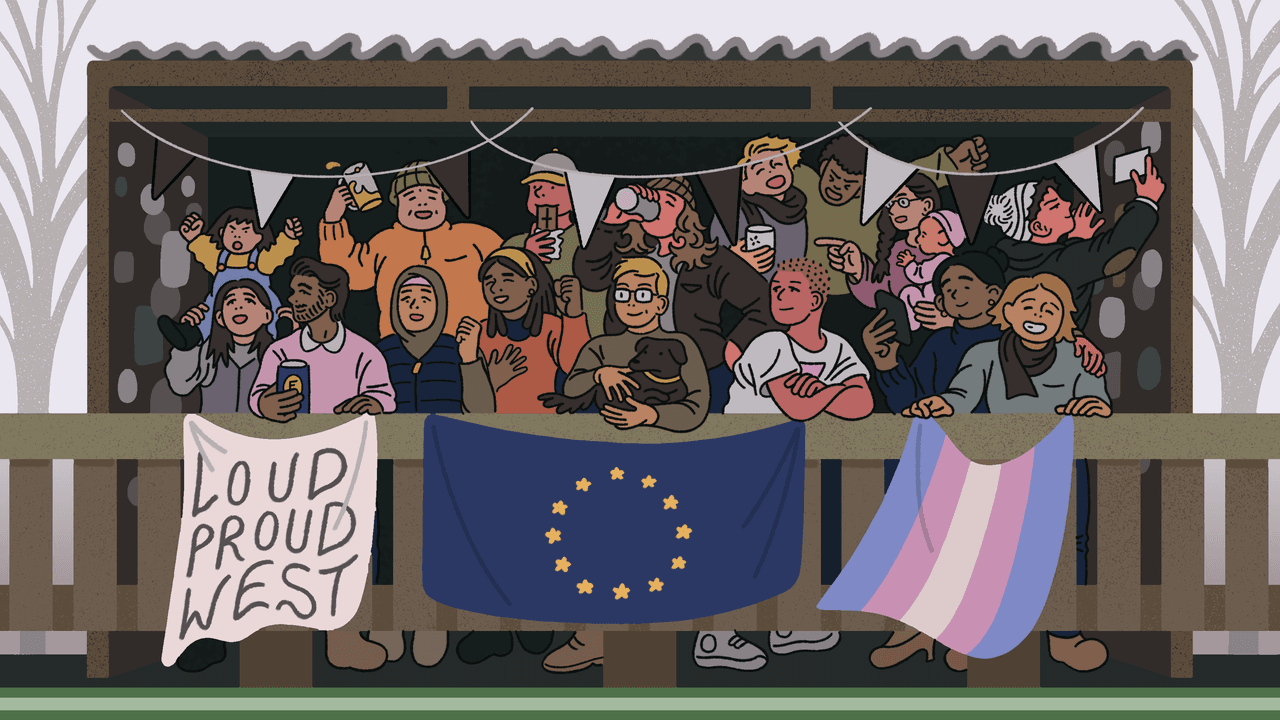
A leveraged take-over, in 2005, by an American family, the Glazers, raised prices and loaded the club with debt. When Ineos, a multinational conglomerate, took over operations, in 2024, prices rose again. Discounts for children, seniors, and other groups were reduced. Longtime season-ticket holders were relocated to make room for hospitality-ticket holders, who lounged in padded seats and were served treacle-cured duck breast with plum compote.
Vinny, a shutter installer, tried to overlook the price hikes. “There’s still that great community thing,” he said, “your group of friends who go there.” But his friends started to disappear. Not only was attending matches expensive—it was increasingly unpleasant. Barriers separated crowds into escort routes before and after games; supporters could be held in the stadium long after the final whistle, so that rival groups did not clash outside. “You get treated like a criminal before you’ve done anything. You wouldn’t take it in any other walk of life, would you?” Vinny said.
And, really, there’s nastiness and there’s nastiness. Vinny still relished the thought of sitting, just the right amount of scared, in a rival stadium, like Liverpool’s Anfield—“Love the thought of going to Anfield, knowing I could get me head kicked in,” he said. But, as Gianni Infantino, the president of FIFA, announced recently, “Football belongs to everyone,” and in some ways this is true. Across any fan base, there is an insistence that loyalty to the badge trumps all differences—a beautiful sentiment, until people open their mouths. At Old Trafford, Vinny usually sat in front of a man who launched into the same racist chant every two weeks. “No one was, like, ‘Dickhead,’ ” Vinny said. Eventually, one of Vinny’s friends punched the man. At halftime, the fan came over. “He was, like, ‘We’re all United fans, aren’t we?’ No, you’re just a dick,” Vinny said. “It’s not 1970 anymore. It’s not 1980, even.”
Vinny stopped religiously going to Manchester United games twelve years ago. “They don’t want me in there,” he said. “Fight for what you believe in or walk away. And I pretty much walked away from United.”
A year passed. On Sundays, Vinny would go to the Turn Moss public playing fields, just south of Manchester, where he would watch amateur leagues play. The River Mersey runs by the bottom of the playing fields. One day, Vinny walked along the river with his two-year-old son into Chorlton-cum-Hardy, and then along a tributary, the Chorlton Brook. Between the brook and the river, he arrived at a football pitch.
The ground belonged to a club called West Didsbury and Chorlton A.F.C. Its supporters call it West. The club played in the North West Counties Football League, in the ninth tier of English football. Any football that is played below the top four divisions of English football is considered non-league, and West fit the category handsomely. Not even a hundred people were at the first match that Vinny attended. His toddler crawled along the touchline. “You just sat there,” Vinny said. “You just feel comfortable. And you think, I like this.”
West, founded in 1908, spent much of its first century yo-yoing up and down the standings of amateur leagues on anonymous fields around south Manchester. When the team settled at Brookburn Road, in Chorlton, in 1996, it was one of thousands of non-league clubs playing for almost nobody. Obscenities, the referee’s whistle, and the thud of boots into balls—and sometimes shins—easily carry across these desolate fields.



