
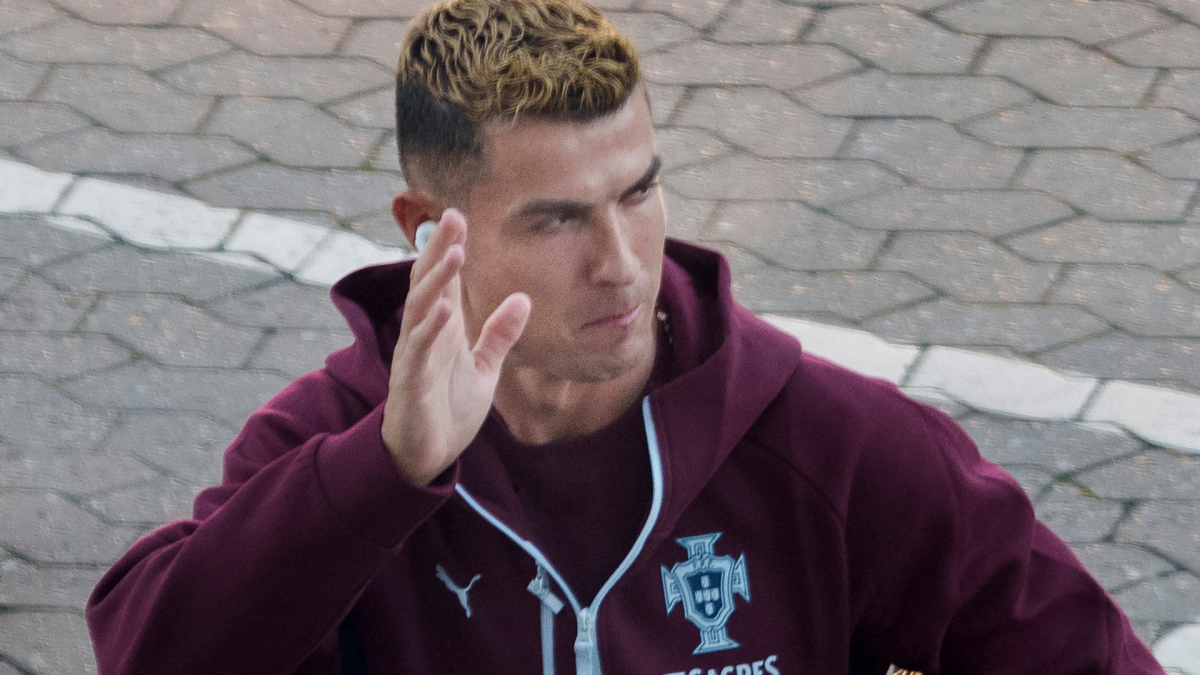
It has been one of the most chaotic weeks in recent memory, as Cristiano Ronaldo left Portugal’s training camp aboard his private jet following a disagreement with coach Jorge Jesus, just hours after an emergency meeting was held in Denmark ahead of Portugal’s game. The story kicked off over the summer when Portugal were knocked out by Spain in the Round of 16 at the 2026 World Cup. The Portuguese Football Federation announced Jorge Jesus as the new head coach of the national team, following the resignation of former manager Roberto Martinez.
Cristiano Ronaldo, who announced he had played his last World Cup match after the defeat against Spain, said it was “not the right time” to make a decision on his future in the national team. The Portuguese star, who turned 41 earlier this year, previously worked under Jesus last season at Al-Nassr, winning his first Pro Saudi League title since he joined in 2023. When asked about the role of Cristiano Ronaldo in the national team when he was unveiled, Jorge Jesus seemed to have a clear idea from day one.
“He will never be a problem, either for the Selecao or for me. I had the pleasure of working with him for a year. When I thought he should play, he played. When I thought he shouldn’t play, he didn’t. I’ll do what I think is best for the Selecao.”
However, since then, things have changed a lot.
September 18 — Ronaldo in the squad
Cristiano Ronaldo is part of the roster selected by Jorge Jesus for the four opening matches of the UEFA Nations League against Norway, Wales and Denmark.
September 23 — Ronaldo speaks alongside manager
Both Jorge Jesus and Cristiano Ronaldo speak ahead of the debut against Wales in the pre-match press conference in Lisbon. Ronaldo explained he met with both the manager and the head of the federation Pedro Proenca after the World Cup.
“They said they are counting on me for the coming matches. I feel I can help with my performances and my goals, not because of my CV. The day I feel the coach and the president don’t count on me, I’ll be the first to pack my bags and leave.”
September 24 — Ronaldo starts vs. Wales
Cristiano Ronaldo is part of the starting eleven against Wales at the Estadio Jose Alvalade, the stadium where he made his professional debut with Sporting CP. He had a chance to score, but his goal was ruled out by VAR. As he left the pitch to be replaced by Goncalo Ramos, he received an ovation from the fans.
September 27 — Ronaldo left out vs. Norway
The day that changed it all. Cristiano Ronaldo is not part of the starting squad as Portugal beat Norway 2-1 in Oslo and he’s among the substitutes while his replacement Goncalo Ramos scores the winning goal. Sunday’s game was only the third time he was on the bench for 90 minutes since he became a regular part of the Portugal national team 22 years ago. Ronaldo was asked by manager Jorge Jesus to train on the sidelines to get ready and potentially play some minutes, but it didn’t happen. As the game ended, Ronaldo went straight down the tunnel and did not join his teammates to applaud the away fans in Oslo.
After the game, Jorge Jesus was asked about Ronaldo.
“You will have to ask Ronaldo [why he didn’t applaud the fans]. I didn’t realise that happened. I will talk to him. As regards not bringing him on, I told Ronaldo before the match I would sub him on in the second half, but the way the match was panning out it did not make sense to do so.”
September 29 — Crisis meetings
Briefly, it all seemed to have cooled down after the game, but it turns out that wasn’t the case at all. Multiple Portuguese media outlets reported that a secret meeting between the coach, Cristiano Ronaldo and the president of the Portuguese FA who personally flew to Copenaghen, took place on the evening before the next press conference. According to the same reports, Ronaldo didn’t train with the team on Monday and Tuesday and worked alone in the gym.
September 30 — An explosive press conference
The big day came on Wednesday when the usual pre-match press conference took place. Speaking on the matter, Jorge Jesus said, “They forced me to talk to him about an issue that wasn’t even an issue. There was nothing to talk about. He never trains on the first or second day after a game. He never refused anything. If you look, he’s training today. Do you think any player at the level of a national team would refuse to train? Only if he wanted to leave. Nobody refuses to train.”
Jorge Jesus added, “Don’t try to make a fuss where there isn’t one. It was a coach’s decision; I had a plan. I can say to any player that you’re starting on the bench; if I need you for 30 minutes, you’re going to play; if I don’t need you, you’re not going to play. The way I was reading the game (against Norway), he didn’t come on. Because it’s not Cristiano, just like it will never be any player that will change my ideas as the coach. Never.”
Despite those words, while the manager was still speaking, Ronaldo made the decision to fly back to Spain as his personal took off from Madrid, and he left the Portuguese national team camp before training. Later, he posted on his social media channels.
“After the National Team coach’s press conference, and following a conversation with the President of the Portuguese Football Federation, I have decided to leave the National Team training camp. In due time, I will tell all Portuguese people the truth about the reasons that led to my departure from the national team, to which I have always dedicated myself… Now it’s the time to wish good luck to Portugal and to all my teammates!”
October 1 — Portugal win again without Ronaldo
On Thursday morning, only a few hours before the game against Denmark, the Portuguese FA announced that Rafael Leao will wear the number seven jersey, the one that Cristiano Ronaldo used to wear in his career. Later, before Portugal’s 4-2 win against Denmark, a game that also saw Danish striker Rasmus Hojlund imitating the iconic celebration of Ronaldo after scoring, Jorge Jesus spoke again on the matter: “I have many years in soccer and I know that I did nothing that should have caused things to go differently. After the Norway game, we will talk about this subject. I will not hide or run away from it. Nobody can take away what Cristiano represents. He’s an icon and that’s not in question.” Seems like this saga is definitively not over yet.
October 4 — Jorge Jesus opens to Ronaldo
After winning their fourth game in a row 2-1 against Norway, the second one after Cristiano Ronaldo left training camp, Portuguese coach Jorge Jesus spoke and opened up the possibility of Ronaldo’s comeback in the future.
“In my opinion, you can’t hold a one-year friendship against someone over a situation that is difficult to understand. Just because it was him. Just because it was him, and perhaps rightly so, because he is a symbol, this whole issue of warming up and not warming up, coming on and not coming on, has been created. How many players warmed up today and didn’t come on? How many? Is there going to be a problem with any of them? No. Cristiano Ronaldo will be called up for the next international break, if he wants to return. It’s his decision. I am ready to call him if he will play with Al Nassr”.
Pedro Proenca, the President of the Portuguese Football Federation added, “Cristiano Ronaldo is the best player in history. He has dedicated more than two decades to Portuguese football and is the ultimate symbol of Portuguese identity. His presence with the national team is well deserved thanks to his exceptional sporting abilities, and this is undeniable. He will always remain part of this group whenever he is fit and ready. What happened between him and Jorge Jesus was simply a misunderstanding that needs to be resolved internally. Cristiano is part of the national team; he is our icon, and he captained the team in the first of the four matches. Cristiano Ronaldo is a Portuguese icon and an exceptional player. He could have ended his career at the World Cup, but he didn’t because of his love for his national team. I can attest to the bond he shares with the Portuguese people and our national team. Now that the four matches are over, we have the time and calm to sit down together and resolve the misunderstanding. Cristiano is part of our legacy, and he will always be here whenever the coach wants him.”
October 6 — Cristiano Ronaldo’s letter
A few days later, Cristiano Ronaldo wrote a long letter that he published on his social media:
“As I promised, I have decided to recount, in the first person and directly, the circumstances surrounding the latest stage of the national team’s journey. After the 2026 World Cup, I prepared a message for the Portuguese people, which I still keep, containing the words I would like to address to them when I finally leave our team. At the end of the tournament, on the return flight from the United States, the federation president asked me and insisted that I reconsider my decision to leave, because the Portuguese Football Federation wished for me to continue. Immediately afterwards, he asked me for my opinion on the name of the current national team coach, whom he was considering, alongside other names he did not reveal to me.
I answered the federation president that, in my opinion, it would be the ideal choice. Therefore, on the day the current national team coach was presented, I was genuinely happy with this choice. It was the right choice, as the results prove. A few days later, I received the first call from the new national team coach, in which he said he wished to meet me in person. I answered in the affirmative, and we set a date for it. “The end of my holiday.” We met at the football city where my team was holding its pre-season training camp. On that day the coach told me that he was counting on me and that my presence was essential to his project. He presented me with a plan for my immediate participation. He said I would play the first and last matches, and that he would make three or four changes in each match for reasons related to physical fitness. At that point, he suggested that I not travel with the national team to Norway and Denmark. He suggested that I play the first match and stay in Portugal, then join them before the match at the Dragão stadium.
I rejected this suggestion immediately. It seemed clear to me that I could not accept it. Not playing the matches abroad would not mean that I would not be captain of our team. The privilege of staying in Portugal would not set a good example. In the end, the coach agreed with my analysis. This conversation was attended by Simo Coutinho, the sporting director of Al-Nassr club, the person to whom the current national team coach reported throughout last season, and one of those responsible for his joining the club in 2025. On the eve of the training camp, the coach came to my home in Lisbon to have another conversation with me at his request. The conversation was calm, and we adhered to all the principles agreed upon in August. I played the match at the Alvalade stadium, and despite being substituted, I caused no problems. I personally placed the captain’s armband on Bruno Fernandes, and it never occurred to me that I might be taking my last steps as a player and captain of the national team. The most important thing that day, for me, was our win. Winning is always a good thing, and in Portugal, and for my country, it is the best. At lunchtime on the day of the match in Norway, the national team coach’s assistant came to the table where the team was having lunch, and told me that the coach wanted to talk to me. To my great surprise, the coach asked me whether I was ready to play 30 minutes. I was fully focused on my physical recovery, blending in with my teammates as usual, and believing I would not play that day. No problem at all.
This request was outside my physical recovery and training plan, because I was only going to play on the fourth of the month at the Dragão stadium, but of course I agreed. He answered me that I should be ready because I would play 30 minutes. The rest is well known. I began warming up from half-time, and I watched the minutes pass, and no one called me on. The coach broke his promise. At the end of the match, I only wanted everything to end with a win and to be alone. I did not go to greet the fans. A mistake I take responsibility for alone, and one that should not have happened. I apologise to the Portuguese people who supported us enthusiastically there, I apologise to the fans, and I apologise to those who travelled there to see me, even if they were not Portuguese, and whom I may have let down. Forty-eight hours later, we had a conversation, myself, the coach and Simo Coutinho, because he was following our conversations It was a very deep and frank moment, without any reservation. We agreed that there was only one way to end this “case”: that the coach would repeat what he had just told me in private, in the presence of Simo Coutinho, but in the press conference room. The agreement was simple: the coach would begin the press conference with this subject, trying to end the matter by telling the truth. He would say that I had never asked to play even for a few minutes, and that the coach alone, no one else, was the one who proposed the plan for this training camp, and that it had been a mistake to subject me only to the warm-up without playing, and that, if it happened again, he would not do it.
We ended that meeting with the coach asking me for a hug, and he promised me that he would say in the press conference what he had just told me, and that the matter had been resolved. I would not play in Denmark, but I would play in the Dragão match. All of this took place in the presence of Simo Coutinho, as usual. At the coach’s request, a video meeting was held between him, Simo Coutinho and Tiago Craveiro, to summarise what we had discussed. A brief document was prepared, which I personally approved, and it was handed to the coach at his request. The meeting was as expected: the behaviour had nothing to do with our meeting. I heard expressions and aggression that I consider unjustified, and an attitude suggesting that he “wants, can, and orders” that he had never shown me, not even indirectly, in a private session, the day before The notes I reviewed were as follows: I believe it is important, because it is the truth, to clarify some matters before talking about Denmark:
1. I personally proposed a plan for Cristiano, without anyone else, for this sporting season with the national team. It was a long and very fruitful conversation.
2. I know how much he loves the national team and his global standing, and more than that, how positive his influence has been on the national team over 24 consecutive years.
3. The plan I proposed to Cristiano was accepted.
4. He never questioned my choices. He was an example to be followed, loyal, and professional.
5. The Norway match was not included in the plan I had set for him. However, I felt that he had physically recovered from the first match, and I warned him that I might be forced to bring him on. Cristiano agreed.
6. I made a mistake by involving a player of the magnitude of Pelé or Maradona only in the warm-up without involving him in the match. If it were today, I would not do that.
7. In short: I want Cristiano in the national team. In truth, I do not want a little, I want a lot. And fortunately, he also trusts me. He believed in me at Al-Nassr and here too.
8. As for not greeting the fans, we spoke about this matter earlier. A player who has played more than 230 matches with the national team does not take lessons from me in loving Portugal. It was a moment of frustration that erases nothing. He is the player who signs the most, takes the most selfies, and shows the most affection to the fans. Let us not create problems out of nothing. When we are not happy, we react. That is all there is to it. None of these notes, therefore, mentioned that the coach had apologised to me.
This was the second time he broke his promise. I decided to leave the training camp without waiting for another promise that would not be kept. For me, the truth remains the most important thing in relationships between people. However painful it may be, I want the truth to be told to me. In fact, in a conversation I had with the president of the Portuguese Football Federation and the coach on the morning of that press conference, you can verify this, I assured them that if they did not want my presence, they should tell me so. They only had to be frank with me. I would have accepted it and promised them that we would prepare something wonderful, as I hope will happen, and no one would be angry.
I remember it as if it happened yesterday. They answered with one voice in the negative. That my place is in the national team. I have never intervened, at any time, in any technical or tactical decision of any coach or national team official throughout nearly 25 years of my career. I accept, whether it is good or bad, what they propose. I respect the decision, and when they break their promise to me, I feel that my place is not here. I also apologise to my national team teammates for leaving the training camp … Despite my complete breach of the coach’s trust, as everyone who witnessed these conversations can attest, I should not have done that. The responsibility rests on me alone. I apologise to the Portuguese people once again, but the breaking of my promise had a profound effect on me. I felt that my continuing with the team, from that moment, would only harm it, so I did what I always said I would do if I did not feel I was of use: I packed my bags and left. The Portuguese Football Federation must assess the consequences of my actions and punish me for them. I believe the penalty should not be reduced. I am not just an ordinary player; I am the captain of the team, and that is an aggravating factor. I have already apologised, but I know that actions have consequences. Anyone in the world of football, like me, knows that the rules are the same for everyone, regardless of individual standing. In this regard, I have heard a lot about farewell matches, and that I need a farewell befitting me, and that the federation wishes to grant me this opportunity.
I learned in life, while suffering from hunger and having nothing to eat, that no one gives anything to anyone for free. I can promise all my fans, and especially the Portuguese people, that we will play one or more farewell matches; there will be time for that. But when I think of the national team, what I really think of is competition. That is what I thought of on the day I received the news of my father’s death. I was at a training camp with our national team, and I decided to stay there until the end of the next day’s match. I did for my country what I would never have done for any club. So, if I am physically fit, playing with my team, and hoping to score goals, after my suspension period ends, I will be available, as I have always been, to compete and win with our national team. This, believe me, is the absolute truth.”



