
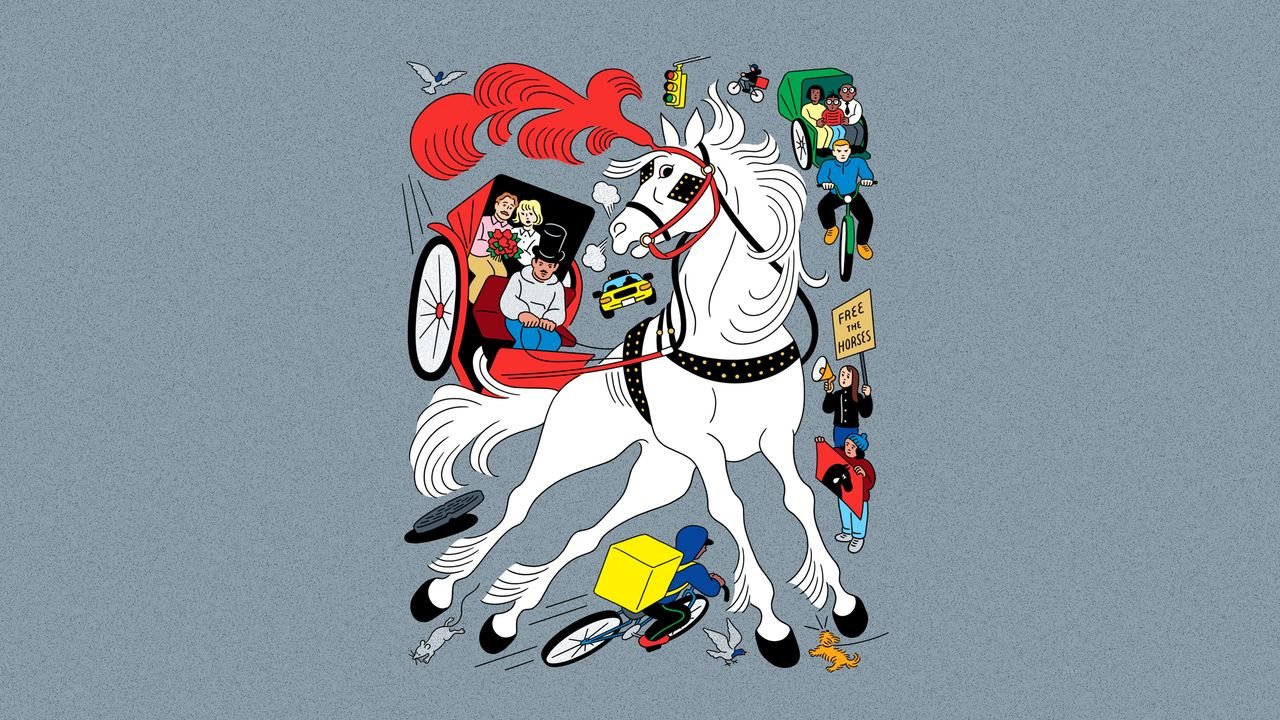
Perhaps that’s why our relationship with them is so fraught. To those who want the horses liberated, they’re indentured servants, forced to haul tourists around in a Sisyphean loop. To others, horse-drawn carriages, like cobblestone streets, are charming throwbacks to New York’s past, enshrined onscreen in “Barefoot in the Park” (Jane Fonda and Robert Redford), “Sex and the City” (Carrie and Mr. Big), and “The Muppets Take Manhattan” (Kermit and Miss Piggy). If they disappeared, after more than a hundred and sixty years, what would we lose?
After Romanch’s death, a poll sponsored by the Conservancy found that sixty-eight per cent of New Yorkers favored a carriage ban. “There are always people who have a nostalgia for the clip-clopping, but the Park is way, way beyond that now,” Betsy Smith, the head of the Conservancy, told me. The pandemic, she explained, “supercharged” use of the Park, which now hosts forty million visitors a year. Carriages compete with joggers, bicyclists, whizzing e-bikes, and Alicia Keys-blasting pedicabs, all of which can startle a horse.
For a quirky municipal issue, the battle over carriage horses has had an outsized impact. This summer’s flurry of horrors is the latest chapter in decades of warfare, with millions of dollars spent, a mayoral election swayed, and opposing sides that are dug in and combative. In July, the City Council held a public hearing on Romanch’s Law that lasted nine hours. Among the speakers were the Mahajan family, animal-rights activists, the actor Edie Falco, the perpetual mayoral candidate Curtis Sliwa, a drag clown, a woman who read a poem from the perspective of the horses (“Hey, man, take a look at what you’ve done / Beat us, ride us, so you could have fun”), and carriage drivers in top hats, including Christina Hansen—a shop steward for Transport Workers Union Local 100, which represents the drivers—who informed the Council, “Horses helped build this very building two hundred years ago.”
Weeks later, I met Hansen at Clinton Park Stables, on West Fifty-second Street, the largest of the industry’s three remaining stables, with ninety horses in residence. Built in the eighteen-eighties, it was once owned by George Washington Plunkitt, the Tammany Hall figure who coined the term “honest graft.” The carriages, festooned with Knicks decals and artificial flowers, are custom-built, mostly in Indiana. Up a ramp were two floors of horse stalls. “The animal-rights people say, ‘Oh, the poor horses are forced to walk up the steep, steep ramp!’ ” Hansen said. “In the wild, it’s called a hill.”
It was a steamy August day, so the horses were benched: they cannot work when the temperature is above eighty-nine or below nineteen degrees. They must be between five and twenty-seven years old, and each gets two annual vet checkups, plus five weeks of mandated vacation at pastures outside the city. They work nine-hour shifts, so most carriages have two or three rotating horses. Since the Second World War, there has been a fixed number of medallions—sixty-eight—which get sold (they’re roughly three hundred thousand dollars apiece) or inherited. There are around a hundred and eighty licensed carriage horses and about a hundred and fifty regular drivers; some own medallions, while others, like Hansen, are independent contractors who split their earnings with their employers. Hansen drives three horses: Sherman, Oreo, and Joker, who was on break in Pennsylvania.
On the second floor, horses were munching hay in their stalls, which are required to be at least sixty square feet, large enough for them to turn around and lie down. (Most carriage horses come from Amish country and are already trained to pull vehicles.) Hansen led me down a hallway, horse eyes staring blankly from either side, and up to the “manure room.” The manure is a source of compost for the Giorgi Mushroom Company, in southeast Pennsylvania. “If you have eaten mushrooms on the East Coast, you can thank a carriage horse,” Hansen said brightly.
Hansen had a long ponytail and the weariness of a battle-tested warrior. The daughter of a sociologist and a journalist, she was raised in Lexington, Kentucky. “I didn’t grow up having horses, but I grew up loving horses,” she said. She learned to ride when she was in grad school, at U.N.C.-Chapel Hill, where she studied French history. She considered writing a dissertation on horses and French national identity after the Revolution, but instead she followed her husband, an architectural historian, to Philadelphia, and answered an ad for carriage drivers. During her first week, in 2006, she was driving her horse Bud near Independence Hall when a woman in a car yelled, “Animal cruelty!” “It just stunned me,” Hansen recalled. “Who would ever look at this horse, happily walking down the street—Bud was a workaholic, he loved his job—and feel like there’s anything wrong with that?”



