
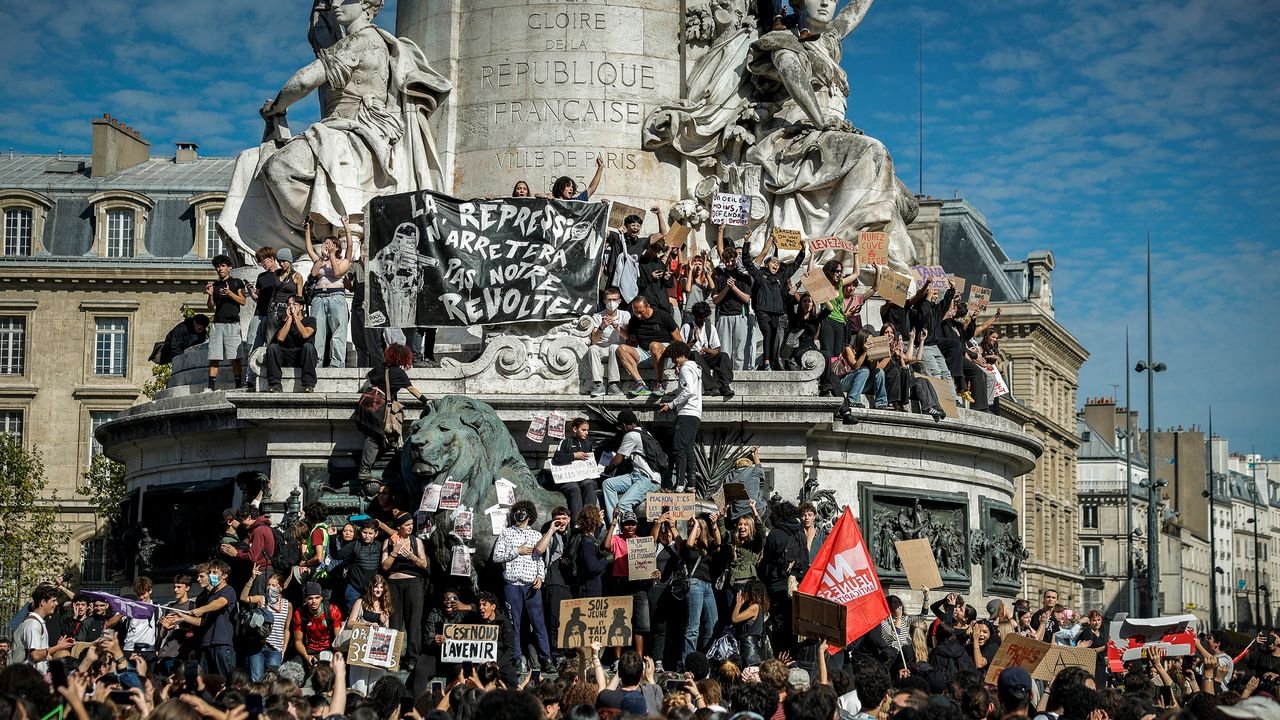
In May of 1968, student protesters imagined a future of poetic discovery—“Sous les pavés, la plage!” (“Under the pavement, the beach!”) their famous slogan went. In the Gen Z revolt that some students have labelled “May ‘six seven,’ ” their rallying cries are more direct. “MACRON, FUCK YOUR PROF, NOT OURS,” with its brutal jab at the President’s marriage to his former drama teacher, is emerging as a favorite line, along with “TOO YOUNG TO BE LISTENED TO / OLD ENOUGH TO BE TEAR-GASSED” and, deliciously, “BISMILLAH, C’EST LES TENÈBRES,” quoting an undercover cop’s rumored attempt to pose as a protester on Snapchat using what he thought sounded like youth slang.
The sociologist Paolo Stuppia, a co-author of “The Geopolitics of Youth: Engagement and (De)mobilization,” explained that previous major student movements—such as a 2006 uprising prompted by a law that allowed employers to fire workers under twenty-six without cause—centered on opposition to specific policies. This time, with the French government under severe fiscal pressure and straining to fund public services, students are “making offensive claims, not just defensive claims,” he said. Their demands are extremely clear. They want repairs to insalubrious buildings (rats, roaches, puddles), reduced class sizes (France has the largest in Europe, with seventy per cent of lycée classes counting more than thirty students), and the hiring of more teachers (middle- and high-school students lost as many as twenty million class hours last year, owing to staff shortages). They want a shorter, more efficient school day. They want an overhaul of Parcoursup, a widely loathed college-admissions system, introduced in 2018.
Their concerns have failed to impress certain observers, such as the center-right deputy Philippe Juvin, who recently declared that they should “get back to work,” like “their little friends in China.” Are the students just “slackers,” as Marion Maréchal—a French member of the European Parliament and the far-right leader Marine Le Pen’s even harder-right niece—put it? Is the movement the result of “out of control mass migration” and “Islam,” as Donald Trump claimed, in a particularly unfounded bit of racist refrigerator poetry? Most French people don’t think so. According to a poll commissioned by Le Figaro, some sixty-two per cent believe that the students’ actions are justified. In Bordeaux, farmers showed up at the barricades with breakfast—bread, jam, and apple juice. (“Only terroir products,” one volunteer boasted.) In the Tenth Arrondissement of Paris, near the Canal Saint-Martin, a mural appeared, seemingly overnight, depicting the lycéens as heroic revolutionaries in a style that seemed equal parts Delacroix and Dragon Ball.
The government, focussed on unrest among struggling farmers and car owners facing surging gas prices, not to mention on the debt crisis, didn’t see the student movement coming. Emmanuel Macron’s experience of public education is limited. He graduated from a private Catholic high school before completing a few years of college prep at the renowned Lycée Henri-IV; his wife taught for years at the exclusive Lycée Saint-Louis-de-Gonzague, where her students included the children of the L.V.M.H. chairman Bernard Arnault, the richest man in France. Even Macron’s current minister of education, Édouard Geffray, has admitted that at least some of his five children attend private establishments. But plenty of people closer to the ground saw a crisis in the making. Marc Rosmini, a philosophy teacher at Lycée Antonin-Artaud, in Marseille, told me that the movement struck him as “sane” and “logical,” and that he’s surprised it didn’t happen sooner. In June, high schoolers sat for the bac, the all-important senior-year exam, amid record-breaking temperatures. (One school set up desks in an underground parking lot, in an attempt to cool students down.) It was not lost on French youth that these conditions were linked to climate change, nor that administrators had taken practically no serious action to ease its effects in their classrooms. Rosmini told me, “It’s a bit like in Spike Lee’s ‘Do the Right Thing.’ The heat wave was the drop of sweat that made the vase of what they could tolerate overflow.”
Another drop came this September, when lycéens went back to school after the summer break and were confronted with a new rule: no phones inside the school building. The rule was based on solid evidence about phones’ effects on concentration and cognition, but it was unpopular with students, who found it infantilizing and inconvenient. The ban may have had the unintentional effect of spurring them to action. A teacher who manages the library at a lycée in Marseille told me, “It gave them back some brain space to think about what was happening and to talk about it with their friends, instead of being on their screens.” The unofficial anthem of the blocus is the French-Vietnamese producer Nodey’s “No Title,” a jaunty yet martial piece of electronic music that originally accompanied a 2015 short film about a young man who has to learn to live without technology.



