
When French designer Louis Réard debuted the bikini on July 5, 1946, he imagined the public’s reaction to the revealing swimsuit would be huge. He named it the bikini because, just four days earlier, the U.S. had conducted its first nuclear test at Bikini Atoll in the Marshall Islands. The international reception of his new two-piece, he thought, would be just as explosive.
The U.S. had taken military control of the Marshall Islands — made up of five islands and 29 coral atolls in the central Pacific — from Japan during World War II. News of the detonation had indeed spread across the world, appearing in newspapers like The Sydney Morning Herald, Le Monde and the New York Times. “There was not much room in anybody’s thoughts yesterday for anything but the fantastic test at Bikini,” one New York Times story, written on the day of the first test, read. These tests — 67 in total across the Marshall Islands — continued for more than a decade, until 1958.
Largely absent from the news accounts, however, were the Marshallese people, who’d lived on the islands for generations, caring for the land and navigating the surrounding seas.
Screenshot from the 2025 documentary Kōmij Mour Ijin / Our Life Is Here
After residents of Bikini and Enewetak atolls were forcibly removed and relocated, Marshallese communities saw their homelands devastated as nuclear blasts vaporized entire islands and destroyed marine ecosystems, leaving behind giant underwater craters. Radiation-related injuries and illnesses like skin lesions, hair loss, thyroid disease and cancer soared among those exposed to the fallout. The atolls became dangerously contaminated, which continues to prevent permanent resettlement at Bikini and restrict the use of parts of Enewetak eight decades later.
But now these stories — not only of nuclear devastation, but also of culture and resilience — are at the center of a campuswide art and climate project at UC Berkeley.
Presented by Berkeley’s Environmental Arts and Humanities Initiative, Kōmij Mour Ijin / Our Life Is Here at UC Berkeley includes exhibitions and installations across campus, a documentary screening, public talks and tours, a community planting workday and courses exploring nuclear testing, colonialism, climate change and Marshallese culture.
“This project focuses in particular on how ecological issues meet nuclear issues meet decolonial issues,” said Shannon Jackson, a Berkeley professor of rhetoric and of theater, dance and performances studies and faculty director of the Environmental Arts and Humanities Initiative. “It’s exploring what happens when you’re in a context that is enduring the legacies of nuclear testing at a place that is also enduring high sea level rise and other types of environmental degradation. We are especially interested in how the arts can be a vehicle for exploring and expressing these conditions to a wider global community.”

Jami Smith/UC Berkeley Library
Kōmij Mour Ijin / Our Life Is Here at UC Berkeley grew from a collaborative artmaking voyage in 2023. For two weeks, a team of 30 artists, writers, scientists and filmmakers from across the world, including Marshallese elders and youth, traveled 450 nautical miles through the Marshall Islands aboard two vessels. Together, they visited five atolls, including Bikini, to honor the Marshallese people’s enduring relationships to the land and ocean; along the way, they created work about the lasting effects of U.S. nuclear testing and the rising seas now threatening the islands.
Canadian filmmaker Jordan Dozzi-Perry was part of the expedition, his first time visiting the vast island nation. Living on the water for two weeks, he said, brought him into a new reality.
“The Marshall Islands, their ocean territory is four times the size of California,” said Dozzi-Perry, who’s based in the Bay Area. “You’re in a water world. It’s a totally different way of existing. Seeing the beauty, then always having to confront the horror that went on, it was surreal. It puts you in dialogue with nature and people and this deep time that’s really remarkable.”

Screenshot from the 2025 documentary Kōmij Mour Ijin / Our Life Is Here
During the expedition, Dozzi-Perry captured every moment he could. He filmed live poetry readings and performances by Marshallese artist Kathy Jetn̄il-Kijiner and youth artists from her organization, Jo-Jikum. He filmed British environmental artist Michael Pinsky dropping fossilized mammoth teeth into the Bravo Crater, created by the 1954 Castle Bravo nuclear blast. He scuba dived into the crater with American photographer Michael Light, moving quietly among sharks, protected in the islands’ waters by a nationwide shark sanctuary. At the bottom, once barren, corals have begun to grow again.
“You have this reverence for these life forms that have existed far longer with the ocean and with the planet in that state than humans,” Dozzi-Perry said. “Time is just totally different out there: This is the fabric of time on a geologic level that you’re just bearing witness to. It really puts you in your place as a small part of a greater whole in time and space.”
From the expedition came David Buckland’s stunning 2025 documentary Kōmij Mour Ijin / Our Life Is Here, which recently screened at UC Berkeley Journalism. It also gave rise to other artworks now appearing across Berkeley’s campus.
The project’s exhibitions began in August at the Berkeley Art Museum and Pacific Film Archive with a teaching gallery, where a series of artworks from BAMPFA’s collection invites visitors to reflect on humanity’s shared responsibility to care for the Earth.
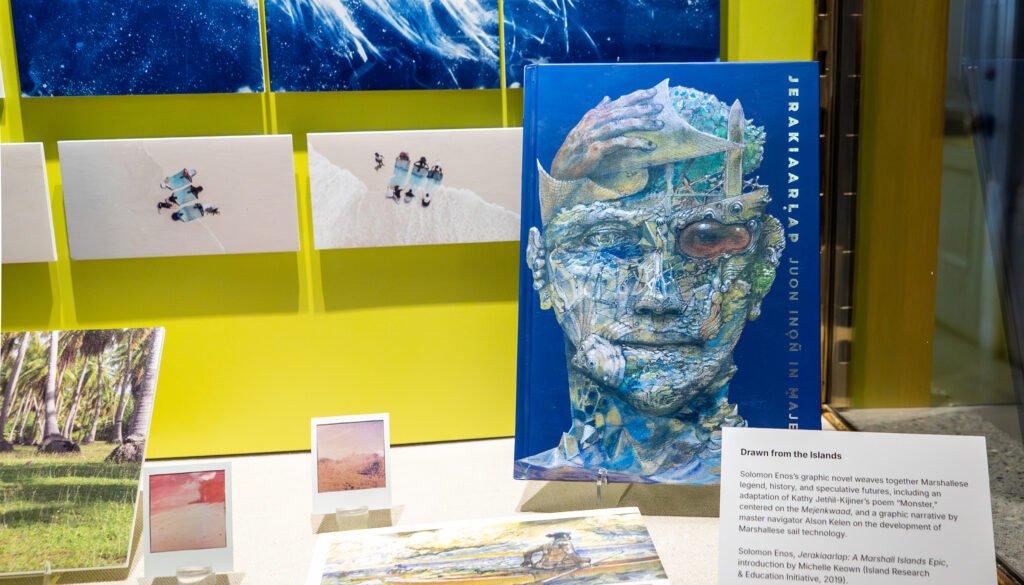
In early September, a photography installation by Mark Klett, with text by William L. Fox, opened in Giannini Hall, depicting remnants of nuclear testing alongside scenes of everyday Marshallese life. Later that month, an exhibition opened in Doe Library’s Bernice Layne Brown Gallery, where visitors can see reproductions of works made during the voyage, as well as rare books and photographs from Berkeley’s library collections. And a temporary site-specific installation at Memorial Glade displayed film stills of Jetn̄il-Kijiner embodying the mejenkwaad, a figure from Marshallese legend.
Most recently, a compilation of four video art pieces by Jetn̄il-Kijiner, Light, Buckland and Pinsky opened in early October at VIDRINE, a video exhibition space adjacent to the Worth Ryder Art Gallery.

Michael Light and Jordan Dozzi-Perry
For Jackson, the campuswide project is meant to be a beginning rather than a conclusion. She hopes it will deepen Berkeley’s relationships with Marshallese artists and scholars and extend Pacific Islands teaching and research — giving Pacific Islander students a chance to see their histories and futures reflected on campus. And she hopes it’ll prompt Berkeley to think deeply about its own role in the history of nuclear weapons development and the responsibilities that come with technological innovation.

Elena Yu/UC Berkeley
“A huge element of what it means to bring this to Berkeley is to be reckoning with our own history, our own accountability to the nuclear industrial complex,” said Jackson.
Throughout the academic year, Jackson’s team at the Environmental Arts and Humanities Initiative will be sponsoring more events, courses and opportunities for faculty and student engagement, anticipating the arrival of the full Kōmij Mour Ijin / Our Life Is Here exhibition at the David Brower Center in fall 2027.
Jackson says additional campus groups and scientific communities have reached out to collaborate since the project opened in September, including researchers at Lawrence Livermore National Laboratory.
“There are many benefits to new technologies, but of course there are unintended consequences,” said Jackson. “It’s important that we think about the ethics of invention, the ethics of innovation and what our accountability is now. Many of our Bay Area scientific colleagues and researchers in Pacific Island Studies want a deeper reckoning with that history. We hope that the arts can propel that process for us all.”
Learn more about Kōmij Mour Ijin / Our Life Is Here at UC Berkeley and see a complete list of related events, exhibits, installations and programs.



