
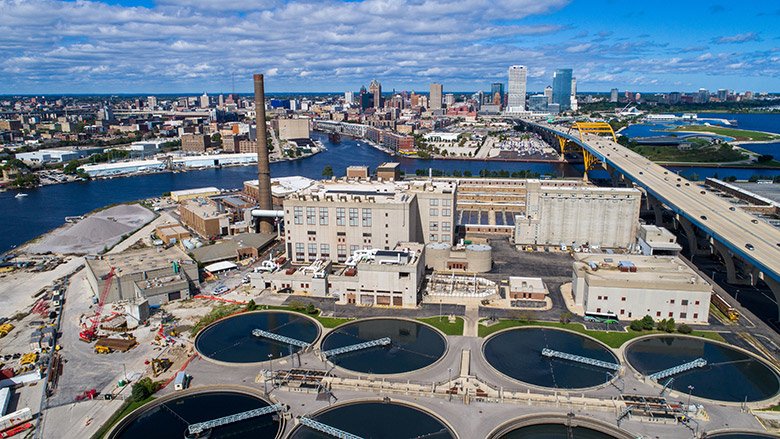
The Milwaukee Metropolitan Sewerage District awarded a $700-million, 10-year operations and maintenance contract on Sept. 28 to Dallas-based Jacobs Solutions, but its longtime contractor, Veolia Milwaukee, has filed a lawsuit against the agency seeking a temporary restraining order and preliminary injunction before the contract is executed.
The lawsuit, filed in September in U.S. district court in Milwaukee, alleges that the agency’s competitive procurement process, which took place over two years, was predetermined and unfairly structured to favor Jacobs for the new operations and maintenance contract, planned to start in March 2028.
U.S. District Judge Brett Ludwig this month paused finalization of the contract until the lawsuit is resolved.
In the lawsuit, Veolia states it has managed district operations and maintenance since 2008 in what it terms the largest public-private water partnership in North America. The scope includes operation and maintenance of two water reclamation facilities with combined capacity of 630 million gal per day, a 361-mile collection system, biosolids production and the 500-million gal Deep Tunnel storage system. Veolia’s current contract is valued at $500 million.
Veolia’s complaint argues that the district’s RFP process did not actually select the winning bidder based on the stated criteria. Instead, it claims the request was used to give the appearance of competition while implementing a decision the defendant had already made or was predisposed to make. Additionally, the company alleges that advocacy groups and elected officials began campaigning against it in early 2026 and sought to influence the procurement.
Common Ground of Southeastern Wisconsin, a non-partisan advocacy group, notes on its website that it investigated allegations of mismanagement of the wastewater management system by Veolia and that it interviewed current and former employees of the company and district, reviewed hundreds of pages of public records and consulted experts, stakeholders and public officials. Former district Director of Intergovernmental Relations Steve Jacquart, who served in the position for 19 years, later identified himself as the first whistleblower and joined Common Ground’s campaign, and other former agency and company employees then came forward with allegations about the firm’s management of the wastewater system.
Common Ground alleges that Veolia failed to properly maintain equipment, falsified water quality reports, performed inaccurate sewage dumps, failed to provide safe worker conditions, did not maintain proper staffing levels and employed unqualified persons. Also, the organization alleged district staff did not properly monitor Veolia’s management of facilities.
Trading Arguments
Responding to those allegations in May, Veolia Senior Vice President Adam Lizberg said in a statement that the “company stands firmly behind the performance and integrity of our team, operating an extremely complex system under rigorous regulatory oversight to meet [agency], state and federal standards,” according to Urban Milwaukee.
He added that “Veolia encourages all employees to report any workplace concerns, even anonymously, whether directly to their supervisors or through additional channels we’ve established to report issues without fear of retaliation.”
The district has denied Veolia’s allegations that it manipulated its procurement process to favor Jacobs Solutions.
In response to the lawsuit, rhe district says the RFP established four criteria for evaluating proposals: pricing (60%); company’s overall approach (25%); staffing, training and corporate culture (10%); and regional partnership (5%).
The district confirms that its ad hoc committee recommended Jacobs on Aug. 17, giving the firm 96.8 points compared to Veolia’s 84.9. It also acknowledges substantial differences in proposed sewer-cleaning prices. For one category, Jacobs proposed $5.54 per linear foot compared with Veolia’s $54. The distrct says it evaluated Jacobs’ rates against recent bids for similar work and found its pricing reasonable.
The Jacobs overall bid was $54 million lower than Veolia’s.
At a meeting in 2025, Veolia asserts that district Executive Director Kevin Shafer told the committee it would compare proposal pricing line-by-line specifically to screen out unrealistic, below-market rates: “So if someone undercuts one or overcuts one, we’ll compare line items, then to make sure that we feel comfortable with whoever we select,” he said.
Wisconsin law does not allow an unsuccessful bidder to recover damages for losing a public contract, meaning its only meaningful remedy is to stop the award before the contract is signed and work begins, Veolia notes.
The district argues that Veolia’s lawsuit should be dismissed because procurement decisions involve discretionary governmental functions protected under Wisconsin law. It says Veolia has failed to identify a law that the district violated, that Wisconsin law does not prohibit public input into government procurement decisions and that no law requires the district to restart the procurement process.
Jacobs Solutions’ bid for the contract also did not go entirely smoothly after its relationship with Palantir Technologies became a point of controversy.
Jacobs initially proposed using Palantir’s technology but later agreed to remove the company following objections from community organizations about the tech firm’s work with U.S. Immigration and Customs Enforcement (ICE), including providing data used in immigration enforcement.
The district serves 29 communities across a 423-square-mile area in southeastern Wisconsin.
Jacobs said in a statement that it “appreciates the confidence and trust the Milwaukee Metropolitan Sewerage District, its commissioners and the ad hoc committee have placed in us, and we look forward to the work ahead, working side by side with MMSD.”
Source: www.enr.com



