
Joel Veach is the writer-director of the desert noir American Muscle. In the piece below, he explains how he shot the scrappy feature in 12 days.—M.M.
It’s Day One of a 12-day shoot.
Brendan Sexton III and Gbenga Akinnagbe (two actors whose work I’ve followed for years and whom I deeply respect) are driving a 1984 Caprice through the winding roads of Soledad Canyon on their way to our first location for the first shot of my first feature film, American Muscle.
Only thing is… we don’t really have a location. At least not one that we paid for. We’re having them drive to an area we have in mind that we’re not even sure we’ll be able to use. That is, of course, because we intend to steal the location—err—borrow it momentarily.
Of course, my actors don’t know this. They’re professionals, and damn good ones at that. They’re in character as they drive, going over their lines, dressed in off-the-rack Circle S suits from a local western wear store. I need them to stay in the zone. Plus, it’s my first film, and the last thing I want them thinking is that I’m just winging it or have no idea what I’m doing.
When we finally arrive at our destination (a desert country backroad), we unload the gear from the back of a beat-up Suburban. Skeleton crew ready to roll. We inform the actors that there might be some traffic and, if so, that we will need to cut and reset. Shouldn’t be a problem, though, as this seems like an abandoned road. What could possibly go wrong?
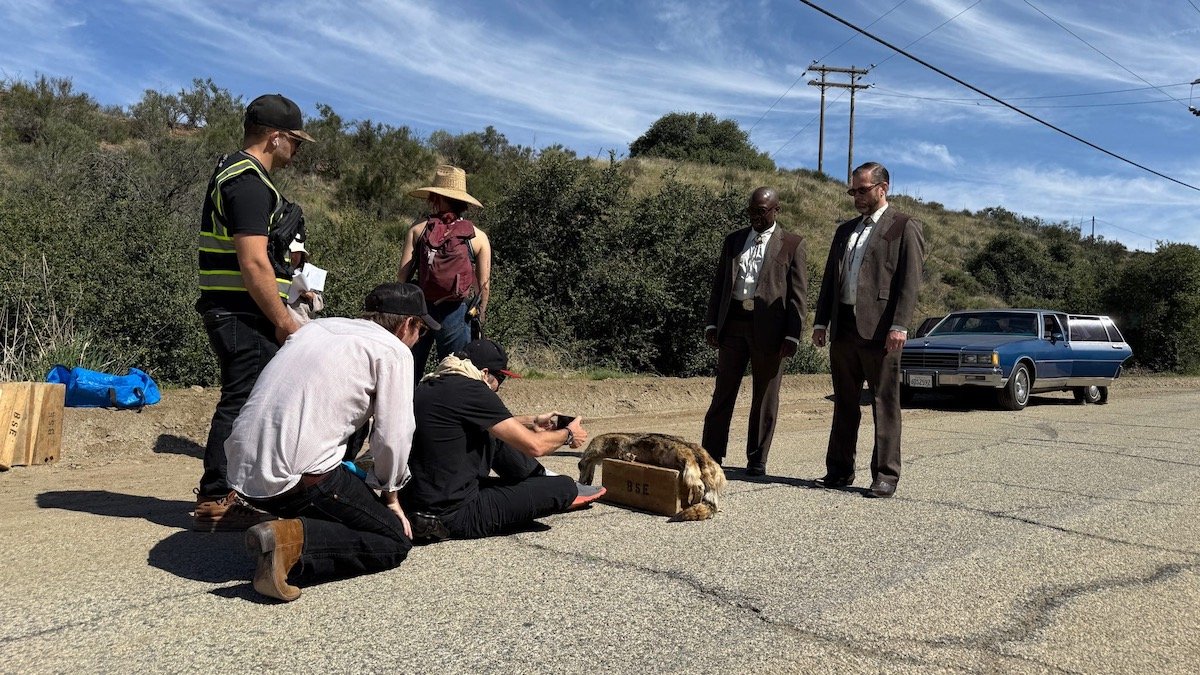
The scene is simple. Brendan and Gbenga play two debt collectors. They drive down a road and come to a stop. They exit the car and slowly approach what appears to be an injured coyote. They make some small talk about how they think the coyote got there, then remark on how it’s sunny and going to be a beautiful day and so on and so forth… Easy.
Now, on a low-budget production, there are many constraints, like having to borrow locations when necessary and also trying to figure out how to film an injured coyote.
Sadly, a coyote wrangler was not in the budget. Nor was an animatronic coyote. Or a puppet coyote.
So we did what any other scrappy and gritty independent crew would do when shooting a desert noir crime film without a lot of money when an injured coyote was needed: we had our amazing production designer, Casey Rose Daniel, buy a real coyote pelt off of Amazon — I know it sounds messed up, but it’s true, and you can do it.
Then we had our equally amazing art director, Izzy Ricker, cover it with some fake blood, put the pelt over her arm, and open and close her fist to make it appear as though there was a real animal there breathing.
Finally, we had our very talented cinematographer, Alex Vendler, put it all together by positioning the camera low to the ground, and voilà—you have it all in one shot: the pelt in the bottom of the frame, the fellas in the background pulling up in the Caprice, parking, exiting, walking, talking. Cut.
Of course, we had to do this several times and cut mid-take because, of course, there were several cars that decided to use the same goddamn abandoned road in Acton, California that we were using. But, hey, we got the scene (just barely), and it’s one of my favorites in the film because of what we went through to get it.
Being there with our crew, making decisions on the fly, and getting it done taught me a very valuable lesson as a first-time filmmaker: a film can only ever be as good as its cast and crew allow it to be.
But how do you find those people? Well, in my experience, you need a great producer who can put the right pieces together.

Enter Nathan Crooker.
Nathan is a talented filmmaker himself: he can write, act, edit, produce, direct—and for our production, he was like having a Swiss Army knife on set. Reliable and ready for anything. His help, along with that of our incredible line producer, Christy Soeder, was what allowed me to focus on doing my job—which was to tell the story to the best of my ability.
He was also instrumental in helping to cast the film. We did not have money for a casting director, so we had to do it ourselves. Nathan ran point on speaking with managers and agents, as well as negotiating contracts.
At the end of the day, we got lottery lucky with our actors. All of them are amazing in the film, but the four leads of David Thompson, Liana Wright-Mark, Brendan Sexton III, and Gbenga Akinnagbe are what give it its heart and soul. Hire the best actors you can find—they’re worth their weight in gold.
Joel Veach on Funding American Muscle

Speaking of… let’s talk money. Because finding the financing for your film feels a lot like trying to climb Everest without a rope, a jacket, or a Sherpa.
In other words—almost impossible.
Almost.
So… How did we find the money? I had written a film called Old Man, directed by Lucky McKee and starring Stephen Lang. I found some equity for that film through some family and friends. They made their money back (plus a little extra) and put it into my next project—American Muscle.
How did we shoot a low budget indie in 12 days?
We paid everyone scale and kept our locations to a minimum — the majority of the film was shot at Tranquility Canyon Movie Ranch, run by Scott Lewis. For example, there are two scenes that take place in two different living rooms. For one of them, we used Scott’s actual living room. For the other? We used our holding area and had Casey Rose Daniel and her team build the set for one day — then tear it down because we needed a place to eat. We simply didn’t have the time or resources to find another location. Over the course of our shoot, we only had two company moves. Saved us a lot of time and money.
Look, there are a million obstacles that will be in your way as you begin the journey to making your film, especially as a first-time director, and finding the money will be, without question, one of the harder hills to climb. But I would argue that equally as important as how you find the money is how you find your crew. Because at the end of the day, the most important pieces on a film set are those individuals you surround yourself with. Big-budget film with lots of unhelpful people running around? You’re broke. Low budget indie with people you care about and who care about your film? You’re rich.
That, and you’ll never have to worry about how to film an injured coyote on a stolen location.
American Muscle is now on the festival circuit, and you can follow its progress here. And you can read more of our film festival coverage here.
Main image: (L-R) Evan Coniglio, Shadia Sepehrnia, Joel Veach, Alex Vendler, Izzy Ricker, Gbenga Akkinagbe and Brendan Sexton III prepare for the coyote scene in American Muscle. Photo by Nathan Crooker



