
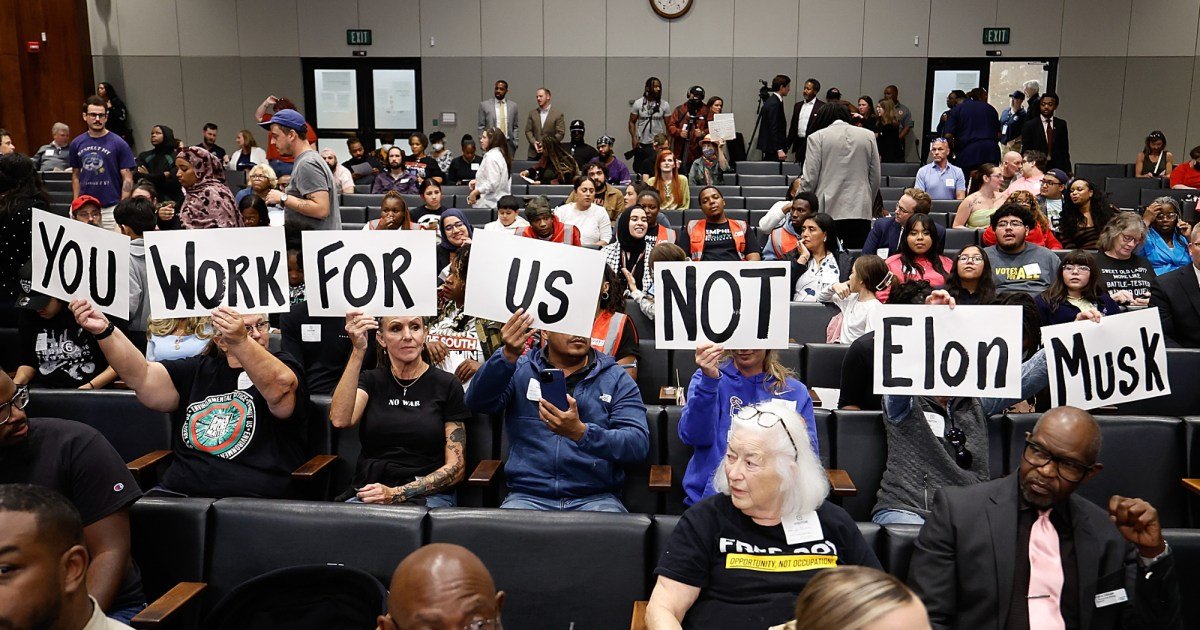
Protesters hold signs at the Memphis City Council meeting on October 20.Justin Ford/Getty
The Memphis City Council narrowly failed to pass an 18-month data center moratorium Tuesday night, but instead approved a 135-day development pause. Elon Musk’s xAI has claimed the city as its “home,” building three hyperscale AI data centers in the Memphis metro area and looking to expand further. But the people who live there have spent the past year suing the billionaire’s company, organizing their communities to get xAI out, and pushing for a moratorium—a push that feels all the more urgent in a city with a long history of environmental racism.
The crowd at Memphis City Council on Tuesday night spilled out the door, undeterred by “enhanced security measures” like a clear-bags-only policy and strict prohibition on noise-making devices.
“We demand representation that chooses us, the people, over the profits of a billionaire’s experiment.”
Tennessee state Rep. and Democratic congressional nominee Justin Pearson, who is running to represent Memphis, joined the meeting—though he was thrown out of City Council only weeks ago after advocating for a data center moratorium. Pearson and five other Memphians had committed “decorum violations,” the council had alleged, by chanting into a megaphone.
That moratorium vote, delayed twice, was rescheduled for October 20. And after suing the City Council on First Amendment grounds and winning a temporary restraining order, Pearson returned to speak in favor of pausing all data center development in Memphis. So did several hundred others.
“If you are for a data center moratorium, would you please stand?” asked Justin Pearson’s brother KeShaun Pearson, president of the nonprofit Memphis Communities Against Pollution.
Most of the room rose, some holding signs reading “Vote Yes To Data Center Moratorium” and “Jesus Would Vote Yes On The Moratorium.” Like many speakers, Pearson brought up respiratory illnesses in his family that he says are aggravated by the gas turbines that power xAI’s Colossus, one of the world’s largest data center clusters.
“If you have never rushed your family to a Walgreens to get an inhaler to save their lives, you don’t know what it’s like for people to struggle to breathe,” Pearson said. “Our most socially vulnerable communities continue to suffer with COPD and respiratory illnesses. We demand representation that chooses us, the people, over the profits of a billionaire’s experiment.”
At the last minute, a pair of city council members introduced a new ordinance: one that would pause data center development for 135 days, not 18 months. There was only one problem: “Nobody’s read it,” Justin Pearson said.
“They haven’t given the public any time to read this ordinance. It doesn’t have any input from the public, and the people up there haven’t even read this ordinance,” he said. Nonetheless, only the 135-day moratorium motion passed; the 18-month moratorium failed on a 6-6 tie.
“I think we failed the citizens of Memphis tonight and what they have been asking for, so it’s really disappointing,” council member Jerri Green, who sponsored the 18-month freeze proposal, told CNN. “We had hundreds of people packed in there that waited for hours. This is the third reading. They’ve been pushing for this for over a year; they’re the people who are being deeply impacted by these environmental hazards.”
Justin Pearson blamed the Greater Memphis Chamber of Commerce, which has been trying to rebrand the city as the “digital delta” to attract more big tech companies. That branding has led some businesses in the city to market directly to xAI employees. Dozens of Memphis-area Airbnbs are now advertised as “minutes away from xAI.”
“We’re committed to expanding alongside this community and doing what’s best for the city,” xAI’s senior infrastructure manager Brent Mayo said in March 2025. “As we transform this property and enhance our facility, we’ll bring more employment opportunities and economic growth to the area.”
But people who live near the facilities see little upside. Boxtown, the majority-Black neighborhood adjacent to Musk’s Colossus I, faces cancer risks from air pollution four times the national average. It leads the state in emergency room visits for asthma.
Boxtown, which was established by formerly enslaved people shortly after the Emancipation Proclamation, has long been neglected by the city. Basic services like water, sewage, and electricity had not made it to many Boxtown homes by as late as 1975. “Our sidewalks are still incomplete,” one speaker at the October 20 meeting said.
Now, as the residents of Boxtown and nearby Whitehaven fight data center expansion, they’re up against the world’s richest man—and the US Department of Justice, which submitted an unprecedented motion backing xAI in a Clean Air Act lawsuit brought by the NAACP this summer. The suit, filed by NAACP lawyers, contended that xAI should owe more than $100,000 a day in civil penalties for violating the Clean Air Act by building unpermitted gas turbines just across the state border in Southaven, Mississippi.
Though Memphis did not pass a full moratorium, the city’s fight against xAI isn’t over. On October 19, a federal district judge denied the US Department of Justice’s attempt to dismiss the NAACP’s citizen suit. “The Trump Administration has gone out of its way to shield Elon Musk’s company, xAI, from liability and to deny local communities their right to protect themselves against illegal pollution,” said Laura Thoms of Earthjustice, one of the groups that brought the lawsuit. “We look forward to presenting our case before the District Court.”
For Justin Pearson, the congressional candidate thrown out of City Council for demanding a moratorium, the battle is only beginning. “We’ve got a congressional race that we’re going to win, and a moratorium that we will pass in the United States Congress,” he said. “We need new leadership, because this leadership has sold us out.”



