
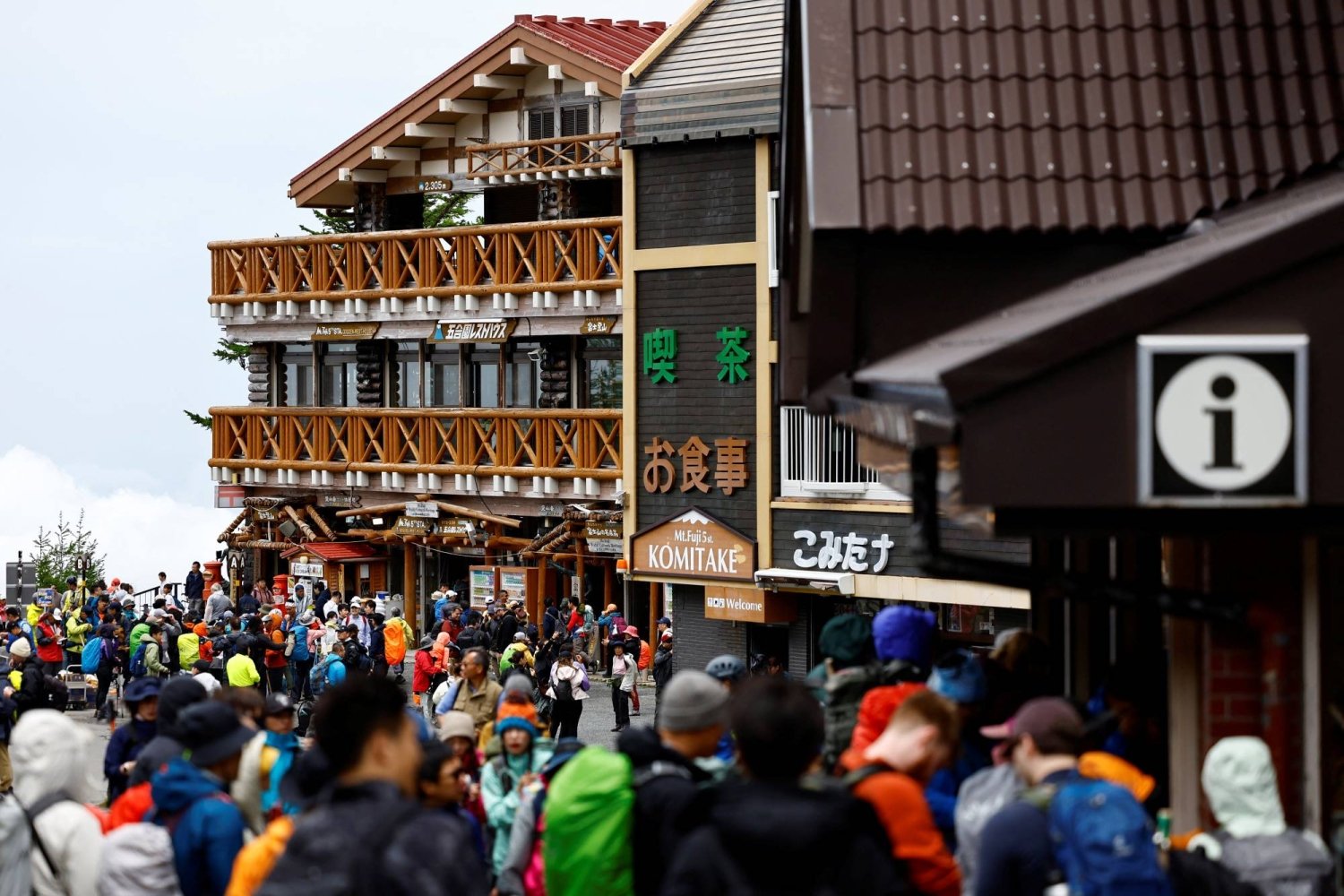
Mount Fuji attracts thousands of foreign tourists each year, but many forget that Japan’s highest peak is an active volcano. With the risk of an eruption ever-present, a critical question looms: how could such visitors be evacuated safely in the event of a disaster?
On Thursday, around 150 participants from local governments, national ministries, transportation companies, airlines and foreign embassies convened in the gateway town of Fujikawaguchiko, Yamanashi Prefecture, to examine this very question.
“While tourism brings economic benefits to our town, I believe we cannot simply celebrate those benefits without recognizing the enormous challenges involved in ensuring that tourists can evacuate safely,” said Fujikawaguchiko Mayor Hideyuki Watanabe.
The group conducted a tabletop drill, simulating an event where the Meteorological Agency raised the volcanic alert level for Mount Fuji to Level 3 on its five-level scale, restricting entry to the mountain and prompting climbers to descend and tourists to leave the area.
Under the scenario, which assumed a busy Saturday afternoon in July, approximately 2,000 international tourists were stranded around Kawaguchiko Station.
Group participants examined how the tourists could be evacuated using buses and sightseeing boats, before being assisted with onward travel to airports and eventually their home countries.
Discussions also covered how to prevent transportation hubs from being overwhelmed by both local residents and foreign visitors seeking to flee simultaneously.
Officials said a sightseeing boat could carry approximately 150 passengers and cross the nearby lake in around 15 minutes, potentially providing an alternative to roads congested with evacuees.
On the issue of language barriers, officials from the internal affairs ministry raised VoiceTra, a free translation app that supports 33 languages, as a potential solution.
But the app, developed by National Institute of Information and Communications Technology, relies on cloud services, raising questions about its effectiveness if internet services and other communication infrastructure are disrupted.

“If an eruption occurs … and roads get congested and people can’t evacuate … it could become a terrible disaster,” Toshitsugu Fujii, geoscientist and chairman of the working group, warned. “We need to address these challenges in advance.”
| Jessica Speed
The working group also reviewed how to coordinate and communicate effectively with embassies to help foreign nationals return to their home countries.
Geoscientist Toshitsugu Fujii, chairman of the working group, told reporters following the exercise that coordinating the evacuation of large numbers of foreign visitors was a challenge that could not be resolved by individual municipalities or prefectures alone, calling for greater involvement from the national government.
“If an eruption occurs … and roads get congested and people can’t evacuate … it could become a terrible disaster,” Fujii warned. “We need to address these challenges in advance.”
The Yamanashi Prefectural Government plans to compile the issues identified during the exercise and consider how the findings could be reflected in its disaster prevention plans.



