
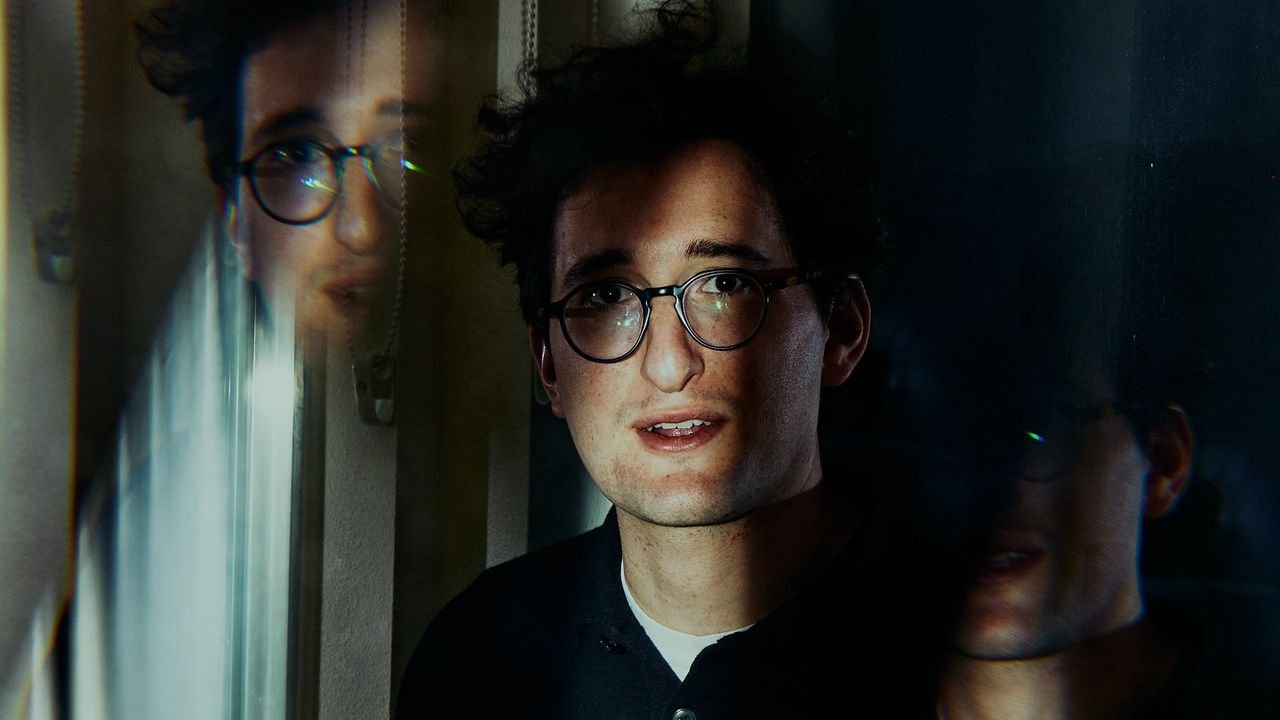
It’s funny, and it’s really nice, [how] people are talking about You Can See Everything as this boundary-pushing thing, which is cool. Thank you. That’s awesome. But I’m also like, maybe the thing that is boundary-pushing about it is having Elizabeth Holmes as a subject. She’s endlessly fascinating. The actual form of the movie is closer to the oldest form of documentary filmmaking, the observational vérité movie, a movie also where one of the directors becomes an on-screen presence, like a Michael Moore or Ross McElwee movie. The use of reenactments later in the film, Errol Morris did that in The Thin Blue Line. So actually it feels like we’ve made a jumbo purely out of responding to what was in front of us, with all of the basic tenets of documentary cinema.
I didn’t need to create something that felt like an adornment or some sort of embellishment or artistic commentary with the sort of film grain. That’s what I’ve done on my other projects. I wanted to create something that just really transported the audience into the room, really made them feel what we felt when we were there, this really intense cognitive dissonance where Nathan and I could not agree on any given moment.
Nathan wasn’t on camera yet, but Elizabeth and Billy kept asking Nathan questions and almost seemed like they were drawing him from behind the camera, in front of the camera. And at the end of the first day, I was like, “Nathan, I’m sorry. I failed you, man. This doesn’t work. You’re right. We’ve got to do something new.” So then we brought in two cameras, both on 25 to 250 lenses. We would identify parts of the house that could essentially give David Bolen, my DP, and Jonathan Mitchell, our camera operator who’s worked with Nathan on everything, a full range of possibilities of seeing and being able to capture almost everything. And we would shoot for 16 hours a day. And I kept saying to David and Jonathan, “Listen, we’re in a confined space. I think we’ve got to change the aspect ratio from something wider screen to something smaller, like a 4:3.” Because the whole movie, the things that interest me are the micro expressions, these moments where you’re just trying to decipher what is going on between two people.” So we started doing that. But then I realized, “Fuck, I’m missing more stuff, because when you’re that tight on someone’s face, you’re not seeing everything around them.” So then, maybe at the end of the first week or a little bit sooner, we brought in a wide camera, basically a 12-millimeter lens on a third camera body, which is what I operated. That was the camera that I was behind for the majority of the movie, but especially in those first 34-ish days. And I really feel like we broke new ground, Nathan and I. It feels unlike anything either of us have ever made before, but somehow also the perfect fusion of his aesthetic and thematic sensibilities and my own, with my team.



