
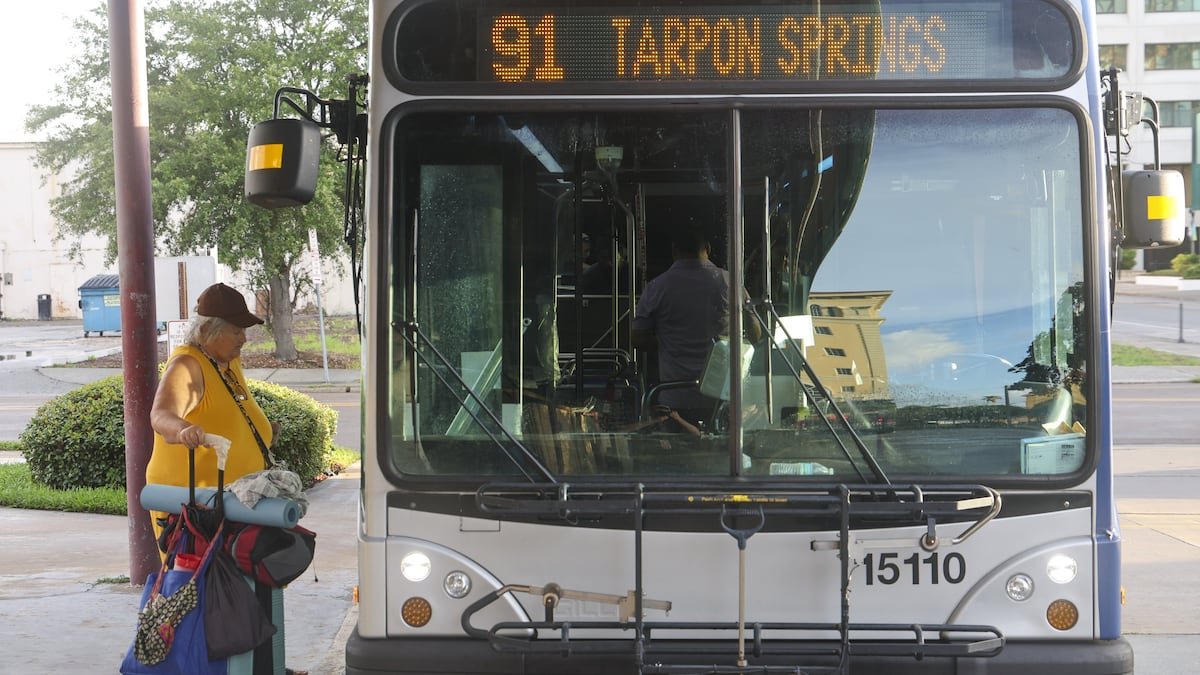
In June, Hillsborough’s transit agency cut three routes in the outer reaches of the county, leaving the few riders who rely on those buses in search of other options.
Now Tampa Bay transit agencies are warning: Amendment 3, a state proposal that would lower the amount residents pay in property taxes, would make those cuts seem trivial.
Should the proposal pass, transit budgets would crater. Most of Hillsborough’s bus routes would become shorter or stop less frequently, according to a presentation prepared by transit authority staff. Six would go away entirely. Nearly 200 bus drivers could lose their jobs. The cuts would affect both urban Tampa and the rest of the county, cutting off nearby access to a bus route for an estimated 70,000 people.
Pinellas’ transit authority, which cut one route earlier this year, said more than half of its routes, particularly those with lower ridership, could be on the chopping block, should Amendment 3 pass.
It’s not uncommon to meet Tampa Bay residents who haven’t dared to board a county bus. The sprawling region’s public transit is sparse. The two largest bus agencies are significantly underfunded per capita compared to peers across the country, a Tampa Bay Times analysis in 2025 found. Riders on low-volume routes may spend a half-hour craning their neck down the road waiting for a late bus, sometimes with nothing but a pole in the ground to offer reprieve from the beating sun.
Amendment 3 would increase the homestead property tax exemption from around $50,000 to $150,000 in 2027 and to $250,000 in 2028. The amendment also lowers how much the assessed value of non-homestead properties, such as second homes and rentals, can increase each year, from 10% to 5%. The move could mean big savings for homeowners. It would also mean a significant drop for local government budgets.
!function(){“use strict”;window.addEventListener(“message”,(function(a){if(void 0!==a.data[“datawrapper-height”]){var e=document.querySelectorAll(“iframe”);for(var t in a.data[“datawrapper-height”])for(var r,i=0;r=e[i];i++)if(r.contentWindow===a.source){var d=a.data[“datawrapper-height”][t]+”px”;r.style.height=d}}}))}();
Hillsborough’s and Pinellas’ bus agencies are largely funded by a fraction of property tax collections. The owner of a $200,000 home in Hillsborough County pays around $100 each year to the transit system. A Pinellas homeowner would pay closer to $140 for a $200,000 home.
“Amendment 3 is going to decimate the heart of HART (Hillsborough Area Regional Transit Authority),” said Tampa City Council member and former agency chair Luis Viera. “We’re talking about an agency where we don’t have any more money to cut.”
Hillsborough Commissioner Josh Wostal, who supports the property tax proposal and has proposed a new Tampa-only transit authority, downplayed concerns about Amendment 3’s effects. After all, he said, Hillsborough has already cut back service under the current system. It’s a sign that transit shouldn’t be funded by countywide property taxes, he said.
“We need to focus on moving it to a new, creative model,” Wostal said.
The prospect of cuts to transit has teed off an age-old, chicken-or-egg debate. Is Tampa Bay’s urban growth hampered by a lack of transportation options, or is the region too sprawling to warrant countywide investment in transit?
Garrett Marple, a transit advocate based in Pinellas, rides the hourly Route 38 bus to downtown St. Petersburg when he can. He knows he has to time the stop perfectly or he’ll have to wait an extra hour.
He fears a worst-case scenario.
“I’m very concerned that this could lead to the death of public transit across Florida when it’s already badly needing an injection and more funding,” Marple said. “This would just kill it. This would just stomp it into the ground.”
Losing routes could leave riders ‘stranded’
Amendment 3 would mean fewer buses and fewer routes that riders rely on, said Max McCann, a Pinellas Suncoast Transit Authority board member.
By 2029, the Pinellas bus agency expects its yearly operating budget could shrink by about a quarter, with losses continuing from there. Around 150 staffers could lose their jobs, the agency said in a news release. And new additions like the revived Tampa Bay Ferry and the express airport route would be eliminated.
Busy lines like the SunRunner would likely remain, but “feeder routes” that take riders from their neighborhoods to key bus corridors may go away. It could leave those who rely on public transportation — among them veterans, seniors, people with disabilities and hospitality workers — “stranded,” McCann added.
The Pinellas bus agency completed more than 884,000 passenger trips this August, according to the most recent ridership report.

“They’re not going to be able to get to work, they’re not going to be able to get to doctor’s appointments, they’re not going to be able to socialize and stay connected with their families and friends as much,” McCann said.
Gloria Lepik Corrigan uses Pinellas Suncoast Transit Authority buses three to four times a week. They take her everywhere: the supermarket, clothing stores, doctors’ appointments, restaurants and even the transit authority office itself.
Corrigan, 73, has multiple sclerosis, an autoimmune disease that causes numbness in the body and makes it hard to walk and drive. She uses a wheelchair and can drive a car with the help of hand controls, but she prefers taking the bus.
It grants her a “tremendous amount of freedom and independence,” said Corrigan, who lives in Clearwater and leads the Transit Rider Advocacy Committee at the Pinellas transit agency.
“My husband always says, ‘Well, I can run out and get that for you,’” she said. “But, as anybody can imagine, it’s not an enjoyable life when somebody has to be bringing everything to you.”
The ideological debate over public transit
Residents disagree over whether public transit helps alleviate traffic and makes it easier to get around, or if it’s a waste of public dollars. Often, the divide falls along party lines.
If the transit agency lost funding, it would force more cars onto roads, McCann said.
“You’re going to have more crashes, more injuries, more air pollution, more noise pollution, more roadway maintenance required, greater dependence on foreign oil,” he said.
While local officials carefully track every dollar spent on public transit, many take for granted how expensive it is to buy, maintain and insure a car, McCann said, not to mention the cost of gas.
“It’s easy to calculate the public cost of public transportation on a per-trip basis. It’s not easy to calculate the alternative,” McCann said.
Some local Republicans, who generally advocate for restraint in spending, worry about the sudden impacts. Kathleen Peters, a GOP Pinellas commissioner and bus agency board member, said the region’s cities — where residents most crave transit options — help pay for some bus routes, and that could go away if their budgets are also tightened.
Take the Jolley Trolley, a tourist-friendly service partially funded by Clearwater. Or Route 1, a popular bus route that goes from downtown Tampa to the University of South Florida and receives funding from the city.
“If cities have to do deep, deep cuts, there’s a good chance that might be on the chopping block,” Peters said.
Public transit is a key part of St. Petersburg’s push for more densely packed development, Peters said.
“Without transportation, that development design doesn’t work,” Peters said.
City officials, for example, voted earlier this year to allow developers to build fewer parking spaces, with the assumption residents could rely on the bus.
Peters suggested increasing fares or doing more sponsorships with private businesses to generate more revenue. The regular fare for a single ride is around $2 on both sides of the bay.
Could a transit sales tax be back on the table in Hillsborough?
If property taxes can’t produce enough revenue for county bus systems, what about switching to a sales tax model?
That’s what Wostal, a Republican, started pushing for last year.
Hillsborough voters in 2018 approved adding a transportation sales tax, raising the county’s sales tax from seven to eight cents on the dollar. Almost half of the roughly $300 million raised annually would have gone to public transit, paving a path for a light rail system.
But it was struck down in 2021 by the state Supreme Court, which argued the ballot initiative unconstitutionally restricted where dollars could go. A re-attempt to pass the initiative in 2022 failed.
Wostal advocates for a leaner sales tax initiative that would dismantle Hillsborough’s long-ailing bus agency.
Instead, he proposes a Tampa-only transit authority funded by sales taxes. It would require legislators’ buy-in, as state law doesn’t allow cities to pass their own sales taxes.
Viera has raised doubts about Wostal’s proposal and its potential to cut service to Hillsborough’s fast-growing southeast suburbs like Wimauma.
But Wimauma already lost a bus route months before, Wostal noted.
“It disgusts me when people ignore the fact that HART is already losing routes and losing workers and having increased route times,” he said. “That’s literally already happening without Amendment 3, right?”
.subtext-iframe{max-width:540px;}iframe#subtext_embed{width:1px;min-width:100%;min-height:750px;}
fetch(“https://raw.githubusercontent.com/alpha-group/iframe-resizer/master/js/iframeResizer.min.js”).then(function(r){return r.text();}).then(function(t){return new Function(t)();}).then(function(){iFrameResize({heightCalculationMethod:”lowestElement”},”#subtext_embed”);});
• • •
Tampa Bay Times Election Coverage
- 2026 midterms voter guide: Get information on candidates in Tampa Bay and across Florida
- A property tax proposal and more: All 3 Florida amendments on the ballot, explained
- Governor candidate stances: Clashing ideas of David Jolly and Byron Donalds put Florida at crossroads
- 3 reasons: Here’s why David Jolly could win the governor’s race, and here’s why Byron Donalds could
- Florida polling averages: governor and Senate
- Redistricting: A snapshot of each of Tampa Bay’s new congressional districts
- St. Pete mayor’s race: 5 takeaways from the primary results
- On St. Petersburg ballots: A breakdown of referenda and charter amendments coming before city voters



