
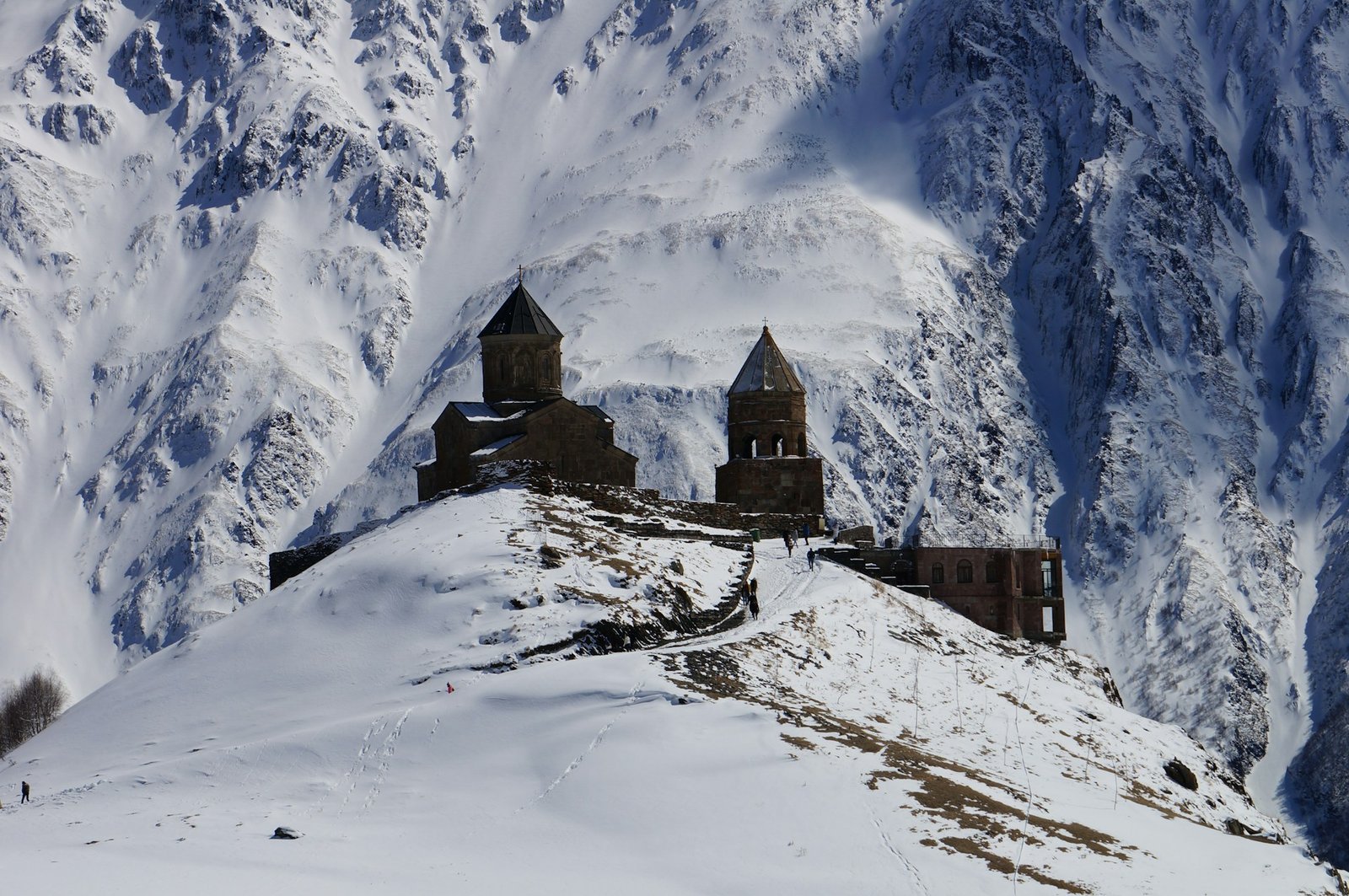
We had skied the same corner of the Alps every February since 2011, and the thing that finally broke the habit was a spreadsheet. Two adults, six days of lift passes, a week of half-board and flights: the total had crept past what we used to spend on three weeks of summer travel. So last winter we flew to Tbilisi instead, and by the second morning we were standing at 3,276 m on Sadzele holding day passes that had cost around €23 each, watching the top lift shut for wind forty minutes after it opened. Both halves of that sentence matter, and this is an attempt to give each of them its due.
The Arithmetic That Changed Our Minds
A single adult day pass at a marquee Alpine area ran roughly €80 to €105 for the 2025/26 season depending on the survey — Zermatt and St. Moritz at the top, the big French and Italian multi-valley passes a little below. Across Georgia, Turkey and Armenia we paid somewhere between €15 and €36 a day. That is not a rounding difference; it is a different category of holiday.
The gap widens once everything else is added. A plate of khinkali and a carafe of house wine in Gudauri cost us less than two coffees on an Alpine terrace. Private instruction, ski hire, a taxi to the next valley — all of it sat at a fraction of what we were used to budgeting, and because the daily burn rate was lower we simply skied more days. We went in expecting to save a third and saved closer to two thirds.
What we had not reckoned with was how much of that saving is, in effect, the price of things that have been removed. Working out which things, and whether we minded, took three trips and one genuinely frightening afternoon.
Georgia: Gudauri, Bakuriani and Svaneti
Gudauri is the one everyone names, and with reason. The Georgian National Tourism Administration puts its base at 1,989 m with lifts reaching 3,276 m and roughly 37 km of marked runs, and describes it as the highest ski resort in Eastern Europe. More to the point, almost none of it sits in forest. The lift climbs and the mountain simply opens out: broad, treeless, rolling flanks in every direction, with the Greater Caucasus stacked up behind. For two people raised on narrow pisted corridors between larches, the first morning was disorienting. There are no natural edges and no obvious boundary. The off-piste begins immediately beside the groomed line and continues, uninterrupted, for as long as our legs held out. Heli-skiing and cat-skiing are sold here as well, and the freeride crowd that this draws gives the base a very particular atmosphere — closer to a climbers’ hut than a spa hotel, with a lot of people comparing airbag packs over beer at four in the afternoon.
The frightening afternoon came on day four. We dropped off the shoulder below Sadzele in flat light, found ourselves in a shallow bowl whose bottom we could not see, and realised we had no idea whether anything was loaded above us, or whether anyone would notice if it were. We traversed out slowly and badly and spent the evening rereading the bulletin we had skimmed that morning. Nothing happened. It was still the moment the trip stopped feeling like a bargain and started feeling like a decision.
Getting there is a short journey with a long asterisk. The resort sits about 120 km from Tbilisi, a two to two-and-a-half hour drive on the E117 over the Jvari Pass, and in settled weather it is genuinely easy. In bad weather the Georgian Military Highway is one road doing several jobs at once: freight bound for the Russian border, local traffic, and every skier in the country. The Gudauri–Kobi section of the Mtskheta–Stepantsminda–Larsi highway is closed outright to all vehicles when the National Environmental Agency rates the avalanche hazard as high, which happened in February 2025 and happens most winters. That closure cuts off the northern slopes and the road on to Kazbegi rather than the resort itself, but heavy snow on the climb up from the lowlands can turn a two-hour transfer into five behind stationary lorries.
That reordered our planning. We now fix the road and the lift report before the hotel, read the Roads Department bulletins for the week before we fly, and cross-check season dates and which side of the pass is actually turning against the practical write-ups of the Gudauri ski resort rather than trusting whatever a booking calendar suggests. On our second trip we moved our flights by three days on that basis and have never regretted it.
Bakuriani, in the south, has the opposite temperament: lower, around 1,641 m to 2,702 m, tree-lined, roughly 29 km of runs, and built for Georgian families rather than ski tourists. Day tickets were listed near GEL 55, under €20. It is reachable by train from Tbilisi via Borjomi, a slow and lovely way to arrive.
Then there is Svaneti. Mestia has two small areas — Hatsvali, low and wooded with four lifts over about 7 km, and Tetnuldi, from roughly 2,265 m to 3,160 m across five lifts and some 14 km of piste. Day tickets at both sat near GEL 50, about €17. The skiing is slight by Alpine standards and the setting is anything but: medieval stone defence towers in the villages, 4,000 m peaks closing the valley, and a real chance a storm shuts the road for a day.
Anatolia: Volcanoes, Snowmaking and Short Transfers
Turkey runs a different model, and in some respects a more dependable one. Erciyes, outside Kayseri, is a dormant volcano whose summit reaches 3,916 m, with skiing from roughly 2,088 m to 3,346 m and more than 50 km of marked piste across several access gates. Much of it has snowmaking, so a thin December is less likely to end a trip. The ticketing surprised us: instead of an unlimited day pass, Erciyes has long sold multi-ride books, and a seven-ride card worked out at well under €20 for the 2025/26 season. Kayseri’s airport is forty minutes away, and Cappadocia close enough that we spent two afternoons among the rock churches between ski days.
Palandöken, above Erzurum, is where we would send a confident skier first. Turkey’s official tourism pages give the ski area as roughly 2,200 m to 3,176 m, with about 28 km of runs served by five chairlifts, a gondola and three smaller lifts, at its best from early December to early May. The access still makes us laugh: five kilometres from the city centre, ten minutes from the airport. We landed and were skiing before lunch, then ate that evening in an Anatolian city of half a million rather than in a purpose-built village. The fall-line runs are long and relentless.
Kartalkaya, in the forested hills above Bolu, is closest to Istanbul and busiest at weekends. It is really two neighbouring lift systems run by separate hotels, and a ticket for one has not historically worked on the other; full-day tickets ran roughly €30 to €36 in 2025/26.
Armenia in a Long Weekend
Tsaghkadzor, about forty-five minutes from Yerevan, is the smallest proposition here and worth it only as part of a city trip: seven lifts, around 30 km of runs, from roughly 1,966 m to 2,819 m. It is also the least cheap of the lot, with a main-season adult day ticket near AMD 13,000, about €32. What it has is a long graded descent through beech forest and a Soviet-era sports heritage still legible in the architecture.
What a Lift Pass Actually Costs
Approximate adult day-pass ranges, converted from local currency and rounded. They are indicative rather than quotable: the lira has moved fast and resorts reprice mid-season.
| Resort | Approx. adult day pass | Local price and season |
| Gudauri, Georgia | €20–25 | around GEL 70, 2026/27 listing |
| Bakuriani, Georgia | €17–20 | around GEL 55 |
| Hatsvali and Tetnuldi, Georgia | €15–20 | around GEL 50 |
| Palandöken, Turkey | €18–25 | roughly TRY 1,000–1,300, 2025/26 |
| Kartalkaya, Turkey | €30–36 | roughly TRY 1,750–2,000, 2025/26 |
| Erciyes, Turkey | under €20 per multi-ride book | no unlimited day pass, 2025/26 |
| Tsaghkadzor, Armenia | €28–34 | around AMD 13,000 |
| Major Alpine area, for comparison | €80–105 | 2025/26 price surveys |
What We Gave Up
We want to be precise here, because the enthusiastic write-ups rarely are.
- Grooming consistency. Some mornings the pistes were corduroy. Some mornings a machine had plainly not been out and the marked run was yesterday’s tracks frozen hard.
- Mountain restaurants. There is no network of terraces to ski between. We carried bread, cheese and a flask.
- Lift maintenance. A chairlift failure at Gudauri in March 2018 threw passengers from their seats and injured at least eight people; it was widely filmed and reported. One incident is not a statistic, but it did change how we feel about a lift that sounds wrong.
- Avalanche control and patrol. This is the serious one. The open terrain that makes Gudauri thrilling is lift-accessed, un-forested and, as far as anything we saw suggested, not actively managed above us: no blasting we could hear, no closures enforced at a rope line, no sweep once the lifts stopped. We hired a local guide for off-piste days, carried transceiver, shovel and probe, and checked our insurance covered unpatrolled terrain. Nobody was going to insist on any of it.
- Published opening dates. Season dates shift, lifts open late, and a listed December start can mean the lower half only. We stopped booking anything non-refundable far out.
- Assumptions about hotels. The January 2025 fire at a hotel in Kartalkaya killed 78 people and prompted a national reckoning over fire safety in resort accommodation. We now ask about alarms, sprinklers and a second staircase before booking.
Worth the Flight?
For us, clearly yes — but not as a cheaper version of the same holiday. The Caucasus and Anatolia are not discount Alps; they are mountains where the infrastructure stops much earlier and the skiing is rawer, bigger and far more a matter of personal responsibility. Anyone whose idea of a ski week is impeccable pistes and a long lunch at altitude will spend it quietly annoyed. For skiers who want a whole unmarked flank to themselves and then dinner in a town where almost nobody skis, the flight pays for itself twice over.
What keeps pulling us back is not the price. It is arriving without knowing what the mountain will give us that week — and after fourteen Februaries of knowing exactly, that turns out to be the part we were missing.



