
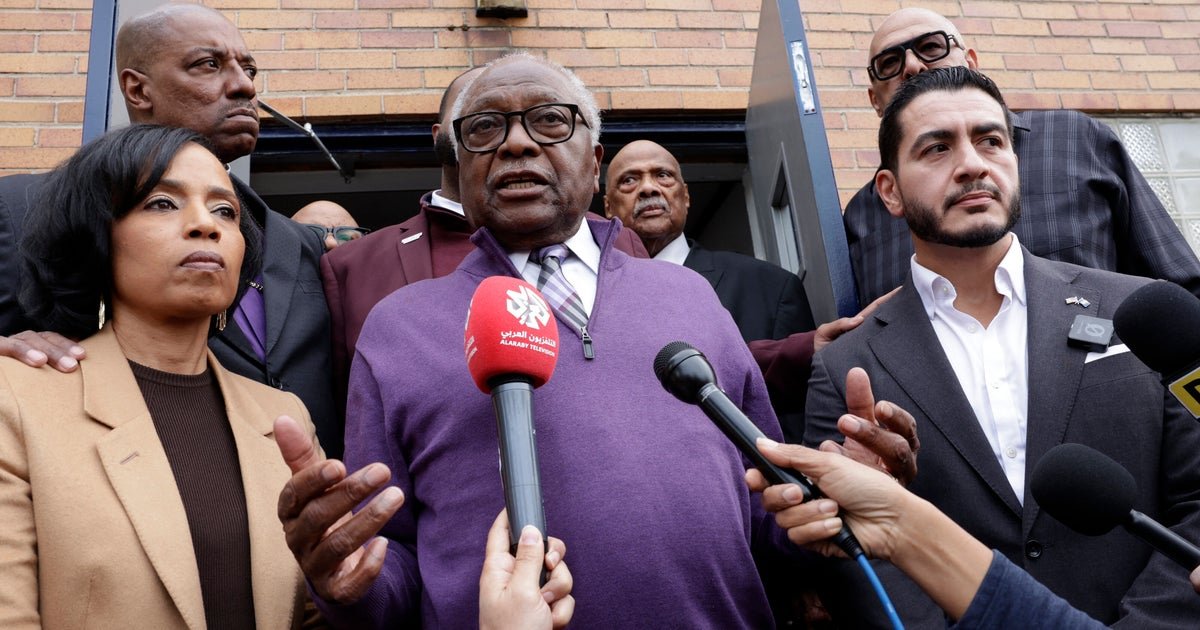
DETROIT ― Rep. Jim Clyburn (D-S.C.), the elder statesman of the Congressional Black Caucus, made his choice in Michigan’s Senate race clear Sunday afternoon: He stands, unequivocally, behind candidate Abdul El-Sayed.
El-Sayed’s campaign “demonstrates what we’re all about as a Democratic Party. This is a party of a big tent,” Clyburn said outside the doors of the Northend Church of God in Detroit, flanked by Black community faith leaders, Sen. Angela Alsobrooks (D-Md.) and El-Sayed himself. “Everything else is a distraction from what we’re all about, and we know what we have in this young man for the future of this country.”
In his remarks, Clyburn did not mention the person he was indirectly rebuking: Rep. Haley Stevens, who he had endorsed in the Democratic primary over El-Sayed. Just hours earlier, Stevens had shockingly reversed her earlier endorsement of El-Sayed and announced she was backing former Rep. Mike Rogers, the GOP candidate in the race.
The announcement stirred a fury of denunciations aimed at Stevens from top Democratic leaders, and a nearly equal number of paeans to her courage from pro-Israel advocates and Republican leaders, including President Donald Trump. But on the ground in Michigan, there is little sign the drama is resonating with the Black voters it is purportedly meant to matter to.
Charnita Croskey, a remote analyst in Pontiac who said she is supporting El-Sayed because of his support for Social Security, said she’s little evidence Black voters in the state are divided over the Senate election.
“Everybody that I know, as far as Black [people] has been, for him,” she told HuffPost Saturday.
The sentiment is backed up by polling: El-Sayed was winning Black voters by 65 percentage points in a recent CNN survey of the race, nearly identical to the 67-point margin Democratic gubernatorial candidate Jocelyn Benson was winning them by.
Or as El-Sayed said while standing alongside Clyburn about Stevens’ endorsement: “None of this matters,” he said. “At the end of the day, I don’t really think about Haley Stevens.”
Stevens announced her endorsement of Rogers outside Perfecting Church in Detroit, a handful of miles away from the church where Clyburn and El-Sayed would gather, and has framed her concerns with El-Sayed around the Black community, insisting an ad he released featuring conservative commentator Tucker Carlson criticizing Rogers was “an insult to the congregation” El-Sayed campaigned in on Sunday.
Broad concerns about El-Sayed’s appeal to Black voters have long been part of national conversations about his electability and Democratic worries about winning in Michigan. In the primary, Black voters and elected officials largely backed Stevens.
One factor: lingering resentment among Black voters about the Uncommitted Movement, of which El-Sayed was a part, and how it damaged former Vice President Kamala Harris in her short sprint bid toward the White House last cycle. Arab voters in the state angry over the Biden administration’s handling of the Israel-Gaza turned against Harris en masse, with many voting third party, leaving the presidential race blank of backing Trump.
Rogers and Republicans have looked to make use of this vulnerability, pushing to make real inroads with Black voters in the last few weeks. Rogers opened a campaign office in Detroit mid-October, and his campaign has worked relentlessly to highlight Black critics of El-Sayed in the media. A GOP group has been sending text messages to Black voters arguing El-Sayed “has been disrespectful and dishonest with Black voters.”
“We have the right set of circumstances for people to be open, and we’re taking full advantage of the idea that we can now have a conversation I probably couldn’t have before,” Rogers said at the time of the office opening.
Still, Sherita Brownlee, a 41-year-old school social worker, waved off the notion that El-Sayed is fumbling with the community as “misinformation” and said he reminds her of friends she had growing up in Oakland County.
For Brownlee, the stakes of the election are deeply personal. When asked whether an El-Sayed victory is vital, her response was certain.
“As a mom, as an educator, as a Black woman — absolutely,” she told HuffPost at an El-Sayed campaign cookout Saturday afternoon.
El-Sayed’s campaign says he’s been to over 45 Black churches and took part in at least 100 events and meetings with leaders and elected officials in the community. The CBC’s political action committee, many of whose members had backed Stevens in the primary, endorsed El-Sayed’s candidacy in September. He also held a roundtable on Black maternal health with Harris and rallied with former President Barack Obama in Detroit late last month.
Brittany Shepherd/HuffPost
At that campaign cookout in Pontiac, Michigan, a city where nearly 43% of the population is Black, dozens of voters and Black elected officials ― both local and national ― threw their support, and a little soul, El-Sayed’s way.
As El-Sayed entered the community pavilion nestled behind the local library, attendees burst out singing happy birthday. (El-Sayed turned 42 that day, and crowds at a later event in Sterling Heights would also sing to him.) But only Pontiac offered their unique encore. After the standard fare version, a group broke out into Stevie Wonder’s rendition of the tune, sometimes understood as the Black version of the classic party staple.
Part of that chorus of voices was Alsobrooks, Maryland’s first Black senator, one of the mere five Black senators in Congress. Alsobrooks said that El-Sayed is “going to make a tremendous difference” in the Senate, part of a larger effort to change course for a future “where all are included.”
“Come Tuesday, we’re going to change this all around, change the direction of our country, and put people in office who can see us, who care about us,” she said.
Pontiac City Commissioner Angela Powell more directly linked the struggles of her Black community to the ratcheting up of racism she believes El-Sayed is facing in the closing weeks of the campaign.
“I’ve never seen as much hatred and racism and evil as I have seen on this campaign trail,” she said. “I know Abdul gets it greatly, and we all get it on the Democratic ticket. Our ancestors fought and died for the freedom that we have.”



