
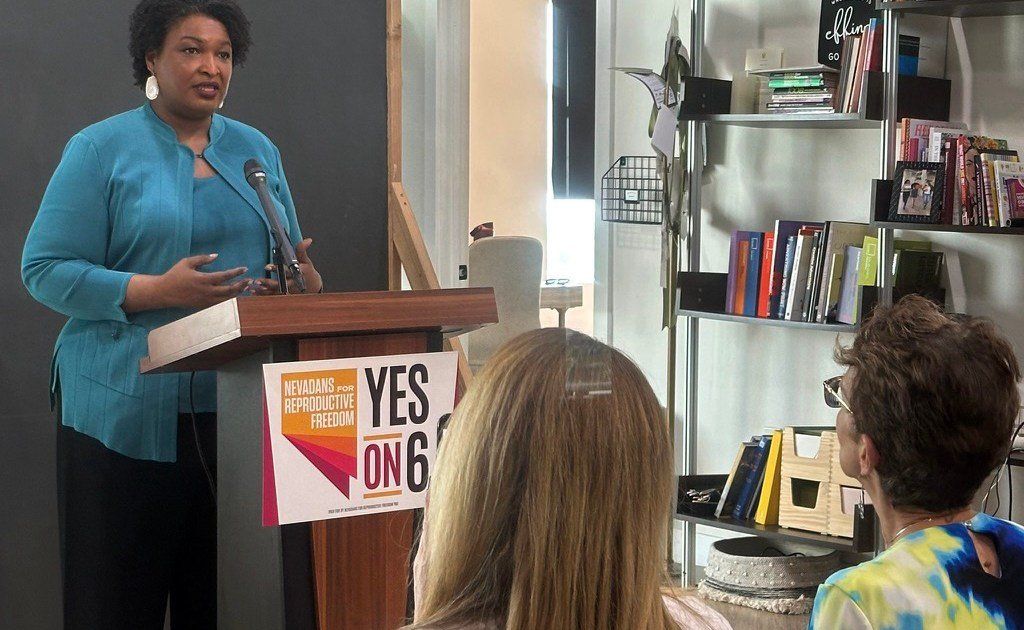
Stacey Abrams at a Las Vegas event for Question 6, which would enshrine abortion rights in the Nevada constitution.Nina Martin
Decked out in a sparkly plaid shirt and a dangly necklace urging “VOTE,” US Rep. Susie Lee was rallying a roomful of canvassers to knock on doors around Las Vegas in support of Nevada’s abortion ballot measure, Question 6. The four-term Democratic congresswoman talked about her background—homeless advocate, nonprofit educator, mom of two adult children via IVF—as well as her history of miscarriages and the abortion care she needed to treat them.
Nevada has statutory protections for abortion, but it also has a Republican governor who has described himself as “pro-life.” Question 6 would enshrine those rights in the state’s constitution. “I don’t want to have to worry about it,” Lee told the audience. “I don’t want to have to worry about it for my daughter, for my grandkids, for families all across the state.”
But abortion isn’t the main topic on voters’ minds this fall—not in Lee’s sprawling Clark County district, not as her MAGA-y opponent Marty O’Donnell describes abortion rights as “satanic,” and not even in this roomful of purple “My Body. My Ballot.” T-shirts. So Lee devoted much of her time to talking about tariffs, the Iran war, $80-a-tank gas, Medicaid cuts, skyrocketing healthcare premiums, predatory housing costs, and student debt. She also drew a direct connection between affordability and reproductive autonomy. “It’s an economic issue for women and families as well.”
When it comes to how reproductive rights are paying out on the ballot this fall, that scene is 2026 in a nutshell.
Two years ago, fury over the end of Roe v. Wade put abortion at the center of the national political conversation. This year, in an election dominated by Donald Trump’s economy, war, and corruption, abortion’s importance as a political issue has seemingly receded. Yet polls show voters care about reproductive rights as much as ever—and strategists say the issue could be a key factor in determining the size of the predicted Democratic wave.
In the closing days of the midterms campaign, more and more pro-choice candidates—in Nevada and around the country—are leaning into the economic arguments. “The most consequential economic decision a family is going to make is whether to have a child,” says Mini Timmaraju, president of Reproductive Freedom for All, which has been working to support ballot initiatives and Democratic candidates in key battlegrounds. “The ability to decide if and how to have a family is critical to your economic future. Voters understand that nuance.”
At the same time, abortion-rights groups are doubling down on their main theme of the past two years: the need for Democratic firewalls in Congress and the states as the Trump administration and its far-right allies threaten access.

At the Las Vegas event, Timmaraju pointed out that Trump officials have been ratcheting up their attacks on medication abortion, federal family planning, contraception and IVF, while telling their supporters that the gloves will really come off after the midterms. “Why after the midterms?” she asked. “Because they know how deeply politically unpopular these attacks are.”
The event’s special guest, Stacey Abrams, focused on the health impacts of abortion bans, including maternal deaths in her home state of Georgia. If Nevada doesn’t enshrine constitutional protections, she warned, it “runs the risk of being in the number of states where no one knows what they’re entitled to, and therefore no one knows what the future holds.”
“Voters will say, this is a deal breaker. ‘They don’t support freedom and access to reproductive health care? I can’t support them. It’s over for me.’”
That kind of messaging resonates powerfully with voters, says Molly Murphy, president of the Democratic polling firm Impact Research. “In every poll I’ve done this cycle, [abortion] is a top negative against Republicans in focus groups,” she said at a press briefing last week. “Voters will say, this is a deal breaker. ‘They don’t support freedom and access to reproductive health care? I can’t support them. It’s over for me.’”
Abortion groups are counting on those sentiments to help Democrats not just retake the House (and, if the latest polls are correct, the Senate) but also win new state trifectas by flipping key legislative seats and governorships—like Nevada’s—that Republicans now hold.
Meanwhile, four states have abortion-related measures on the ballot that could determine access for millions of women.
Here’s a look at some of the biggest reproductive rights battles of the midterms.
For a while, it seemed as if helping pro-choice Democrats like Lee win their elections and regain the House majority was the most that reproductive rights groups could reasonably hope for. Lee, first elected in the 2018 blue wave, was seen as vulnerable after Trump won her Third Congressional District in 2024 while she narrowly held onto her seat. But Lee has been helped by Trump’s plummeting popularity and by the extremism (and unseriousness) of her opponent. O’Donnell—a millionaire video-games composer endorsed by Trump—has a rabid online following (“The Marty Army,” recently busted for neo-Nazi and white nationalist comments) and far-right views about abortion and LGBTQ rights. Cook Political Report now rates the race as “Likely D.”
With the House seemingly locked up for Democrats, reproductive rights groups have intensified their focus on the Senate, whose role in picking Supreme Court justices and federal judges makes it an especially important prize. According to one policy brief, anti-abortion messaging moved support toward Democrats by as much as five points and “significantly increased” motivation among independents. But Republican candidates have been playing down (or actively scrubbing) their anti-abortion records, and pro-choice groups weren’t getting through to voters. The repro-rights side has “a believability gap to overcome,” the polling firm Impact Research warned in a July report. “Most battleground voters are not hearing about the issue of abortion, so while many express concerns about Republican policies that restrict access to abortion, they also believe these policies are unlikely to happen.”
For repro groups, the final weeks of the cycle have been all about filling that information hole. Reproductive Freedom for All has poured $23.5 million into its midterm campaign, which includes support for key Senate races in Michigan, Iowa, and Maine. Planned Parenthood Votes, a PAC affiliated with Planned Parenthood, announced a $47 million investment with targets including Maine’s Susan Collins and Michigan’s Mike Rogers. Timmaraju argues that repro rights has become a powerful closing argument: “The tipping-point issue, the thing that really helps make it plain that Republicans are too extreme to represent average voters.”
In 2024, the trifecta that Democrats fantasized about winning was in Congress and the White House. This year, they have their eyes set on the states.
Gaining complete control of state governments has proven to be one of the best defenses against Trump and the GOP, says Sarah Curmi, executive director of States Win, which supports Democrats running for state legislatures. “Trifectas are critical to protecting abortion rights and reproductive rights generally.”
Democrats could gain full control over state governments in Pennsylvania, Michigan, Arizona, Minnesota, and Wisconsin by flipping a net total of just 22 legislative seats, Curmi says. Winning gubernatorial races would lead to trifectas in Nevada and Vermont.
“Being under Democratic control … would have a huge impact for those of us living in those states,” says Curmi, who hails from Michigan. “Not just for abortion access… but also voting rights, redistricting, environmental protections, LGBTQ+ equality—we could be here all day listing all the different ways that state legislatures impact our lives.”
In Pennsylvania, Democrats are hoping that popular Gov. Josh Shapiro wins reelection by a big enough margin to help them take the state Senate, which Republicans have controlled since 1994. If they gained just two seats, Democrats could raise the minimum wage, increase funding for mass transit, repeal decades-old anti-abortion laws, and codify abortion and LGBTQ protections. While Democrats have a narrow majority in the state House, “the Senate is where our bills have gone to die,” says Signe Espinoza, executive director at Planned Parenthood Pennsylvania Advocates. “If we can change things in the General Assembly, we won’t just be playing defense, but really thinking about the needs of Pennsylvania women and families and moving forward legislation that can really support us.”
In Nevada, it’s popular incumbent Republican Gov. Joe Lombardo, running for a second term, who is standing in the way of a Democratic trifecta. Lombardo has a reputation as a moderate who, while personally opposed to abortion, has pledged not to impose his views on the state. Although he has signed some pro-choice legislation passed by the Democratic-controlled legislature, he has vetoed bills on IVF and paid family leave and told the Reno Gazette Journal last month that he would vote against Question 6, saying the current statutory protections are “sufficient.” He had been favored to beat his Democratic rival, Attorney General Aaron Ford, but heading into the final stretch, polls shows the race is tied, while early voting has trended strongly toward Dems.
Two years ago, 10 states had measures aimed at enshrining reproductive rights. This November, Nevada is one of only three states that do—and a fourth measure, in Missouri, is trying to repeal abortion protections.
The vibe around ballot initiatives is also different. Two years ago, Democrats and abortion rights groups hoped the measures would drive angry women—including Republicans—to the polls and sweep Vice President Kamala Harris into the White House. This time around, the goals are more state-specific and expectations more muted. A new analysis by economists in Virginia and Texas helps explain why: Despite more than $250 million in spending in 2024, abortion measures may actually have helped Republicans by giving moderate GOP women a way to blow off steam on reproductive rights without abandoning their party or its anti-abortion candidates.
Nevada is a perfect example of how this played out. Question 6—which guarantees abortion rights until fetal viability or to protect the health or life of the mother—must be approved by voters in two consecutive elections. It was on the ballot for the first time in 2024, winning 64 percent of the vote. But Trump took the state. Something similar happened in Arizona, Missouri, and Montana—all passed abortion measures while reelecting Trump by margins ranging from comfortable to landslide. Trump’s handling of the abortion issue in his campaign—insisting that the Dobbs decision left regulation up to the states and minimizing the possibility of a national ban if he were elected—“was almost like a permission structure for Republicans to go vote for a ballot measure and then vote for him,” Timmaraju says.
Another hard-earned lesson of 2024: “It’s not enough to win ballot measures,” Timmaraju says. “If you don’t have the constitutional officers and you don’t have the legislature, you’re stuck.”
“It’s not enough to win ballot measures. If you don’t have the constitutional officers and you don’t have the legislature, you’re stuck.”
Missouri is a cautionary tale. Two years ago, it became the first state to overturn a near-total abortion ban, passing its Right to Reproductive Freedom Initiative with almost 52 percent of the vote. But as my colleague Sophie Hurwitz has reported, instead of working to implement the amendment, anti-abortion lawmakers pushed back at every opportunity, including putting their own measure on this year’s ballot that aims to overturn the 2024 measure by demonizing transgender kids. “The results of the 2024 election cycle taught us that we cannot fight for abortion access in a silo,” says Brittany Fonteno, president and CEO of the National Abortion Federation.
That realization is one reason progressive groups are putting so much effort into state trifectas. Michigan and Arizona have both enshrined abortion rights into their constitutions, but without Democratic control of those legislatures, “we haven’t been able to finish the job,” Timmaraju says. Virginia offers a powerful counter-example: It it the only state in the South that hasn’t enacted some sort of abortion ban since Dobbs, thanks to Democratic lawmakers who were able to thwart then-Gov. Glenn Youngkin, an anti-abortion Republican. Now, after winning the governorship and a trifecta in 2025, Virginia Democrats have a trio of progressive constitutional amendments on this year’s ballot: one guaranteeing reproductive freedom and abortion rights through the second trimester of pregnancy, one repealing a 20-year-old ban on same-sex marriage, and one bolstering voting rights for people with felony convictions.
“We are just trying to remind people that we could be like North Carolina, South Carolina, other states across the South,” says Jamie Lockhart, executive director of Planned Parenthood Advocates of Virginia. Enshrining abortion and other protections means “we don’t have to worry about turning into a state that backslides.” All three measures are expected to pass.
Because of the on-the-ground realities, repro advocates are keeping their expectations in check in deep-red Idaho, where abortion supporters are trying to pass Proposition 1, which would create a right to reproductive freedom and privacy under state law. Today, Idaho has some of the most draconian abortion laws in the country. While a win would send a powerful signal to the state’s overwhelmingly anti-abortion lawmakers, because the measure wouldn’t amend the state constitution, those same Republicans could vote to reinstate the ban. A new poll shows the measure is losing.
In Nevada, meanwhile, Question 6 is expected to easily win, but to a lot of voters, it feels like a throwback. At the Las Vegas event, Denise Lopez, director of Nevada campaigns for Reproductive Freedom for All, addressed the problem head on. “Some voters are asking, didn’t we already pass this?” And the answer is yes,” she said. “We have to do it a second time to ensure that these rights are permanent in our constitution.”



