
As the ballot counting stretched into Wednesday morning, it became clear that the U.S. had broken free from an era dominated by President Donald Trump.
“Democrats rout GOP,” blared a New York Times headline. “Party flips Senate and House as voters deliver stunning rebuke to Trump.”
And yet if this were the beginning of a post-Trumpian world, nobody told Florida. Republicans won all the statewide races: U.S. Senate, governor and three Cabinet positions — attorney general, agriculture commissioner and chief financial officer.
Trump himself even made a cameo Tuesday night, calling to congratulate the man he endorsed for governor 21 months ago.
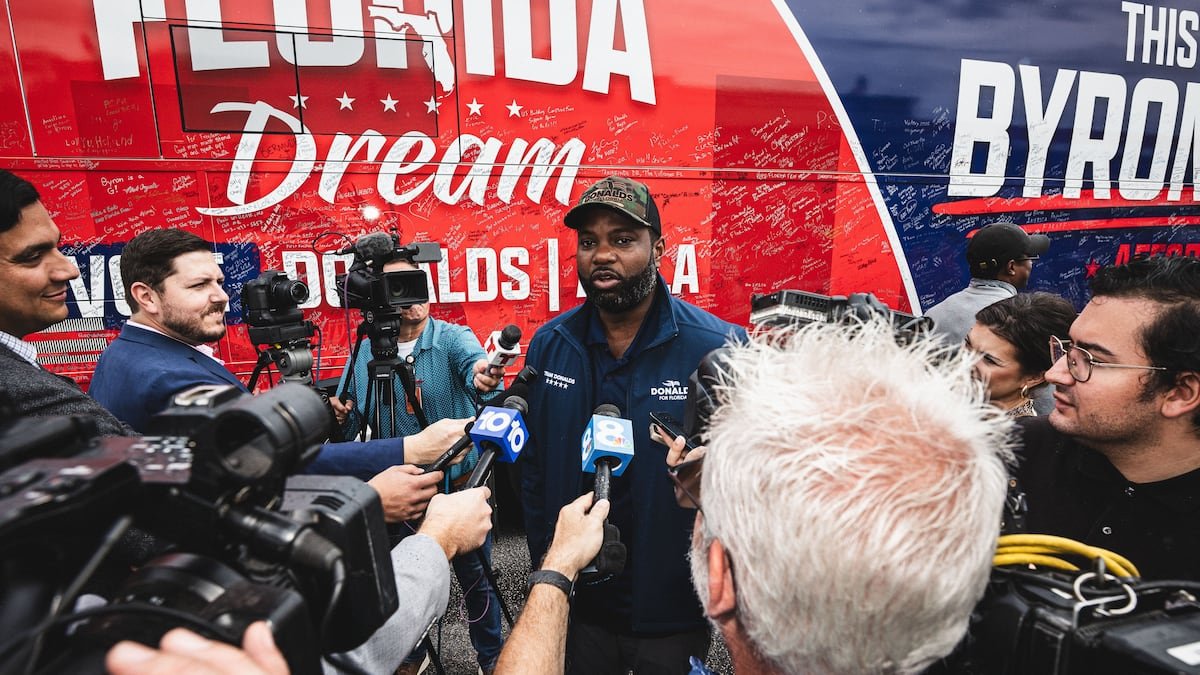
“Mr. President, I want you to hear from Florida that we are still ready,” said U.S. Rep. Byron Donalds, recounting his phone call during his victory speech. “I also want to tell you, ‘Thank you for your support and thank you for being in my corner.’”
But the blue tsunami that disrupted the national political landscape also wreaked havoc in Florida. A closer look reveals that the shifting tide nearly overturned a GOP hierarchy that has controlled the state since 1999.
Compared to the midterms from four years ago, 1.3 million more Floridians voted this year. Republicans picked up no new seats in the state’s congressional delegation, despite redrawing the maps to do just that. Statewide Democratic candidates came within a few percentage points of winning. Local Democratic candidates wrested away the GOP supermajorities in the Florida House and Senate.
And Jolly erased most of the 19-percentage-point loss from four years ago, coming within 1.3 points of becoming the first Democrat to win the Governor’s Mansion since 1994.
Jolly, 54, ran for governor in part on the premise that this year would be reminiscent of post-Watergate 1974, a high-water mark for midterms that saw Democrats pick up 43 seats in the U.S. House and three in the Senate.
Turns out Jolly was right. But it wasn’t enough in Florida. Over the last three decades, Republicans built up such an advantage with the electorate and perfected their party’s ability to raise money and out-campaign Democrats that even Tuesday’s historic blue wave didn’t matter here.
“We held out,” said Ryan Smith, the chief strategist for the Donalds campaign. “We said we would, and we did.”
A powerful tool
Donalds, 48, raised more than $175 million in his run for governor, the second-biggest haul for a Florida gubernatorial candidate since Gov. Ron DeSantis’ reelection in 2022, dwarfing the $27 million that Jolly raised.
“Raising more than $175 million in politics is a powerful tool,” Jolly said shortly before the polls closed on Tuesday. “He made the most of it.”
In campaigns, the TV ads get all the attention. But just as instrumental down the stretch for Donalds was a sprawling turnout machine that in the waning hours of the race found the necessary votes.
This machine is made of many parts. Canvassers knocked on more than 2.2 million doors in targeted areas, especially in South Florida. It included texting, phone calls and mail. As polls tightened, Smith said it would be this machine that would lift Donalds to victory.
“Republicans are mobilizing a full-throated, get-out-the-vote effort, and there’s nothing like that from Democrats,” Smith said in early October. On Election Day, as 600,000 more Republicans voted than Democrats, Jolly seemed in awe.
“The money they spent in the field in South Florida was the most effective,” Jolly said. “He paid his door knockers $28 an hour. We don’t have anything like that.”
Meanwhile, Donalds monopolized air time with ads that defined Jolly. The Donalds campaign relentlessly hammered him, characterizing a key proposal from Jolly to overhaul the state’s hurricane insurance coverage as a $1,000 “hurricane tax.” Jolly cried foul, saying his plan would cut premiums by up to 70%, but the damage was done.
According to a University of North Florida poll last month, more respondents expressed trust in Donalds on property insurance, at 43%, compared to 38% for Jolly. More worrisome for Jolly was that another recent poll, the New York Times/Siena poll, showed that nearly a quarter of voters hadn’t heard of Jolly, compared to 14% not knowing of Donalds.
Jolly said he tried calling donors who had given before but was denied.
“I didn’t make a convincing case to the donor class, and that’s on me,” he said shortly before polls closed.
In a state starved for Democratic victories and the patronage that comes with them, most in-state industries that typically contribute have GOP ties. Traditional Florida Democratic deep pockets belong almost exclusively to progressives who live out of state.
Their attention this year was diverted elsewhere because Democrats were competing unexpectedly in previously red states like South Carolina, Ohio and Georgia. Jolly found himself waiting in a longer line with a tougher case to make. Because of its size and numerous media markets, Florida costs more money.
“You could win Iowa with $10 million,” Jolly said. “And Florida will cost you $100 million. That’s a paradigm I couldn’t overcome.”
The Democratic Governors Association spent nearly $10 million each in states like Georgia, Ohio and Arizona. It wasn’t until Oct. 20 that it agreed to spend $1 million in Florida. Republicans scoffed.
“This is peanuts for a state as big as Florida,” Gov. Ron DeSantis posted on X.
“(Jolly) got late money, but it was so late the only thing to do with it was TV,” Smith said. “He couldn’t do it fully. He had no turnout operation.”
Staying on message
Representing competing worldviews, Jolly and Donalds proved to be skilled orators who could stay on message.
In an attention-driven media landscape where algorithms reward the loudest and most provocative voices, keeping a campaign strictly focused on a singular message like affordability is no small feat.
Both did so.
“The main thing for the voters was affordability and who can make your life more affordable,” Smith said. “So that’s why the framing of the campaign was very simple. Byron Donalds will make your life more affordable, and David Jolly will make your life more expensive.”
“David’s not deviated from the cost-of-living message from Day 1,” said Fernand Amandi, a Democratic strategist and pollster who helped convince Jolly to run. “That meant not taking the bait on the culture war issues that have stymied Democratic statewide candidates in recent years.”
But with no money, Jolly couldn’t amplify his message. Donalds could.
Those who saw Jolly on the campaign trail were groups ranging from 75 to 500 who attended town hall meetings. With an animated speaking style reminiscent of an earnest preacher crossed with a popular college civics professor, Jolly wowed his audiences. But without his ads reaching a statewide audience, his town hall meetings were limited, impressing a tiny fraction of Florida’s 13 million voters.
“For whatever sets of reasons, there just wasn’t an investment made,” said Mark Riddle, Jolly’s senior adviser. “And because of that, we never defined ourselves, we never defined Byron on TV except for a few mosquito bites. In the story of David versus Goliath, we couldn’t afford the slingshot.”
A ‘catastrophic mistake’
A televised debate could have given Jolly the one thing that had been missing from his campaign: a statewide airing of his message.
But in what Smith would later call a “catastrophic mistake,” Jolly declined.
When asked why he refused to debate Donalds, Jolly gave a well-rehearsed excuse that ended on a false note. He said that because Donalds continued to lie about Jolly’s record and what he stood for — alleging that he’s a socialist or a supporter of trans surgeries for children — there was no point in debating him.
“It’s not actually discourse,” Jolly told talk radio host Ryan Gorman last month. “It’s about insults, and I think that’s wrong. I’m not going to platform that type of division and ugliness.”
Donalds, Jolly continued, was the only person in the race who needed to debate.
“You have a Republican statewide candidate chasing a Democratic statewide candidate for a debate because he’s losing,” Jolly said.
That was never the case. Jolly trailed Donalds in every major and minor poll released before and after the primary. It wasn’t clear what metric Jolly was using that indicated he was beating his better-funded opponent.
But on Election Day, Jolly stood by his decision.
“A debate wouldn’t have helped,” he said.
Donalds’ path
Sure, Donalds had the money. And Trump’s endorsement cleared the field for him so he more easily won the GOP nomination without having to debate his Republican opponents.
But Donalds didn’t have the easiest path to getting elected Florida’s first Black governor, either.
For one, he had to rise above the racist provocations thrown his way throughout the campaign. One of his primary opponents, James Fishback, called him a “slave to donors” and a “token Black” in Congress who wanted to turn Florida into a “Section 8 ghetto.”
Donalds didn’t take the bait, a level of restraint that gained him deep admiration and respect from a skilled campaign staff that needed him to stay on message.
It was also an unfavorable political environment for Republicans, even in a red state like Florida. Polls showed voters were unhappy with rising costs, usually a sure sign of distress for any party in power.
It didn’t help that Donalds was tied so closely to Trump, who is getting the lowest approval ratings of any U.S. president entering the midterms since Harry S. Truman in 1948. In the stretch run of the campaign, most Republican candidates avoided any mention of Trump in their television ads. Even Donalds chose to tout his late, half-hearted endorsement from Gov. Ron DeSantis in ad spots over mentioning the man who thrust him onto the statewide stage.
Yet somehow, while Republicans across the U.S. on Tuesday paid for their association with Trump, Donalds won and made history.
“I know how this campaign started 21 months ago, coming in with President Trump’s endorsement,” Donalds told reporters Tuesday night. “All you guys were writing it. Everybody was saying, ‘Oh, it’s a foregone conclusion. He’s going to win.’”
Donalds credited his victory to not taking anything for granted.
“It wasn’t because we just sat back and let the campaign come,” Donalds told reporters Tuesday night. “It’s because we were intentional about engaging communities everywhere, and all that hard work, all the doors, all the calls. It all paid off tonight.”
.subtext-iframe{max-width:540px;}iframe#subtext_embed{width:1px;min-width:100%;min-height:750px;}
fetch(“https://raw.githubusercontent.com/alpha-group/iframe-resizer/master/js/iframeResizer.min.js”).then(function(r){return r.text();}).then(function(t){return new Function(t)();}).then(function(){iFrameResize({heightCalculationMethod:”lowestElement”},”#subtext_embed”);});



