
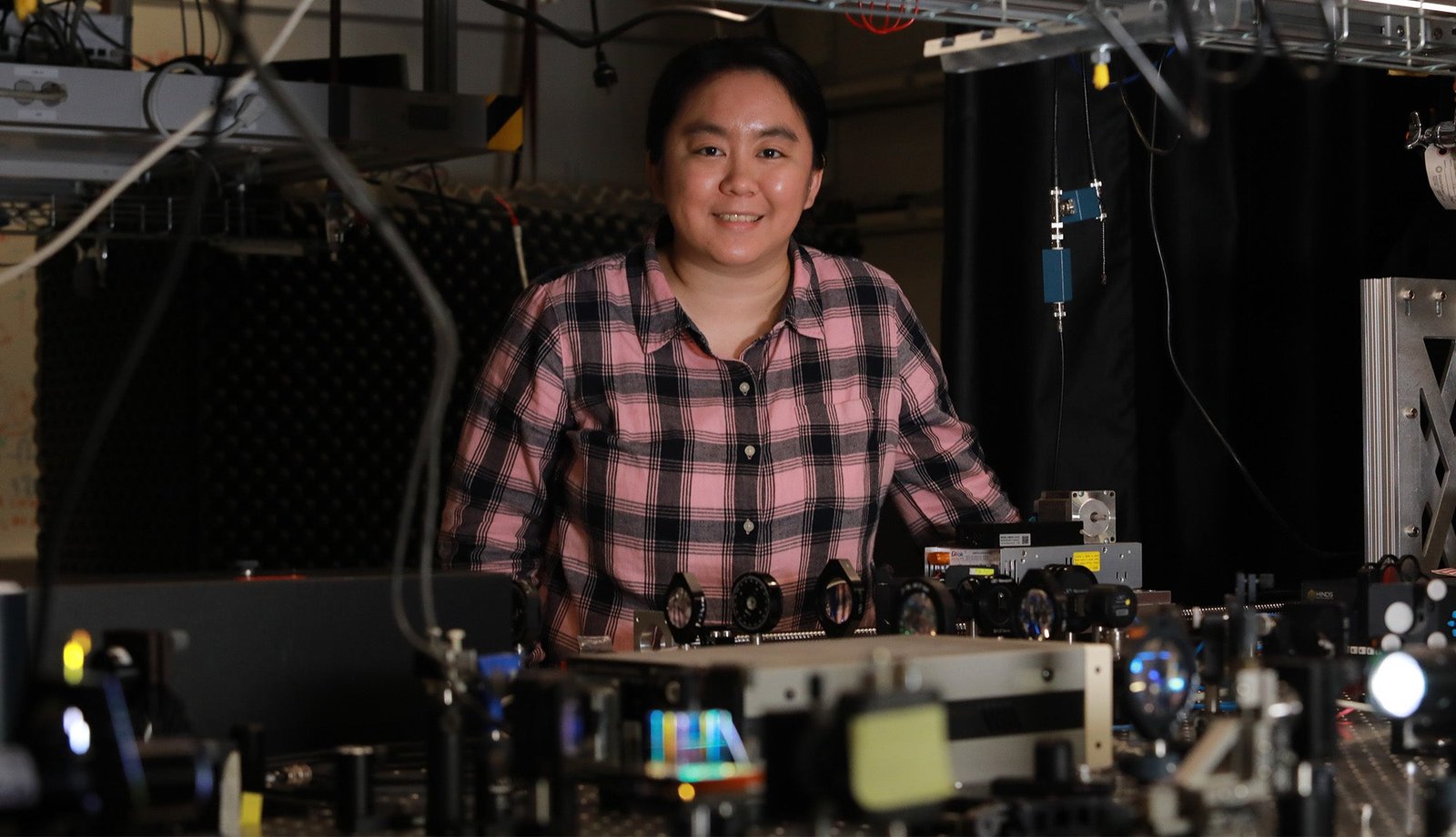
Electronics could soon be much smaller, faster and more energy efficient, thanks to the ingenuity of Kelly Luo, Gabilan Assistant Professor of Physics and Astronomy at the USC Dornsife College of Letters, Arts and Sciences.
Luo studies spintronics, a field that explores a magnetic property of electrons known as “spin” to store and process digital information more quickly and with less energy than conventional electronic components require.
In support of this effort, Luo has received the Early Career Award for Scientists and Engineers (ECASE-Army) from the Army Research Office (ARO), an award historically used for recipients of the prestigious and highly selective Presidential Early Career Award for Scientists and Engineers (PECASE). If the award earns presidential endorsement, Luo will be only the second USC Dornsife faculty member to receive a PECASE, following Moh El-Naggar, Dean’s Professor of Physics and Astronomy, who received the award in 2014.
The five-year, $1 million award is the latest in a series of accolades for Luo. It follows a Department of Energy Early Career Award in 2024 and an ARO Early Career Program Award in 2025.
The ARO’s Solid-State Physics Program nominated Luo for a PECASE, citing her “pioneering research achievements in the field of opto-spintronics and quantum magnetism that enable next-generation electronics and memory devices for Army’s battlefield needs, and for her unwavering commitment to mentoring the next generation of young scientists.”
Said Luo: “I am deeply honored by this recognition and grateful for the Army Research Office’s confidence in our work. This award gives our group sustained support to explore how controlling magnetism with voltage could lead to faster, more energy-efficient electronics and memory devices.
“Empowering our students and postdoctoral researchers to bring their own ideas to these questions and grow into independent scientists makes that support especially meaningful to me,” she added.
The Spin Doctor
Luo grew up along the Yangtze River in China’s Sichuan Province, where her father worked at a teaching hospital as an oncology professor and her mother in the hospital’s administrative office.
Her interest in physics was first nurtured by a middle school physics teacher. “He was a quiet, patient, older gentleman who would stay after school to answer my endless questions about why a ball rolls downhill or how electric charges move,” she says.
She completed her bachelor’s degree in physics at The Hong Kong University of Science and Technology in 2012 and her PhD in physics at The Ohio State University in 2019. She joined USC Dornsife in 2023, drawn by the chance to conduct cutting-edge research and to collaborate across multiple disciplines. She holds courtesy appointments in chemistry as well as chemical engineering and materials science at the USC Viterbi School of Engineering.
As a graduate student, Luo helped show that light could create a magnetic pattern among electrons and transfer it into graphene without the pattern disappearing, even at room temperature. Graphene is composed of carbon that is layered in sheets that are one atom thick. Luo’s finding suggested a possible way to connect information carried by light with spin-based electronic components.
More recently, Luo and her colleagues built a device that could detect the extremely rapid motion of oppositely aligned atomic magnets inside an antiferromagnetic material. Their 2025 study, published in Science, also showed that voltage could change how quickly that motion faded. It was an important step toward controlling it in future devices.
Switching magnetism with voltage
With support from her ECASE-Army, Luo’s team will investigate altermagnets, materials that have an organized magnetic pattern inside but produce almost no magnetic field outside. This lack of exterior magnetism could allow electronic components to sit close together without interfering with one another.
They’ll pair an atomically thin magnetic layer with a ferroelectric material. A brief voltage application can switch the electrical polarity inside the ferroelectric material, where it remains in its new position after the voltage is removed.
Luo’s team will test whether that electrical switch can also rearrange the magnetism in the adjoining altermagnet, the way a shake to an etch-a-sketch rearranges its design. If it affects the altermagnet, a short pulse of voltage might create a magnetic state that remains in place without continuous power. Different states could eventually help store computing information in electronics while consuming far less energy.
The magnetic activity Luo studies can occur at gigahertz-to-terahertz frequencies: billions to trillions of cycles per second. This means the materials hold potential for high-frequency signal processing, compact sensors and new forms of low-power memory. Since the magnetic layers she’s using are just a few atoms thick, it could also allow engineers to build extremely thin components and stack them closely on a chip.
Luo’s team will first test how reliably voltage can change these magnetic states and how they can be read and controlled in a working device. They’ll be using ultrasensitive optical microscopy and methods of ultrafast measurements developed in her lab to detect small magnetic changes and follow the rapid motion of the spins.
If successful, the approach could give engineers a new tool for improving a vast array of technologies, from memory chips to computing and communications systems. The work is particularly timely, as growing computing needs make energy efficiency increasingly important. Luo also leads USC’s participation in a U.S. Department of Energy Genesis Mission project that uses artificial intelligence to advance electronic materials and manufacturing.
“Kelly is a rising star and a key part of USC Dornsife’s strength in quantum science and technology,” says Aaron Lauda, Divisional Dean for Math and Physical Sciences and professor of mathematics and physics and astronomy. “What makes her work so exciting is that the applications are potentially limitless. More efficient electronics and quantum sensors are potential applications, but the discoveries may ultimately enable things we have yet to imagine.”



