
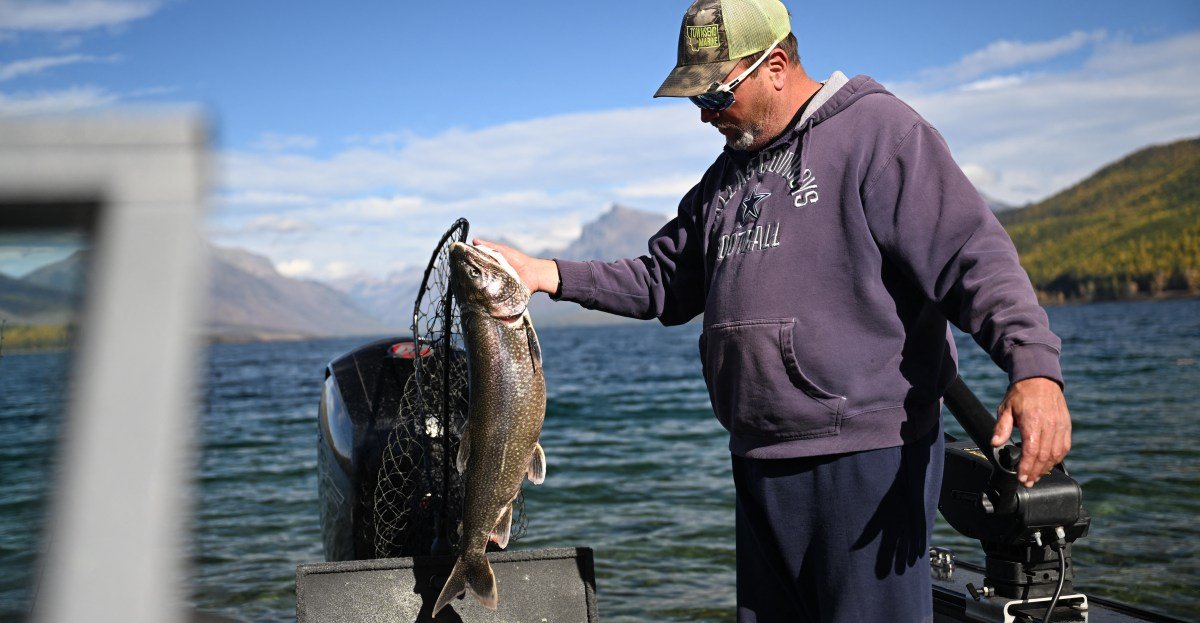
On a summer day in 1992, a man dumped a cooler full of a fish called yellow perch into Lake Mary Ronan, in northwest Montana.
We know this because two teenagers saw him do it; they wrote down his license plate number and called in a tip to the Montana Fish, Wildlife, and Parks department (FWP), which immediately dispatched biologists to capture and kill the perch with nets and poison.
The teenagers got a reward of $500 each for their efforts, while the man was charged with illegally introducing non-native fish into the lake, slapped with a small fine, and sent on his way. The law changed soon after: Now, intentionally introducing a non-native, invasive species to Montana’s waters is a felony punishable by as long as two years in prison or a fine of up to $25,000, or both.
I visited Flathead Lake Biological Station in October, and while I was there I heard from a biologist about this strange, totally avoidable, invisible catastrophe in the making. I was absolutely fascinated — as I looked at the lake, I hardly believed it could lose its signature clarity because of a bucketful of fish — and decided I had no choice but to open this can of worms.
But the perch? The yellow perch — at least two of them — survived, multiplied, and quickly went on to wreak havoc. They established dominance in the lake, wiping out its population of a native fish called the Westslope Cutthroat trout and causing other ecosystem disruptions. This hasn’t only happened here: Montana is filled with thousands of beautiful alpine lakes and rivers, nestled in the sort of rugged territory that sold people on the idea of the West. Yet, across the state, without permission, people keep dumping non-native fish into them.
The reason is simple: The introduced fish, according to some anglers, are more fun to fish than the stuff that’s already swimming around in Montana’s waters. But this guerrilla ecology — or “bucket biology” as some call it — risks upending delicate, longstanding ecosystems, harming not only native fish, but also animals that depend on them, like bald eagles, bears, and otters. It could turn Montana’s pristine waters into murky messes that also require millions of dollars in cleanup and additional maintenance every year.
And it’s not just a problem in Montana. Across the country, states are trying to stop people from filling lakes with fish that don’t belong. It’s a high-stakes issue with ramifications that can reach far beyond the underwater neighborhood of a single lake; efforts to stop illegal fish-dumping have now spawned everything from high-dollar bounties and dedicated fish forensics.
“A decision made by one person can affect an entire interconnected ecosystem,” said Craig Barfoot, Fisheries Program Manager for the Confederated Salish and Kootenai Tribes (CSKT), which is based on the Flathead Reservation in northwestern Montana and oversees some of the most pristine aquatic habitats in the state. “It’s like an act of arson.”
Flathead Lake, about an hour’s drive south of Glacier National Park, is the sort of place postcards were made for. The 27-mile-long lake, half within the Flathead Reservation (and overseen by the tribes) and half managed by the state, is one of the cleanest, clearest lakes in the populated world — a survey last year found that the lake is clear down to about 36 feet — which draws all sorts of creatures to its shore. During a two-day visit in October, I saw a black bear ambling along the shore and a bald eagle sitting in a tree, tearing into a fish it had scooped out of the water.
This massive glacial lake “was ice about 15,000 years ago,” said Tom Bansak, associate director of the Flathead Lake Bio Station, a research station in the lake that’s run by the University of Montana. “Before western contact, there were maybe eight to 10 species of fish in the lake, which is not very many for a lake of its size.”
That changed starting in the late 1800s, when wildlife managers at the federal and state levels decided to start stocking lakes around the country with fish that were raised in hatcheries and released into the water for recreational fishing. For decades, states mostly made stocking decisions based not on local ecologies but rather on the kinds of fish people wanted to catch, filling them with nonnative fish like trout, bass, walleye, and pike. If you live in the United States, there’s a good chance the closest popular fishing spot is filled with stocked fish; at Flathead Lake, wildlife managers introduced around 30 different kinds of non-native fish, of which about a dozen established spawning populations, and today non-native fish outnumber native ones.
Eventually, state wildlife agencies began to realize that this sort of recreation-driven stocking can harm local ecosystems: In the 1970s, for example, Montana decided to stop stocking non-native fish in most of its streams and rivers. It still stocks plenty of fish, though, including a few non-native species, in some of its lakes and reservoirs, as do most other states.
For some people, however, that’s not enough. Some anglers believe the fish native to Montana, like bull trout, cutthroat trout, and sturgeon, just aren’t as fun to catch or as tasty to eat as, say, northern pike and walleye — both of which have been illegally introduced to the state’s waters in recent years.
Enter the bucket biologists. It can take as little as a bucketful of fish to alter the population of an entire lake, which means that if someone is bored of the fishing options at their local lake, they could unilaterally decide to spice things up with little risk of getting caught. Despite nonnative fish introductions now being a felony in Montana (and at least four other states), not a single person has been charged, let alone convicted there; that man the two teens saw at Lake Mary Ronan more than 30 years ago is the only person to have ever even been reported.
“People are mad at us, and they vocally say it.”
— Sam Bourret, FWP Fisheries biologist
But fish and wildlife officials know it’s still happening because they keep finding non-native fish in the state’s waterways, and the most likely way they got there is by someone illegally dumping them in.
”They’re obviously avid anglers, and we probably know them,” said Sam Bourret, a fisheries biologist at FWP based near Flathead Lake. Investigating illegal fish introductions is Bourret’s speciality: The Great Falls Tribune called him the “fish detective” for pioneering a forensic technique that looks at chemical clues inside otoliths, fishes’ stone-like ear bones, to figure out where they might have come from. He’s also used data modeling based on conditions like elevation and fishing pressure to figure out which lakes might be most vulnerable to future fish introductions, which could help steer resources towards them and stop would-be bucket biologists. From his time on the job, which has included many firsthand interactions with anglers, he can tell many of them are irked that they can’t stock the fish they want wherever they want them. “I do think some of these people are spiteful in their desire to move fish around,” Bourret said. “People are mad at us, and they vocally say it.”
Sometimes the culprit is less intentional. Non-native fish that are kept in ponds on private property (which technically require permits to build and stock but often slip by under the radar) can get into nearby rivers or lakes if the pond overflows during a storm, or by being picked up by a bird and then dropped into another waterbody. Earlier this year, FWP biologists on Bourret’s team removed 4,000 goldfish from a pond at a hotel on the edge of Montana’s Thompson River; the pond had been an attraction for families visiting the hotel with small children, who liked to scoop fish out of the water with nets. But goldfish can be disastrous for freshwater ecosystems, and the FWP wanted to be sure they wouldn’t slip into the adjacent river — and from there into a nearby lake.
But they often don’t get so far ahead of a potential problem. “Introduced fish probably go undetected often,” Bourret said. “We usually find out about them through a needle in a haystack catch. Once a population sets up in a lake, it’s already way too late.”
Monitoring species in the underwater realm of rivers, lakes, and streams is vastly more challenging than it is on land. “It’s a lot more obvious when a terrestrial animal doesn’t belong,” says Andrew Gilham, Fisheries Management Bureau Chief at FWP. “If you see a zebra in Montana, you’d probably think it’s weird. But if people see a brown trout, which is from Europe, it just doesn’t register in the same way.”
And that may even play into the general public’s understanding of just how much impact a few fish can have. “Some of it may just be that they don’t really understand the consequences that can follow illegal introductions,” he said.
Aquatic ecosystems are delicate balances, and in a healthy lake the populations of fish, predators, and small organisms like zooplankton and phytoplankton typically exist in a hard-won equilibrium. To simplify greatly, there are usually enough zooplankton to eat phytoplankton and prevent algal blooms, enough zooplankton-eating fish to prevent the zooplankton from eating all the phytoplankton, and enough predators to keep those zooplankton-eating fish in check — but not so many that the smaller fish get wiped out.
“If you see a zebra in Montana, you’d probably think it’s weird. But if people see a brown trout, which is from Europe, it just doesn’t register in the same way.”
— Andrew Gilham, Montana Fish, Wildlife, and Parks
Bucket biology, especially with voracious carnivores like pike, is a bit like tossing a fish-shaped grenade into the lake. If the newcomers establish a spawning population, they can compete for resources with the native fish or eat them directly, eventually causing something called a trophic cascade: a domino-like series of events that can upend an entire ecosystem.
What happens to fish in a lake can have huge effects on the creatures outside of it, too. In the Yellowstone region, Yellowstone Lake had long been home to a native fish species called the cutthroat trout. These fish would make long, winding spawning migrations through the Yellowstone lake and river system, where some four mammal species and 16 bird species — bears, otters, eagles, and pelicans, among others — would pluck them out of the water for meals. The migrating cutthroat were also important vectors for nutrients, which came from the fish’s poop and were important food sources for plants and algae growing in and along the waterways.
But then, in the 1990s, a non-native species arrived (likely through an illegal introduction): lake trout. Lake trout eat cutthroat, and without any predators of their own, they could feast on the smaller fish without anything to stop them. Once the lake trout appeared in Yellowstone Lake, they decimated cutthroat populations; according to a report from the National Park Service, by 1998, there were some 125,000 lake trout in the lake, and they ate somewhere between 3 and 4 million cutthroat that year.
Zooplankton in the lake, which the cutthroat used to eat, had a population boom, which led to a decline in phytoplankton. And the lake trout just stayed in the lake rather than migrating through the rivers and streams like the cutthroat did, which not only robbed those waters of the additional nutrients they brought, but also took a of a high-impact food source away from bears, otters, and birds. Bear and otter activity alongside the streams declined; while bears are opportunistic feeders and likely found another food source, the otters probably had a harder time finding something to supplement their diets. Bald eagle nests saw a sharp decline in their success rates after cutthroat disappeared, and osprey nest counts fell from 60 in 2001 to 3-5 from 2008-2015.
“We don’t want to just be moving things around willy-nilly,” said Niall Clancy, director of the Fisheries Lab at Salish Kootenai College. “Because one thing we learned is that we are bad at predicting the impacts — and there’s a good chance that something will go wrong that we didn’t think of.”
And, Clancy added, these sorts of introductions can cause financial cascades alongside trophic ones: FWP now spends millions of dollars each year to reduce invasive fish populations in the state’s lakes and boost native fish populations through hatchery programs. This, in turn, diverts money away from other programs.
Can the buckets be stopped?
Stopping illegal fish introductions is a nearly impossible task; catching someone red-handed would require vigilantly monitoring thousands and thousands of miles of shoreline in Montana. Instead, FWP and groups like the CSKT are investing in things like an educational outreach program and signs along popular waterfronts that exhort people not to dump live fish, warning that doing so is a felony.

FWP has also teamed up with groups like Trout Unlimited, a nonprofit that advocates for fish and waterway conservation, to offer massive rewards for information on bucket biologists. In 2017, for example, they offered a reward of over $35,000 for information related to the illegal introduction of walleye in Swan Lake, a lake about eight miles east of Flathead as the crow flies. But even the promise of a big reward hasn’t worked, and nobody has come forward yet. Instead, FWP declared open season on invasive fish like brown trout and walleye, requiring that anyone who catches one of the fish kill it rather than toss it back into the water, and then bring the entire fish into a FWP office so that biologists can study it. Biologists at FWP are also exploring other solutions like following the lead of Washington state in introducing sterile non-native fish to lakes. This would reduce the populations of non-native fish by tricking fertile ones into wasting their mating efforts on fish that will never be able to reproduce.
For the Confederated Salish and Kootenai Tribes, the issue goes beyond the science.
“We have stories about the native bull trout and the native West Oak cutthroat going back to before colonization,” said Rich Janssen, head of the CSKT’s department of natural resources. “They’re part of our heritage and our culture, and when they’re gone, they’re gone. It’s like losing our language.”
At Flathead Lake, the lower half of which is in the Flathead Reservation, the fish that were introduced through earlier federal and state stocking programs largely settled into a state of coexistence with the native fish. That doesn’t mean they were completely harmless, however: They competed for resources with the bull trout and cutthroat, which led to a reduction in those fish. Today, the CSKT has placed restrictions on bull trout and cutthroat fishing, banning people from taking those fish except for religious reasons, and has stepped up efforts to proactively monitor for new non-native fish at Flathead Lake. They’ve also removed fishing restrictions for smallmouth bass and northern pike in tribal waters. Both species were illegally introduced to the lake and can not only outcompete the bull trout and cutthroat but eat them outright, so anglers are now welcome to take as many of those non-native fish out of the water as they’d like.
“They’re part of our heritage and our culture, and when they’re gone, they’re gone. It’s like losing our language.”
— Rich Janssen, Confederated Salish and Kootenai Tribes
When I went for a swim in Flathead Lake this fall, the water was startlingly clear and calm, the surface broken every now and then by ripples from a passing fish or insect. But farther north, where the Flathead River meets the lake, a gauntlet of hungry pike lay in wait for bull trout making their way upriver to spawn. And as cold as the water was — it is a glacial lake, after all — it has also been warming with climate change, creating more pockets of warmer water for smallmouth bass to spawn in and shrinking the cold-water areas that the bull and cutthroat trout like.
I waved at a passing motorboat, which had a fishing pole stuck into a holder on its side. More and more people have been moving to Montana in recent years, attracted by the rugged nature and the allure of the West; new houses and docks have sprung up along Flathead Lake’s shoreline. But much like the pike and bass, their presence has been putting more pressure on the local landscape, and the newcomers could make the problem worse if they decide Montana’s fish aren’t as good as what they have back home. The future of the lake, and many others like it across the country, is murky. What it will look like depends, in large part, on what people decide to do with their buckets.



