
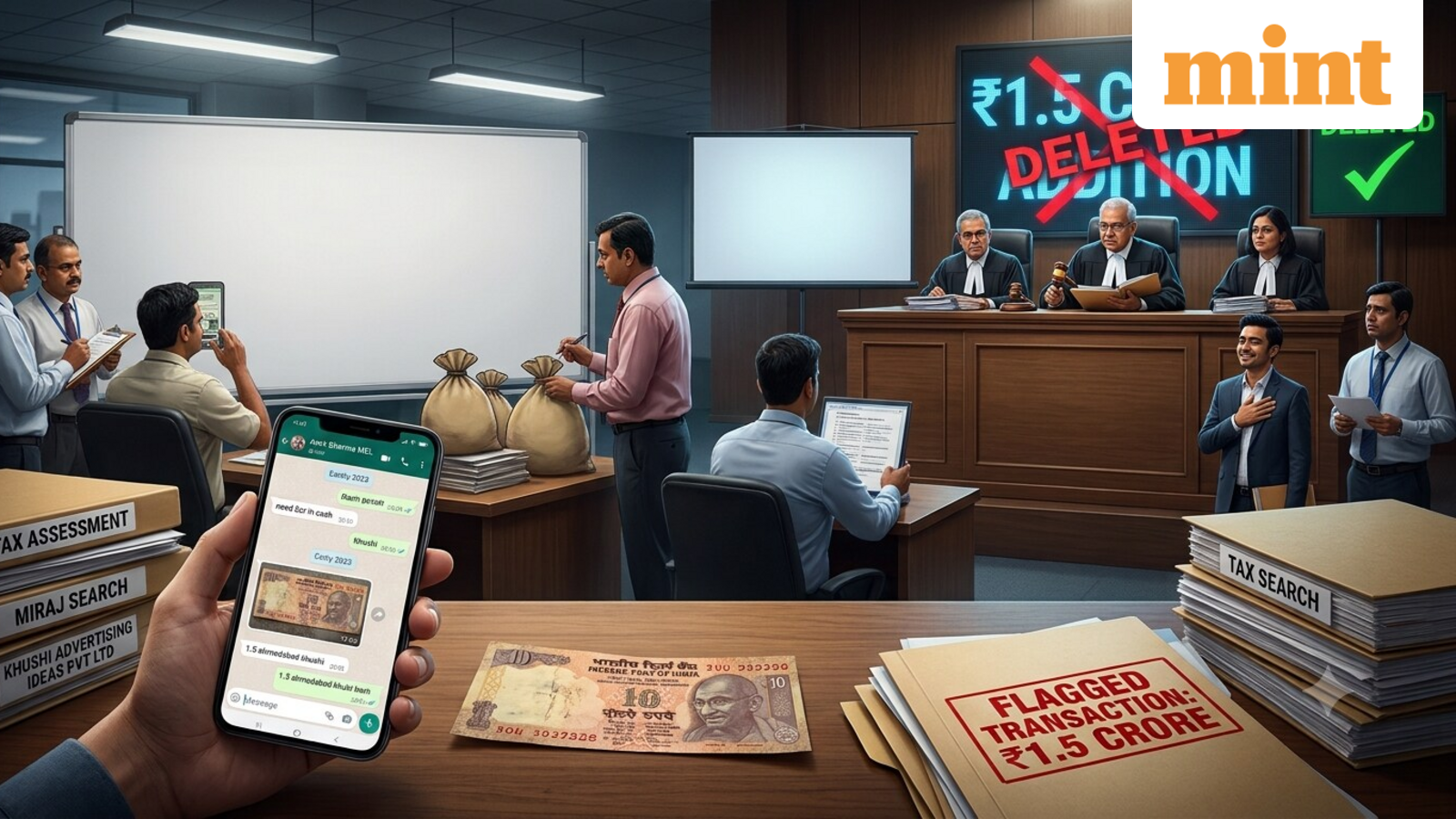
A WhatsApp conversation, a ₹10 note photograph and a statement alleging a cash delivery of ₹1.5 crore led to a tax addition against Ahmedabad-based Khushi Advertising Ideas Private Limited. The Income Tax Appellate Tribunal (ITAT), however, found that the department had not established the company’s involvement in the alleged transaction and upheld deletion of the addition.
The Ahmedabad bench delivered the ruling in DCIT vs Khushi Advertising Ideas Private Limited, ITA No. 2200/AHD/2025 on 14 October 2026, dismissing the department’s appeal for assessment year 2023-24. The tribunal held that third-party communications and statements, without corroborating evidence linking cash delivery to the taxpayer, could not sustain the addition.
How the WhatsApp conversation triggered the dispute
The matter originated in a search conducted on the Miraj Group on 21 February 2023. Investigators recovered WhatsApp conversations from the mobile phone of Amit Sharma, a director of Miraj Entertainment Limited (MEL).
According to the messages, Sharma had asked Sanjay Singh to arrange ₹2 crore in cash. Of this, ₹1.5 crore was allegedly delivered to Khushi Advertising Ideas in Ahmedabad. A ₹10 note photograph was reportedly sent to Singh as an identifying token for the transaction.
In a statement recorded under Section 132(4) of the Income Tax Act, Singh claimed that he had delivered ₹1.5 crore to a person named Ajay in exchange for the token. The department treated the messages and statement as evidence of an accommodation-entry arrangement involving MEL and the advertising company.
The assessing officer alleged that Khushi Advertising Ideas received cash from MEL and routed the amount back through banking channels. The officer treated ₹1.5 crore as unexplained expenditure under Section 69C, alleging that the company had recorded bogus expenditure in its books. The addition increased the company’s assessed income from ₹14.56 crore to about ₹16.06 crore.
Why the company challenged the tax demand
Khushi Advertising Ideas argued that the department had not established a direct link between the alleged cash delivery and the company. It pointed out that it was not a party to the WhatsApp conversation recovered from Sharma’s phone. The message contained the words “1.5 ahmedabad khushi”, which the department interpreted as a reference to the company.
Singh’s statement referred to a person named Ajay, but the department had not established that he was its employee, agent or authorised representative.
The company maintained that its dealings with MEL were genuine business transactions. It said it had submitted details of its transactions with MEL to the assessing officer. It argued that the department had not identified specific defects in the supporting documents to show that the expenditure was fictitious.
The Commissioner of Income Tax (Appeals) accepted the company’s submissions and deleted the addition. The department then appealed to the ITAT.
Why ITAT upheld deletion of the ₹1.5 crore addition
The Ahmedabad bench agreed that the material relied on by the assessing officer did not establish that Khushi Advertising Ideas had received the alleged cash. The WhatsApp exchange was between individuals associated with MEL, and the advertising company was not part of that conversation.
The tribunal observed that the reference to “1.5 ahmedabad khushi” could prompt further investigation, but could not, on its own, prove that the company was the recipient. It also noted that the department had not identified Ajay or shown that he was connected with the company.
It also considered the retraction of Sharma’s statement. A retraction does not automatically invalidate an earlier statement; it must be assessed alongside the other evidence. In this case, the messages and statements, even when read together, did not establish the company’s involvement.
The ITAT further clarified that the amount involved in an alleged accommodation-entry arrangement cannot automatically be treated as the taxpayer’s income. Any commission or other income earned for facilitating such an arrangement would have to be examined separately on the basis of evidence.
The tribunal upheld the appellate authority’s decision to delete the ₹1.5 crore addition under Section 69C and dismissed the department’s appeal. The ruling highlights the need for evidence linking a taxpayer to an alleged transaction.