
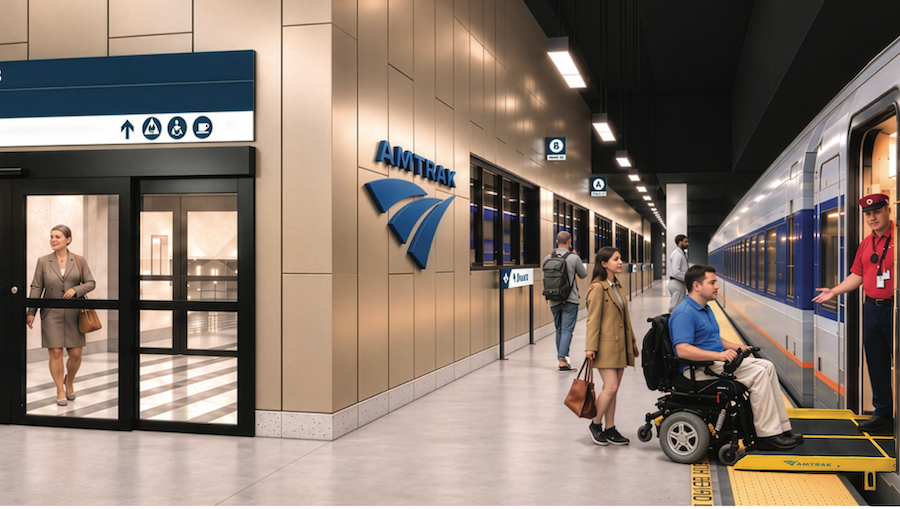
Passengers getting off Amtrak or Metra trains in Chicago Union Station at rush hour often find themselves in a lengthy queue along narrow platforms to get to the station. They then have to navigate Amtrak’s third-busiest station while contending with inadequate wayfinding, a single elevator and poor ventilation.
Their trains may or may not have been delayed due to operational issues with a 112-year-old steel vertical lift bridge three miles south, which has to be raised some 1,200 times a year. If the bridge malfunctions, trains have no other route to and from the station.
The Chicago Hub Improvement Program (CHIP) aims to fix all of these problems.
This month, Clark Construction officially began a $112-million, 30-month project that will convert dormant platforms originally built for mail and parcels into passenger platforms that will be compliant with the Americans with Disabilities Act, increase rail capacity and enhance operational flexibility, according to an Amtrak press release. These platforms were connected to a post office that operated in the area until three decades ago.
Crews will retrofit the defunct platforms to make them level with the existing four passenger platforms. “In general, we’re looking for 48 inches above the top of the rail,” says Kevin Ahern, group director of construction services with HNTB, which serves as construction and program manager for the project. WSP is the designer of record.
Current elevation gaps vary along the half-mile platform area, he notes.
Clark will also build a 14,000-sq-ft enclosed passenger boarding area that will include bathrooms and an Amtrak police presence. Currently, passengers are exposed to the Chicago weather while on the platforms.
Looking for quick answers on construction and engineering topics?
Try Ask ENR, our new smart AI search tool.
Ask ENR →
The station footprint is hemmed in on all sides by dense city infrastructure and the river, but “Amtrak has a well-used paved road underneath Union Station and the old post office that provides access for equipment, services and vehicles,” says Ahern. But crews will have to navigate remaining active tracks and passenger flows. “[Clark] will have to get nighttime outages for some work and weekend outages for significant work,” he adds.
A future project, currently in the preliminary engineering and permitting phase, will widen and lengthen existing passenger platforms, add emergency egress and improve ventilation.
The Concourse Ahead
Chicago-based Epstein, in partnership with FXCollaborative, is in the final design stage for concourse improvements. When the current concourse design was finished three decades ago, Amtrak had an annual passenger count of 2.3 million in Chicago. In 2019, that total was 3.3 million, according to an Amtrak release. Annual Metra ridership over the same period grew from 26.6 million to 32.6 million.
The project will add ADA-compliant escalators or elevators at each access point, remove old escalators, remove defunct office space and add air handling units, says Teresa Fourcher, Amtrak program director. Pending the outcome of a federal grant application and final design, construction could begin as soon as 2029. “Construction management-at-risk is being considered,” Fourcher adds.
Preliminary engineering is also underway for both near-term upgrades to the South Branch Bridge and for its eventual replacement. Bolstered by a $37.2-million National Railroad Partnership grant in August, the first project will extend the bridge’s life by a decade. Construction is expected to begin next year.
Century-old South Branch Bridge has minimal underclearance and ongoing operational issues. Photo courtesy Amtrak
The 388-ft-long bridge has a main movable lift span of 273 ft and only a 10-ft underclearance. It must be constantly lifted to provide up to 130 ft of clearance for marine traffic.
For Amtrak and Metra, “it is the umbilical cord,” says Joe Shacter, Amtrak director of program management for CHIP, noting that 560 trains pass over it every week.
In extreme heat, sprinklers are used to cool the deck and keep it from warping, he notes.
The grant also funds preliminary engineering and environmental permitting for the planned new bridge. According to Amtrak, the new structure would have 11 ft more clearance, eliminating 90% of annual lifts.
Sandwiched into a tight alignment that passes through an industrial area and squeezes into Union Station’s footprint, and with historical and community issues to address, the current phase is expected to take about five years.
A plan is currently in final design to restore double track to 19 miles of alignment between Chicago and Southwest Michigan, says Suzanne Mosher, Amtrak senior director of capital delivery. The double-tracking will allow trains in opposite directions to pass each other without stopping. Construction is anticipated to begin next year.
Source: www.enr.com



