
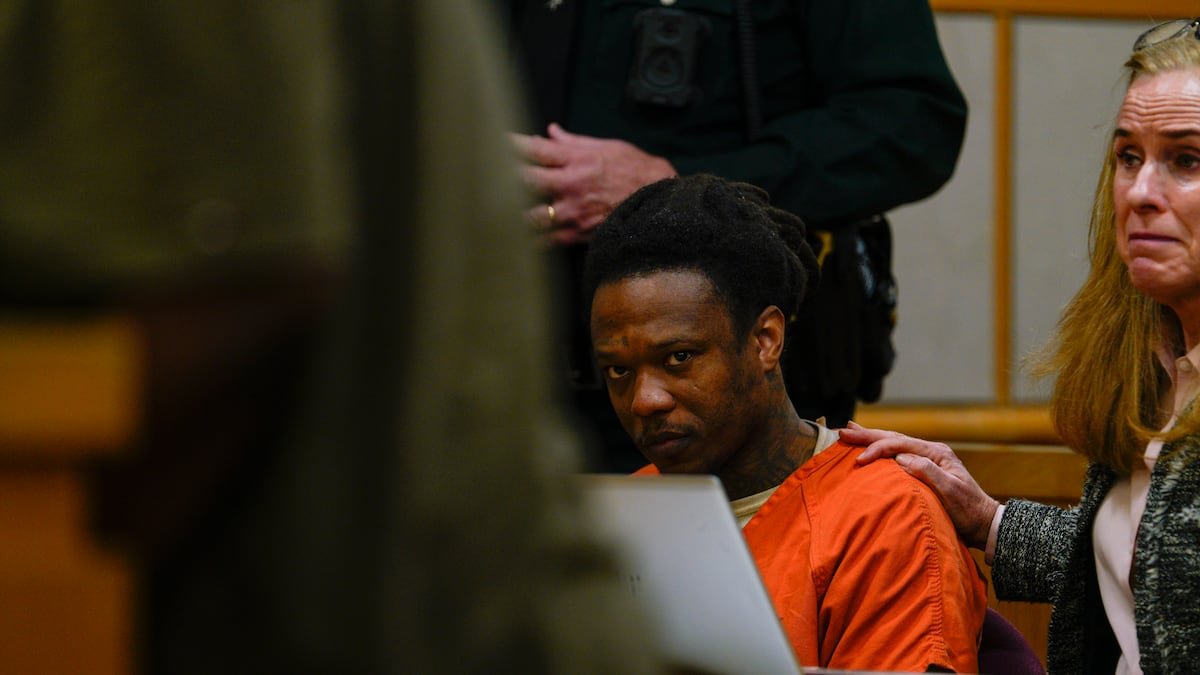
Shirleylene Harilal sat on a cramped courtroom pew, playing with the rings on her weathered hands as she waited for the judge to address her son’s case.
It was about the 40th time in the last five years that she found herself there.
Her son, Cornelius Whitfield, 37, faces charges of shooting her and killing her mother, grandmother and brother at their family home in St. Petersburg on Feb. 16, 2021. Two weeks earlier, he’d shot two of his friends — one fatally, prosecutors say.
In July, Whitfield was ready to plead guilty to the killings and accept a mandatory sentence of life without the possibility of parole. But the prosecutor on the case rejected the offer, insisting on continuing to seek the death penalty despite tearful pleas from surviving family members.
Now, with the case before a new judge and new defense attorney, the clock has essentially restarted. At the hearing Harilal waited for in October, the judge set a date for the next one.
“We’re all sick of this and ready for it to be over,” Harilal said over a mug of coffee on a recent afternoon. “Every time I go, things change. It’s frustrating, and it’s getting aggravating.”
‘We’re at an entirely unusual position’
The defense presented the plea offer to State Attorney Bruce Bartlett’s office a week before the July 24 hearing.
Assistant State Attorney Thomas Koskinas said he needed time to speak with Bartlett and the victims’ family before reaching a decision, according to a transcript of the proceeding.
When Judge Philip Federico asked whether the state would accept the plea offer the following week, Koskinas replied, “Rejected.”
“It seems as though they have rejected it out of hand without consultation with the people who are going to be most affected by this,” public defender Julia Seifer-Smith told the judge.
In response, Koskinas accused the public defenders of intentionally delaying the case.
“I find it hard to believe that they can stand here and chastise the state with a straight face when they know what they’ve done,” he said.
Federico said he was “at a loss” about the situation.
“We’re at an entirely unusual position having this conversation, and on top of that, we got to start all over again,” the judge said.
Federico then allowed the victims’ family members to address the court. Leslie Carter, the mother of Darren Lorenzo Barnes Jr., who was 31 when he died, begged for an end to the cases.
The state is not seeking the death penalty for Barnes’ killing. But if Whitfield is found guilty, prosecutors plan to use the conviction as an aggravating factor in support of a death sentence for the killings of Whitfield’s family members.
Rashad Whitfield, Cornelius Whitfield’s older brother, stood in the front row of the gallery waiting to speak. When he approached the podium, he said he lost his grandmother, great-grandmother and uncle that February day.
“We all want this over,” he said. “If he’s going to admit, let him admit. Please don’t drag us no more. I’m not trying to live another year, three or five years, chasing behind this.”
Federico suggested that Koskinas listen to the victims’ family members and conclude the cases.
Koskinas had a tense exchange with the judge, arguing that Whitfield deserves the death penalty and his office has the right to pursue it.
“We are still so far from that point we’re literally going to spend tens of thousands of dollars if not hundreds of thousands of dollars,” the judge responded. “He’s willing to accept responsibility and never be released from prison.”

Koskinas accused the judge of favoring the defense and said he was going to seek to disqualify him. Two weeks later, he filed a motion arguing that Federico was “advocating under the guise of practicality” and had created a “reasonable fear of bias against the State of Florida for continuing to pursue the death penalty.”
The most recent hearing in the case was on Nov. 4, before a new judge. A trial date for Barnes’ death and the attempted murder of Rodney Green was set for August.
In a phone call with the Tampa Bay Times, Koskinas said his office does not need to honor the wishes of next of kin because “the three decedents in this case have no voice.”
“The defendant qualifies for the death penalty in this case, and the jury can ultimately make a decision,” he said.
Florida leads the country in pursuit of death sentences
Florida has become the leading state in the use of capital punishment, executing 20 people so far this year, with two more scheduled in December. In support of the death penalty, Gov. Ron DeSantis has often pointed to the interests of victims’ next of kin.
Mitigation specialist Christine Scott says that’s part of what makes Whitfield’s case unusual.
Scott helps family members of victims and defendants prepare for the possible penalty phase in capital cases. Part of her job is to try to reach an agreement with the state before a case goes to trial.
The Pinellas-Pasco Public Defender’s Office hired Scott to work on Whitfield’s case in 2025, and she did so until the office withdrew in September.
“I’ve never had a situation where a client offered to plead to life without the possibility of parole and the prosecution said ‘no,’” she said. “I hope that somebody will do what is right eventually and let this be over for the people who have been deeply in pain about it since February 2021.”
Bartlett told the Times that Koskinas’ stance aligns with how his office feels about the case.
Whitfield qualifies for the death penalty, the state attorney said, and he doesn’t feel life in prison without the possibility of parole is a guarantee.
“Do we want this guy back out again?” he said. “Maybe the family doesn’t get to make that decision. You have to look at the circumstances and the situation.”
Bartlett said he has never directly spoken with the next of kin.
“We always make it a point to talk to the family of the victim, but it’s a little more complicated when the victim is in the defendant’s family,” he said. “We had our input from the defense lawyers. They have the opportunity to talk to us in court.”
The defense attorneys on the case left the public defender’s office at the end of July for unrelated reasons, and the office withdrew from the case in October.
It’s not uncommon for offices to withdraw from capital cases because of the workload. The public defender’s office and the Office of Criminal Conflict and Civil Regional Counsel — which also withdrew in October — do not have to provide reasons for doing so.
If both of those offices withdraw, the Florida Supreme Court provides a list of lawyers qualified to represent clients in capital cases.
David Joffe, a federal defense attorney based in South Florida, got the call to represent Whitfield late last month. Despite his heavy caseload, he agreed.
Joffe said he doesn’t anticipate a resolution short of trial.
“I think this prosecutor has made his position known,” he said. “We can agree to disagree.”
‘She went through hell’
Daniela Camacho represents Harilal on behalf of Gulfcoast Legal Services, a legal aid organization that, among other things, helps voice crime victims’ wishes in court.
“Her voice is, she doesn’t want the death penalty to be applied because she went through hell,” Camacho said. “She’s already buried her whole family; she just doesn’t want to bury her son as well.”
Patricia Ann Whitfield Sharpe, 66; Sallie Hobbs Whitfield, 83; and Antonio Maurice Graham, 45, are buried at Woodlawn Memory Gardens in St. Petersburg. Harilal says she often visits with her grandchildren.
“He already knows what we want, so why is he still prolonging it?” she asked, referring to Koskinas. “What is he trying to gain out of this? That’s what I want to know.”
Between sips of coffee, Harilal scrolled through photos of her family on her phone and paused on one of her mother smiling in a light yellow blouse.
“I miss you, Mommy,” she whispered into the phone.



