
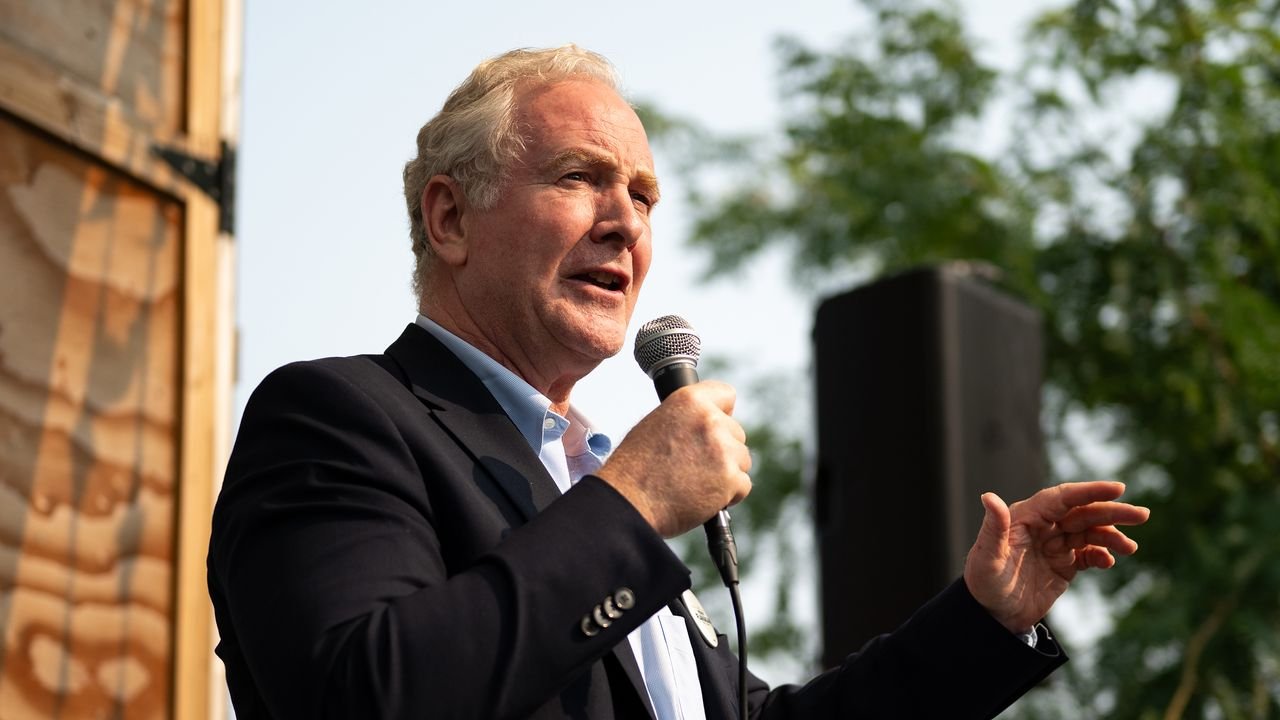
Van Hollen began his political career as an aide to the Maryland senator Charles Mathias, a moderate Republican. Five years later, he won a seat in Maryland’s House of Delegates, the first in a series of victories that would distinguish Van Hollen as something of a ruthless operator. He ascended to the state Senate by primarying a former mentor, Patricia Sher, the Democratic incumbent, who described Van Hollen’s challenge as “like one of my sons has kicked me in the mouth with a boot.” When Van Hollen ran for the U.S. House, in 2002, some of his colleagues saw the move as an act of blind ambition. “Once he decided to run for Congress, I think he lost his compass a little bit,” Barbara Hoffman, a state senator, told the Washington Post at the time.
No matter: Van Hollen beat Mark Shriver, a nephew of John F. Kennedy’s, in the Democratic primary, then ousted the Republican incumbent that November. He rose through the ranks of House leadership as a budget wonk and twice chaired the congressional Democrats’ campaign arm; Pelosi regarded Van Hollen as a possible successor. Instead, he ditched the House for the U.S. Senate in 2016. (Schumer, then the third-ranking Senate Democrat, had backed Van Hollen in the primary.) Some of Van Hollen’s skeptics have questioned whether his run for Senate leadership is an attempt to reclaim what might have been in the House. “With respect to whoever’s pushing this meme out, that’s a bunch of nonsense,” Van Hollen told me. (He says he spoke to Pelosi ahead of his challenge to Schumer, but declined to share specific details of the conversation.)
At the start of the second Trump Administration, Democratic leadership seemed “kind of content to, as James Carville said, ‘play possum’ and wait for Trump to fuck it up himself,” Leah Greenberg, a co-founder of the grassroots group Indivisible, said. Schumer’s decision to join eight of his Democratic colleagues in voting with Republicans to avert a government shutdown, in March, 2025, had especially disappointed the Party’s left flank. Representative Alexandria Ocasio-Cortez, of New York, who is considering a primary run against Schumer in 2028, called his sidestep a “tremendous mistake.”
Van Hollen, meanwhile, seemed eager to shine a light on the Trump Administration’s abuses, casting himself as an avatar of Democratic fury. When Kilmar Ábrego García was deported, Van Hollen sought to meet with the President of El Salvador, Nayib Bukele, while Bukele was in town visiting Trump; Van Hollen didn’t receive a response, so he went down to El Salvador himself. “That was a moment that really inspired a lot of our folks at a time when they were desperately looking for signs of life out of Washington,” Greenberg said.
Van Hollen has also become one of the loudest advocates for placing conditions on U.S. military aid to Israel. “I grew up overseas, and I take seriously the idea that the United States should stand up for its values,” Van Hollen told me. “I think we lose credibility entirely if we do not apply those standards across the board. ” Schumer, who is Jewish and has described a deep connection to the Israeli state, has taken a more restrained approach, backing continued arms support for the country while calling for new elections to replace Israel’s Prime Minister, Benjamin Netanyahu. In 2024, when Netanyahu addressed a joint meeting of Congress, Van Hollen boycotted the event. Schumer, who had joined congressional leaders in inviting Netanyahu, attended but chose not to shake the Prime Minister’s hand. Paul Pinsky, a former colleague of Van Hollen’s in the Maryland legislature, supported Van Hollen’s stance, but also cautioned him that it could be politically risky. “I said, ‘Chris, you’ve got a lot of Jewish folks in your neighborhood in Montgomery County, and I’m sure some people were pissed off when you challenged Schumer and Netanyahu,’ ” Pinsky recalled telling him. Van Hollen was unmoved. “He said, ‘Look, more and more people are going to get tired of this,’ ” Pinsky said. “And he was right.”
The Maryland senator’s clash with Schumer over Israel spilled from policy into politics last September, when Van Hollen, addressing the Polk County Steak Fry, in Iowa, a popular stop for Presidential hopefuls, endorsed Zohran Mamdani’s candidacy for mayor of New York City—and admonished New York’s congressional leaders, Schumer and Hakeem Jeffries, for not yet doing so. (“Chris Van Who?” a spokesperson for Jeffries told the Times in response.) Jeffries would eventually endorse Mamdani, on the day before early voting began, but Schumer never did. “I made the point that there was supposed to be a big-tent party, from [Joe] Manchin in West Virginia to Mamdani,” Van Hollen recalled.