
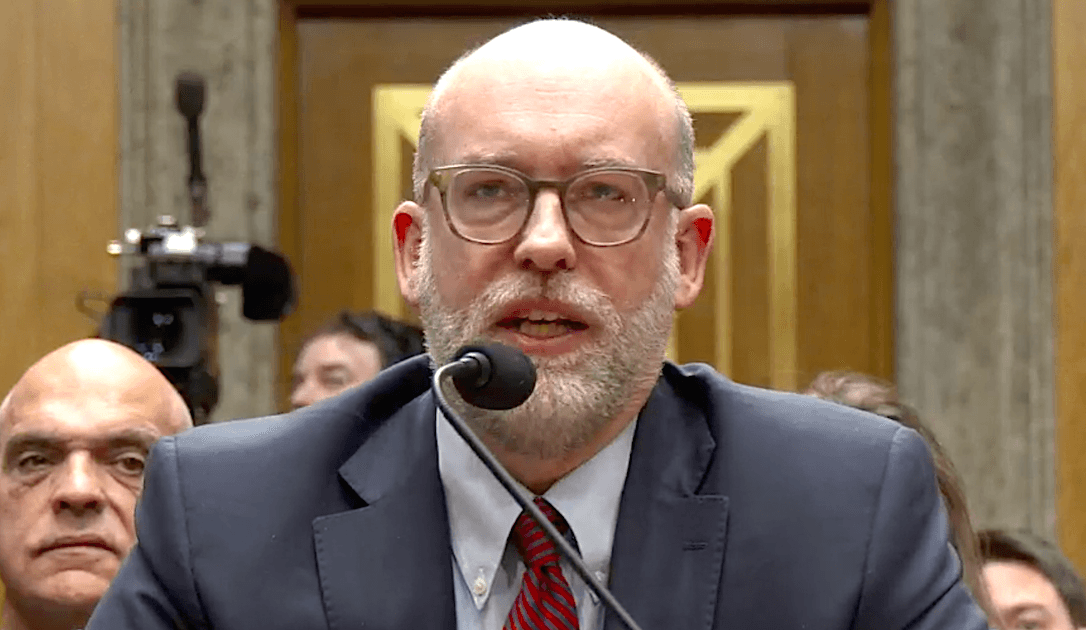
President Donald Trump’s budget chief has directly taken over managing the classified spending plans of major U.S. intelligence agencies, just as the administration works to further shrink the spy community’s top office.
Russell Vought, director of the White House Office of Management and Budget (OMB), assumed hands-on responsibility for overseeing the secret budgets following the recent departure of Amaryllis Fox Kennedy, a senior intelligence official who simultaneously served in multiple roles, including one at OMB.
Four people familiar with the matter said it is unclear how long Vought will handle the day-to-day budget oversight for spy organizations like the CIA, the National Security Agency and more. The secret allocations are typically overseen by someone with deep expertise in the intelligence community.
“To have the director get personally involved in some of these things is not necessarily unusual,” said one source, who spoke on the condition of anonymity because Vought’s new level of involvement hasn’t been publicly disclosed. “If it lasts for the rest of the administration, that’s unusual, because you just don’t have the bandwidth, the expertise or the time to deal with all that. He still has to run the rest of the federal budget and that’s a big job.”
While such a shift might not have raised eyebrows in previous administrations, these people who spoke to Recorded Future News pointed to the ongoing confluence of events within the clandestine community, with Trump naming federal mortgage chief Bill Pulte as director of national intelligence with orders to downsize that office, as well as Vought’s past as an architect of the controversial conservative governing plan Project 2025.
For the upcoming fiscal year, the administration has requested almost $82 billion for the National Intelligence Program and $50 billion for the Military Intelligence Program, which together cover the totality of the spy community and would be under Vought’s increased scrutiny.
“Does Russ think this stuff is cool? Does he think there’s a ‘Deep State?’ Is he going to do a purge? Is it just playing into the Pulte stuff? We don’t know,” another person said.
OMB did not respond to a request for comment.
Kennedy, a daughter-in-law of Health and Human Services Secretary Robert F. Kennedy Jr., was named to be one of a handful of program associate directors at OMB after Republican senators rebuffed an effort to make her deputy director of the CIA.
The political appointment put her in the upper echelons at OMB. She was later also named a deputy to former Director of National Intelligence Tulsi Gabbard and made a member of the President’s Intelligence Advisory Board.
The intelligence budget post, which previously also covered national defense, works closely with the National Security Council. The role was so powerful that some saw it as a “shadow” national security adviser.
Still, even the pared-down position made Kennedy, a former CIA undercover officer, what is sometimes called in the spy community a “super user” — with an outsized role in overseeing every facet of the national security apparatus, including the cost of her past agency’s covert actions around the globe.
The unique security clearances required to fill the job might be one reason why Vought, who as budget director already has access to the nation’s most closely held secrets, has taken the intel reins.
“There are so many classification ‘read-ins’ that you need in order to oversee this that it’s very, very hard to do it quickly,” the first source said, referring to access given to compartmented programs.
It also necessitates a “level of expertise that it’s really hard to get” and political savvy because when the White House weighs in on the intelligence account, it’s “principally over the stuff that’s the most sensitive and the most relevant to the administration’s policy priorities,” they added.
OMB also has a deputy associate director and an intelligence branch chief, positions that have traditionally been filled by careerists who could move up into the role Vought is filling. The current administration, however, has often favored political loyalty over bureaucratic expertise when filling senior positions.
A third source speculated that Vought added the intelligence job to his portfolio due to the nature of Kennedy’s departure. It was initially reported she stepped down over Trump’s war with Iran, but in a subsequent interview she said she quit over concerns about the CIA’s use of taxpayer funds. Vought could share similar views.
The CIA “has never been audited. It has all these front companies and they’re paying firms to place agents surreptitiously,” this person argued. “Are we paying for things just because we’ve done it for the last 30 years or is this still an intelligence priority that this person or this role is fulfilling?”
Another possible draw for Vought is the intelligence community’s work on a cryptography-breaking quantum computer, the person added.
Trump last week signed two executive orders accelerating U.S. quantum technology development to achieve such a device by 2028 and requiring federal agencies to transition to advanced quantum-resistant cryptography by 2031. It came on top of a $2 billion government investment program targeting nine quantum companies.
“Billions of dollars is going towards this and they want to make sure it’s being done right,” they said, suggesting the effort will cost “tens of billions” to accomplish.



