
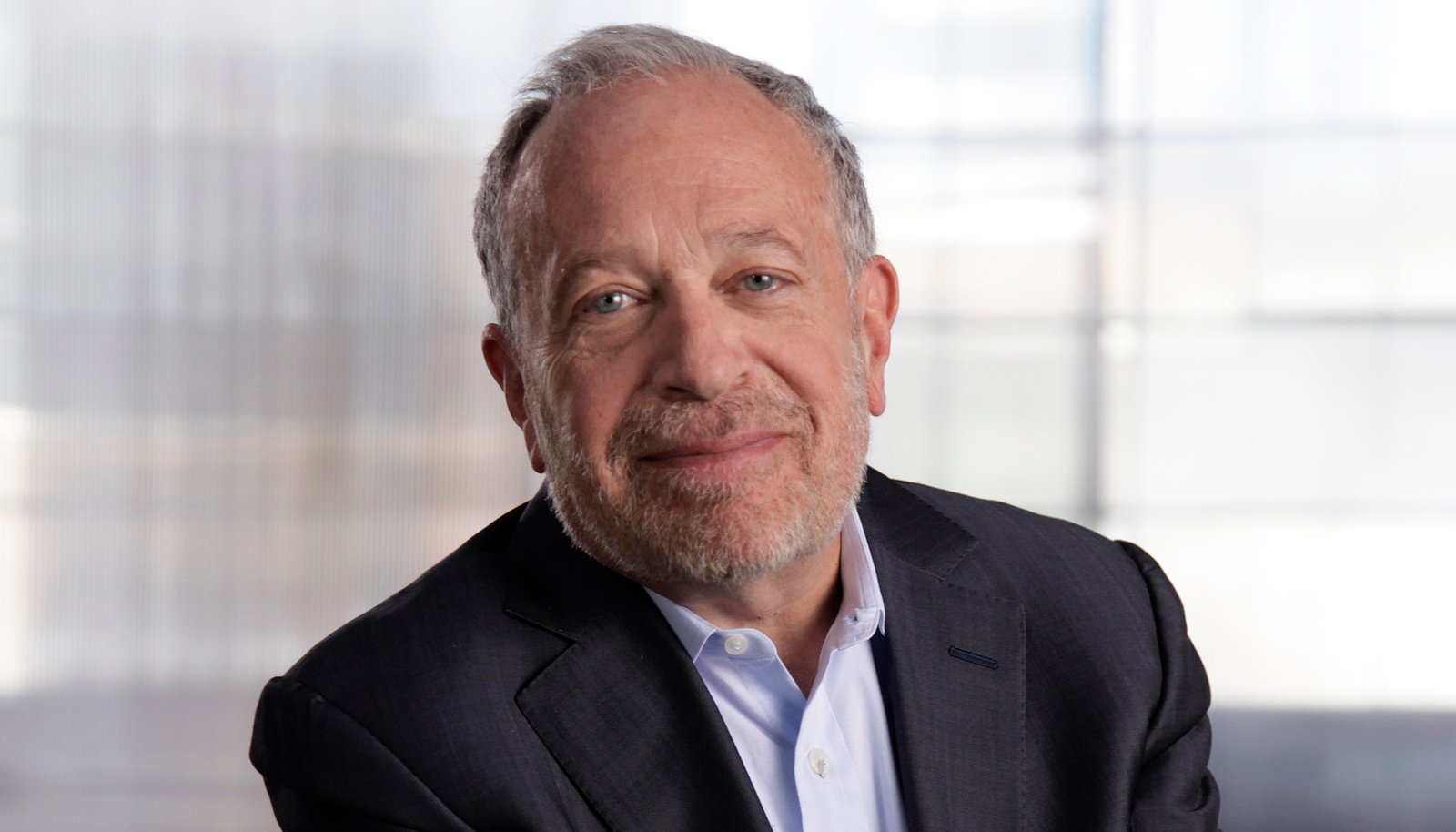
Across the span of six decades, Robert B. Reich has had two constant commitments: to social justice and to teaching. In Reich’s universe, one is not more important than the other. They are interrelated, inseparable and self-reinforcing.
Three years after taking emeritus status at UC Berkeley, Reich’s voice remains as trenchant as ever, and perhaps even more ubiquitous. He is a regular on television news and talk shows and the subject of a popular 2025 film, The Last Class. His autobiography, Coming Up Short, was a bestseller last year. He has his own podcast, and he’s omnipresent in the digital realm, daily and sometimes hourly calling out leaders and policies who threaten disadvantaged people or democracy itself.
Now Reich has been named to deliver UC Berkeley’s 2026 commencement speech on Saturday morning, May 16, at California Memorial Stadium — a huge live venue that is sure to be rocking. But in an interview with UC Berkeley News, the assignment had him in a reflective state of mind. He offered little partisan fire, but rather a deeply thoughtful consideration of the turbulent world that awaits this year’s graduates, much as turbulence awaited his graduating class at the end of the 1960s.
Reich’s career spans an extraordinary age of conflict and change in America. Before joining the faculty of the UC Berkeley Goldman School of Public Policy in 2006, he served as an adviser to top political leaders of both major parties, including four years as secretary of the Department of Labor under President Bill Clinton. He has written 18 books and won a trove of honors.
And though he is often known today as a standard-bearer among American liberals and progressives, in the interview he rejected the left-right taxonomy that often molds U.S. political thought. Instead, he emphasized the importance of questioning one’s own assumptions and of being open to opposing viewpoints — a message he’s delivered to generations of students.
UC Berkeley News: What’s your mindset as you prepare for the commencement address? What issues are you thinking about?
Robert Reich: I want to center it on the students, on the people who are graduating. They have a huge challenge in front of them. I don’t remember a time when the country was more challenged, when the job market was more difficult, when uncertainty reigned as intensely.
I also love Berkeley students. I want them to have wonderful lives. And I want to center my remarks on a positive note. I haven’t written my remarks yet, but I want to inspire them.
Courtesy of CoffeeKlatch Productions
I can’t help but ask: On the political right, some commentators have already made note of your selection — a well-known progressive scholar and critic of the current administration. I imagine there may be some Berkeley students, faculty and staff who feel the same. Why is your talk going to be important to people across the spectrum, right, center and left?
I don’t consider myself politically pigeonholed. Most of the larger questions facing this country — and indeed facing anybody who’s graduating this spring — don’t have to do with left or right. They have to do with the future of the country and the future of the world.
One of our problems is that we have bought into this left-right distinction, this notion of polarization. We are polarized, but it seems to me — and I told this to my Berkeley students for almost 20 years — that the best way of learning is to talk with somebody who disagrees with you. The best way of testing your ideas is to test them against the values and assumptions of somebody who is very different from who you are.
So I think criticisms in advance from people who probably have not read my work and certainly have not been in my classroom are irrelevant, quite frankly.
Let’s go back in time a little bit. You graduated from Dartmouth in 1968 — what was the zeitgeist at that time? What forces were shaping the era and shaping you?
It was, in many ways, a terrible time. Robert F. Kennedy was assassinated in June that year. Martin Luther King Jr. had been assassinated in April. Our cities were in flames.
The country is enormously resilient. We have been through terrible times before. We always seem to learn something.
Robert Reich
I had worked on the Eugene McCarthy presidential campaign, to no avail. Hubert Humphrey was getting the nomination. Friends of mine were getting beat up in Chicago at the Democratic Convention. Other friends of mine were being drafted and sent to Vietnam. I thought there was a chance I would be as well. Thousands and thousands of Americans were being killed there. Tens of thousands of Vietnamese were being killed.
In a few months, Richard Nixon would become president of the United States. Can you imagine a worse time in our nation’s history? Well, some would say today is worse, but it was very, very bleak.
It’s an interesting comparison. How were the mood and the spirit of that time different from the climate today?
There are very many similarities. I think some people then thought the American experiment was over, that the polarization was too extreme for us to go on.
I remember at my graduation, the speaker urged us graduates not to go to Vietnam, not to be drafted, but to escape America, to go to Canada. And upon saying that, I remember looking in the stands at parents who were aghast — there were fistfights among parents who were so upset with each other. The tensions were palpable.
I was fortunate enough to have won a Rhodes Scholarship, and I headed off a few months later for England, for the U.K. Which was a great escape in certain ways. But the anxieties, fears, worries about the country and about where we were heading hung over me and all the other Rhodes Scholars at the time. Including a young man I met on the boat heading over to England named Bill Clinton, who offered me chicken soup when I was seasick. We talked endlessly about politics.
I maintained my optimism, I think, in ways that I do now. I think the country is enormously resilient. We have been through terrible times before. We always seem to learn something. And I’m especially optimistic because of the young people who I have taught for over 40 years, almost 20 of them at Berkeley.
Do you think that students in the late ‘60s, those incredibly trying times, were different in a fundamental way from students who are living through their own trying times today?
Not in any fundamental way. That is, in 1968, we didn’t have the problem of a terrible economy, a terrible job market, and really the economic headwinds that students are facing today. But by the same token, students today don’t have the Vietnam War hanging over them like a sword of Damocles.
I’ve taught for years a very large class called Wealth and Poverty, in Wheeler Hall. The real difference is that students today are more diverse, more interesting. I think they’re smarter, if that generalization is not too bold.
I’ve often wondered whether both the class of ‘68 and more recent classes are characterized by a deep insecurity— they fear for the future generally, and for their own future. The challenge might be Vietnam, or a very difficult economy, the rise of AI …

On the one hand, yes, the graduates of 1968 were graduating into extraordinary political turmoil and uncertainty. The graduates today are graduating into extraordinary economic uncertainty. There is also political turmoil, obviously, but the economic uncertainty and economic challenges are much, much greater than they used to be.
Now, what does that mean? I graduated from a prestigious university. I didn’t really know it at the time, but the odds were very high that I would survive economically. And also high that I would not, because of my privileged position, have to serve in Vietnam. Turned out that I didn’t have to serve because I was under the minimum height requirement.
Berkeley graduates are also in a privileged position. Berkeley is the best public university in the world. My personal view is that it’s the best university in the world. Berkeley graduates will not have the kind of economic challenges faced by most graduates today. That doesn’t mean that they will be unchallenged, but they begin very far ahead in the game.
Some writers have commented on the lack of student protests at this time. There’s a war, extreme polarization, conflict over civil rights, worries about the future of democracy. Does the relative quiet of college campuses right now seem surprising to you?
No, it doesn’t. The degree to which students actively protest comes and goes. There are periods of intense student activism and then periods of quiescence. I don’t have a formula for why and how that happens.
Be patient. Don’t worry about failing. You’re gonna fail, inevitably. … If you don’t fail, it means you haven’t tried.
Robert Reich
When I came back to the United States after being in Oxford for two years, and I started law school, it was extraordinarily quiet. It was as if the air had suddenly gone out of the tires of America. There were no protests. And yet, the Nixon administration was doing terrible things. And the Vietnam War was continuing.
I don’t think we can draw too many conclusions from how many protests, or where, or how. I don’t believe that the Trump administration has silenced America’s students. I don’t think that America’s students could be silenced if they wanted to raise a ruckus.
In your biography that came out last year, you had a line that hit me as such a perfect distillation: “Teaching is about getting students to re-examine the assumptions they entered the classroom with.” If you were talking to students now, what assumption would you ask them to reconsider?
One assumption is that efficiency is good. Another is that economic growth is inherently positive. A third is that the free market knows best. Another is that big corporations are inherently bad. Another: that wealthy people are suspect. I would hope students would question those assumptions and ask themselves why they have them.
Thinking again about your past and your present: If you could talk to the young man that you were in 1968, would you have any advice for yourself? And would this advice hold for students today?
I’d say: “Be patient. Don’t worry about failing. You’re gonna fail, inevitably. I would worry if you didn’t fail. If you don’t fail, it means you haven’t tried. Everything will work out fine, barring ill health and bad luck.
“Be true to your own integrity — that’s one of the most important things you have. Check in with yourself on that.
“On the other hand, don’t be too hard on yourself. Try to love yourself. Not because you want to be boastful or lord it over anybody else, but because if you love yourself, then you can possibly be true to your authentic self and true to values that matter.”
I would say all of that to my little 22-year-old self.
Do you have any closing thoughts?
I don’t mean to be hokey or corny, but UC Berkeley really is an extraordinary institution. I’ve been a student at and taught at a number of other great places, but there is really no place like Berkeley.
Because —
Because the students here are truly kind and smart and helpful to one another. And the faculty is not just brilliant, but deeply cares about teaching and learning. The staff are superb. It is the exemplar for what higher education ought to be, in my humble opinion.
This interview has been lightly edited for length and clarity.



