
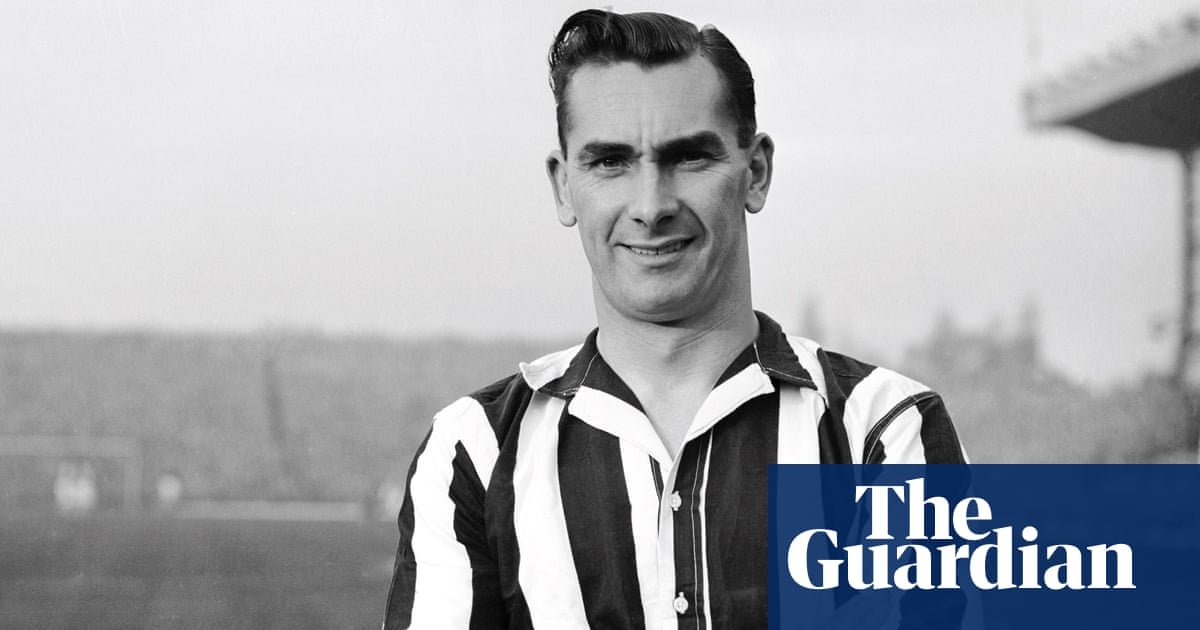
Of all the footballers who have worn the black and white, that possessive geordie pronoun “Wor” (our) was unique to Jackie Milburn; for he was a man of the people as much as he was a great sportsman. In that respect, his birthplace of Ashington in Northumberland only added to the mythology.
“The biggest pit village in the world,” as it was known, was the north-east in microcosm – a one-horse coal town where miles of identical terraced houses spread out from the pitheads and the menfolk were obsessed by whippets, leeks, association football and pints in the club. Nevertheless, he had a self-discipline that saw the pitfalls of alcohol: “Certainly it prevented my dad, Alec Milburn, from making the big time,” Jackie recalled. “He could have gone to Tottenham but preferred to stay home and drink his ale.”
At the St James’ Park homecoming following the 1951 FA Cup final, “Wor Jackie” (by which epithet his skipper Joe Harvey introduced him) was invited to address the throng. “At first I tried to ‘talk posh,” Jackie later recalled, “then there was a roar of laughter when a voice shouted, ‘Taak tiv us in your own language, Jackie!’” The dialect of Ashington is one of the most melodious varieties of the ‘pitmatic’ geordie of the coalfields, and still the butt of numerous jokes to this day (when an electrician asked a barmaid where the mains were, the answer came, “Tha just doon there, past the ladies.”)
Jackie’s lineage was important, for Ashington was an unusually fertile footballing hotbed. His great-grandfather, “Warhorse” Milburn, had kept goal for Northumberland in the 1880s, and young Jackie grew up reading about the Football League exploits of his four Milburn cousins who played professionally, while another cousin, Cissie Charlton, née Milburn, was later almost equally famous as the mother of World Cup winners Jack and Bobby.
Although the coalmines of Ashington demanded their human tribute, professional football was a feasible way out for many – and Milburn once counted 47 local boys he knew of who had played in the First Division. In his 1957 autobiography Golden Goals, he recalled waking early one Christmas morning to find a new pair of football boots at the end of the bed. He slipped them on straight away and headed out into the back lane at half past three in the morning only to find “most of my friends, wearing their new boots, playing football by torchlight in the middle of the street”.
The prevailing work ethic in pit villages throughout the coalfield helped to mould such formidable players. Miners were famed for their stamina, and with generations of pitmen in his family tree Milburn’s genetics shaped the way he played. In Ashington folklore it was told that Jackie kicked the same stone to school and back for three years, and his one-time teammate Len Shackleton was always impressed by his tenacity and “never-say-die spirit”. This was exemplified by tireless high pressing, and a trademark sliding tackle that hooked the ball from any defender unwise enough to prevaricate on the ball. In his early life he had made money as a sprinter, competing at Edinburgh in the famous Powderhall Handicap and running 100 yards in around 10 seconds.
With his pace, allied to phenomenal shooting power with either foot Milburn rightly takes his place in the Newcastle pantheon. His record of 200 goals in 401 appearances is second only to that of Alan Shearer.
Until 1948 Milburn combined football with work at local collieries, and as he didn’t then have a car, with almost too-perfect symbolism he would take the bus from Ashington into Newcastle with the same supporters who would pay to watch him. “The size of the crowd meant that it sometimes took us up to three-quarters of an hour to walk up the bank and round to the players’ entrance,” Milburn recalled. “But what could we do? Our supporters were a marvellous warm-hearted lot. They even flooded the club with clothing coupons to help kit out the side.” That cosy, close-knit and deeply sociable world of the postwar north-east suited Jackie down to the ground.
“He was everybody’s friend!” wrote his famous second cousin Jack Charlton. “If you ever walked through Newcastle with him, you got stopped every two minutes; everybody said hello to him.”
Yet he never sought this fame, and it’s telling that whenever he went to the pictures in Ashington, he always waited until the lights were down before he entered the auditorium. Here was a modest and even shy man, who shared the small-c conservatism that characterised the otherwise Labour-voting north-east. He was thrilled to meet Winston Churchill at Wembley in 1952 – “the greatest hero of my life whose bust has occupied pride of place in our house since 1948” – as well as the ailing King George VI, whose courage he admired.
In Golden Goals Milburn presents an image to the world of domestic bliss with his wife, Laura, admitting his aversion to gardening and patterned socks, and his enjoyment of watching TV, reading thrillers and going to the dog track most Wednesdays (greyhounds were always a miners’ passion).
Due to the dominance of a handful of dangerous, heavy industries it was a truism to say that communities across the north-east thrived on being in it together. This may have been one of the reasons why Jackie never quite made a consistent mark on the international stage, despite his 13 caps and 10 goals for England. In later life he confessed that many of his international teammates were too self-obsessed to play as a team and even suggested that “one or two of them were outright snobs”.
Milburn became talismanic for Newcastle. When United’s new manager Dugald Livingstone took the probably rational decision to drop the ageing Milburn for the 1955 FA Cup final against Manchester City on form and fitness grounds, the wily former manager Stan Seymour – by then back upstairs in the boardroom – stepped in to overrule him. Milburn was duly reinstated and would score what was then the fastest Cup final goal – with a rare bullet header from a corner after only 45 seconds.
The people of the area saw in Jackie Milburn the image of their favourite son. He was modest, witty, warm and honest. He was effortlessly, unaffectedly dashing and handsome. He was hard when necessary, but always ready with a grin and a conciliatory word. He was a canny lad with a passion for his homeland.
He was never cautioned in his 14-year career, and the noted First Division whistler Arthur Ellis concluded that: “If there were 22 players on the field like Jackie you wouldn’t need a referee!” His teammate Joe Harvey noted that Jackie was “gentle and generous in victory, always first with the handshake in defeat”, and Milburn himself conceded that his innate courtesy, and tendency to play in colleagues when he had a chance to shoot himself, was a drawback. “I had a lack of devil.”
It’s amazing to think how much more lethal a ruthless Jackie Milburn would have been. But then he probably wouldn’t have been so endearing.



