
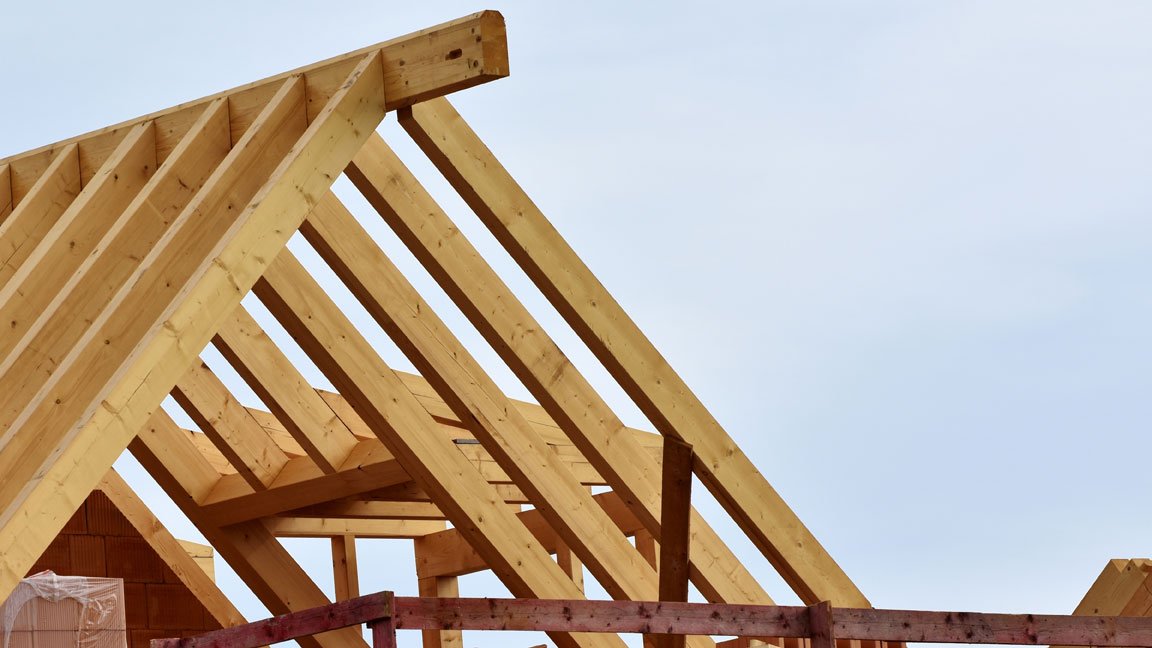
 WASHINGTON — Legislation to increase the country’s housing supply, in part by limiting the number of homes that corporate buyers can control and speeding the permitting process, will soon become law — if President Donald Trump eventually agrees.
“This is going to help build more housing in America,” Sen. Andy Kim (D-NJ), who played a role in writing the compromise legislation, said in a recent interview with NJ Spotlight News. “And that will help give people more opportunities to own and rent.”
Trump blindsided lawmakers Wednesday — Speaker Mike Johnson was caught unaware — when he refused to sign the housing bill that lawmakers had worked on for months. Instead, the president demanded that Congress pass a restrictive bill that would make it more difficult to register to vote.
Passage in the House or Senate of that voting bill is highly unlikely.
So rather than a rare legislative breakthrough capped with a bill signing, workers in Statuary Hall, a ceremonial space in the Capitol, dismantled a stage and removed chairs, a desk and the presidential seal.

Months of negotiations
A product of months of negotiations between the House and Senate banking committees, and among Republican and Democratic legislators, the bill cleared both chambers this week. Every New Jersey lawmaker in Washington voted for the bill except for Reps. Tom Kean Jr. (R-7th), who has been out with an undisclosed medical condition since March, and LaMonica McIver (D-10th).
McIver had a scheduled hearing at a federal appeals court in Wilmington this week. She faces federal assault charges from a scrum outside Delaney Hall, the Newark immigration detention center, in May 2025.
The House voted 358-32 on Tuesday night to pass the legislation, following a Senate vote on Monday, 85-5, to amend. Those were two of 12 total votes in Congress since February across both chambers to get this bill cleared for Trump’s signature.

“This package sends a message that we can still work together and solve hard problems facing Americans,” Kim, a member of the Senate banking committee, said in the spring as Congress debated another version of the bill.
New Jersey state government spends less than several states to address homelessness, according to new research from Rutgers University’s Bloustein School of Planning and Public Policy.
The state’s homeless population has increased by about 70% from 2021-2025, researchers found. They cited annual Point-in-Time counts conducted by an independent group, Monarch Housing Associates.
Of the $60.7 billion proposed budget from the Sherrill administration, $25 million is set aside for people at “imminent risk of homelessness” while $11 million is slated for homeless military veterans.
Banks, hedge funds
Depending on estimates, the U.S. is short 4 million to 7 million homes, a dearth that has driven rents, housing costs and the nation’s homeless rate to record levels. The National Low Income Housing Coalition, an advocacy group, puts the shortage at 7.2 million homes.
Kim managed to fold in language that would allow a popular federal grant program, the Community Development Block Grant, for new construction. The program would also be able to rebuild after a natural disaster, such as a hurricane or extreme flood.
“After decades of advocacy across New Jersey, towns across our state will finally be able to use their CDBG funding to rebuild after disaster,” Kim said in a statement Monday. “It’s one tool of many included in this historic set of bills that will be truly life-changing for so many.”
Democratic Congressman Frank Pallone (D-6th) said Trump was thwarting the legislation.
“Trump is blocking a bipartisan bill that would build more homes and lower housing costs because he’d rather make it harder for Americans to vote than easier for them to buy a home,” Pallone said in a statement. “At a time when the American dream is increasingly out of reach for people, this selfish President is holding economic opportunity hostage to push an agenda that has nothing to do with helping people who, unlike him and his billionaire friends, have to work for a living.”
Rep. Jeff Van Drew (R-2nd) recalled, when he was in state politics, pushing former Congressman Frank LoBiando, who once held his seat, for cleanup funding after Superstorm Sandy.
“It is always a headache,” Van Drew said in an interview Thursday with NJ Spotlight News about disaster cleanup.
One much-anticipated section that made it in the bill would cap institutional investors, like banks or hedge funds, from owning more than 350 homes at a time.“What sticks out the most is institutions just can’t go forward now, big investment firms, and suck up all the housing,” Van Drew said.
Things were different, the 73-year-old Van Drew said, when he bought his first house — a 1,000 square-foot rancher that he “got a really good price on.”
Now, he said, first-time buyers compete against buyers with deep pockets who can pay cash. “Hopefully, that’s going to help.”
Campaign point
Members of both parties want to campaign on the legislation, assuming it becomes law. Van Drew said the bill won’t enter into force for a while, even if it does become law.
“I don’t care how good it is or how fast you’re moving — the wheels of government are a little bit slow. But it’s a very good start,” he said.
Van Drew, a South Jersey Republican who infuriated Democrats when he switched parties during the first Trump presidency, lauded that the bill was bipartisan and by wide margins.
“So rare that you have almost unanimous support for it on both sides,” Van Drew said. “That’s one you almost could fall down.”
The speaker on Thursday evening transmitted the bill to Trump, an often overlooked legislative step.
Trump has 10 days, not including Sundays, to sign or return the legislation.
The bill will become law after that period if the president has not acted. Yet if Congress is adjourned during that 10-day window, the bill is stymied by what’s known as a pocket veto.
If Trump vetoes the bill and sends it back to Congress, lawmakers could override him with two-thirds majority votes in both chambers — 290 votes in the full House and 67 votes in the Senate.



