
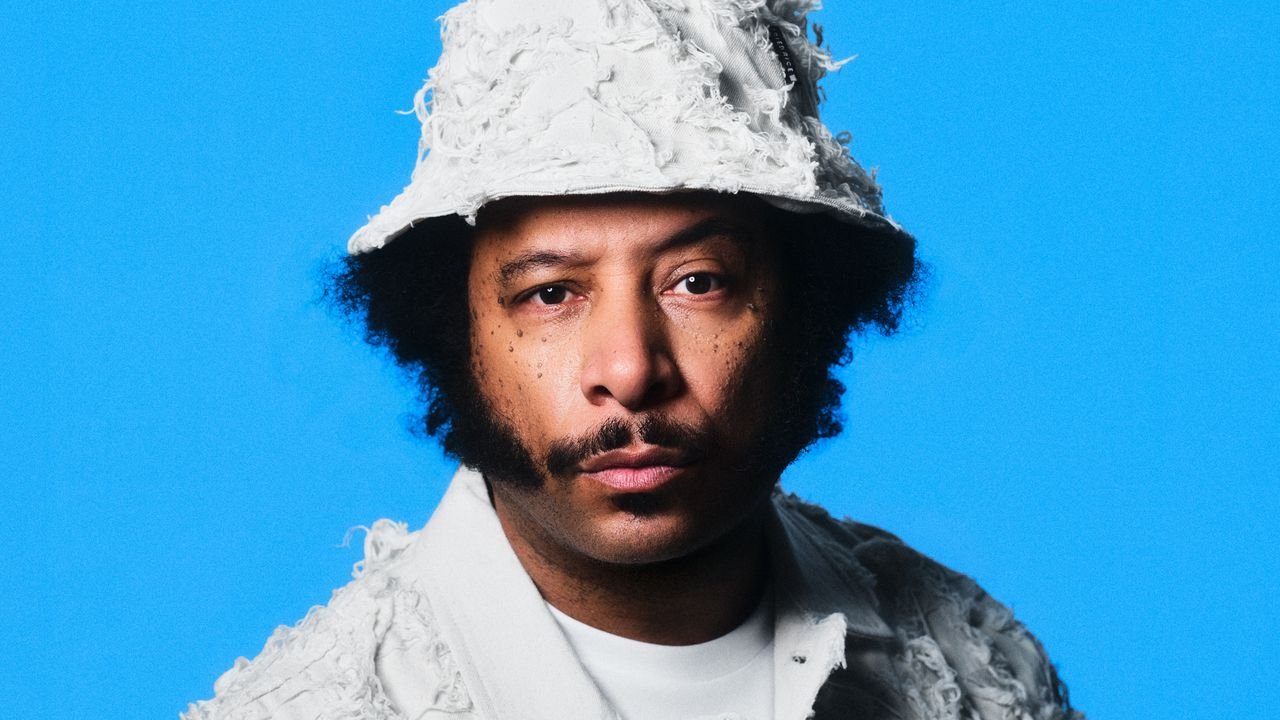
Riley has been through his share of personal loss. In 2006, several of the Coup’s crew members were injured when the group’s tour bus flipped over and burst into flames; a few years later, the group’s bassist was shot and killed on his way to a rehearsal. Pam the Funkstress died young. Riley has a phobia of anesthesia, so much so that he underwent a colonoscopy without it. “I’m more afraid of dying than of the pain,” he told me. It had been his weirdest experience of being recognized by a fan: when he was on the table, the doctor told him, “This is a strange way to meet you.” Riley didn’t look at the monitor during the procedure. “It was, like, just looking at the inside of myself in real time,” he told me. “I don’t want to think about how, you know, how fragile it all is.”
A few months after filming the fashion-show scene, Riley was in Oakland for postproduction. On a sunny Saturday morning, he, La La, and their kids met up at the New Parkway Theatre, which hosts a weekly screening of cartoons. Riley, in a jumbo-sized blue hat and black-and-white pajamas, watched a clip from the show “Underdog.” He’d loved TV cartoons growing up—they were funny and simple but also educational, stuffed with sly parodies of pop culture he’d never heard of. Years ago, Riley had explored the idea of doing voice work, thinking that it might be both fun for his kids and a way to make good money. After talent agents at W.M.E. proposed some roles, he clarified that he wouldn’t play a dope dealer or a cop. “And they were, like, ‘Well, you should probably generate your own material,’ ” he said. He’d also had a chance to experience a different flavor of fame: while he was recording “Genocide & Juice,” he was recruited to appear on MTV’s “The Real World.” He turned it down, mainly, he recalled, because he “didn’t want people to know I wasn’t hard.”
After the cartoons, we headed to Riley and La La’s house; he’d bought it with the money Amazon had paid him for “Virgo.” It was a warm, bohemian hangout with a ceramic rabbit in the front garden, a lounge with a fireplace, a studio for La La, who is a fibre artist and an illustrator, and a cozy kitchen with a whimsical mural of a tree blooming with fruits and cupcakes. In the bathroom, a framed Red Scare-era poster read “Is your washroom breeding Bolsheviks?”
Earlier, Riley had described La La to me as a mischief-maker. When we arrived, La La, who wore flower-print clogs, handed me a “Friendship Buck,” a handmade faux currency that she gives to everyone she meets. As she cooked noodles for Django, she told me about the many art projects that she had in progress, including a graphic memoir done in watercolors. But these days she saw herself mainly as a mom (“chief noodle-maker”) and an “extreme feminist” with a wide circle of friends. When I asked if she shared Riley’s ideology, she said, “I’m apolitical.” Her focus was more on making things, including a Y.A. book that she’d written, celebrating her childhood in the Bay with her white Jewish mom and Chinese Methodist dad. Like Riley, she considers herself Jewish, and, she told me puckishly, she also sees herself as white: “Boots says I’m not white, but I am—it’s, like, Are you what you see or what other people see of yourself?”
Riley, who was sitting nearby, at the dining room’s long table, smiled but suggested that this was probably not how white people saw her. “Potato, potahto,” La La drawled. “Have you seen my mom? She has black hair. We look exactly the same. She basically is Chinese.” Later, when Riley and I began to talk about the Coup track “5 Million Ways to Kill a C.E.O.,” which had been embraced online by admirers of Luigi Mangione, she chimed in: “My mom was a C.E.O., and it hurts my feelings!” Her mother had founded a wool-diaper-cover company called Biobottoms, she said, which was run primarily by women. Later, as Riley and I talked about his packed schedule, he theorized that in a truly revolutionary society people might work only three days a week, allowing them to devote more time to things they loved, like art or gardening. La La wisecracked, “For moms, we’re only changing diapers three days a week. Best of luck to you children, sitting in your diaper for four days!”



