
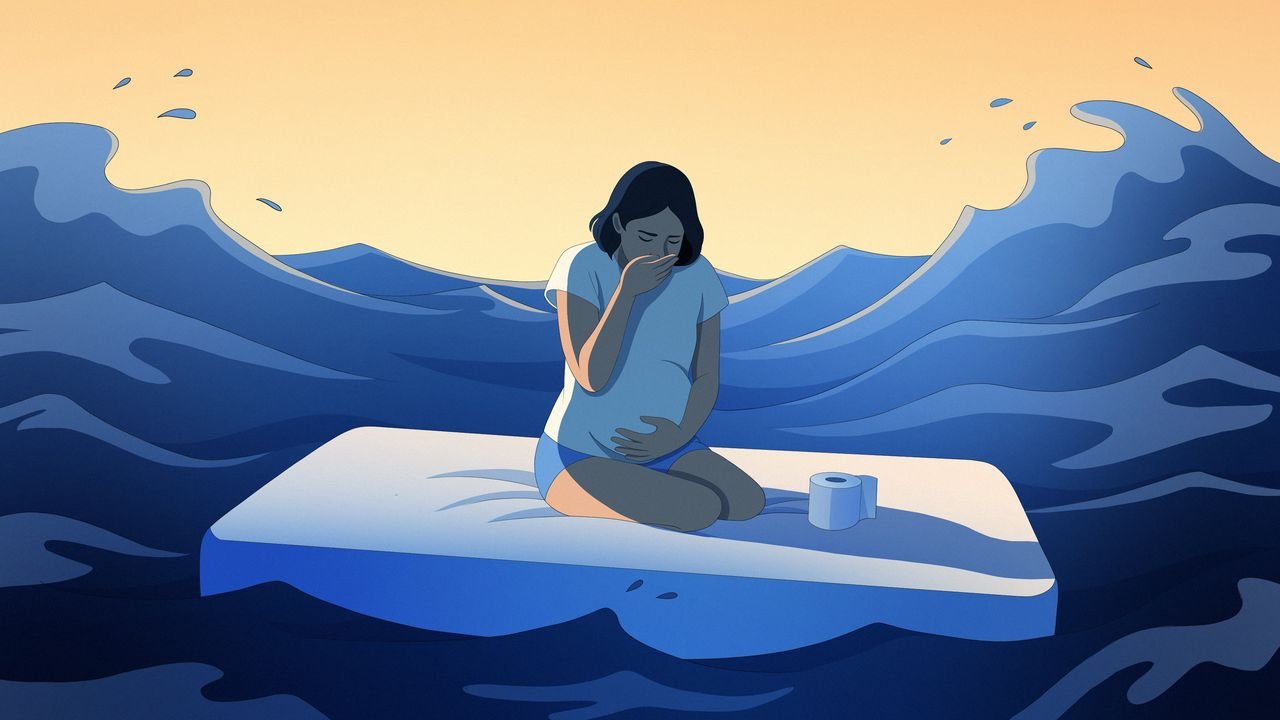
In May, I met with Fejzo at an international conference for hyperemesis gravidarum, held at a quaint hotel at the base of a fjord near Bergen, Norway. Fejzo is in her late fifties, petite and brunette, with birdlike features and a polite intensity. In the H.G. world, she is something of a celebrity; in 2024, she was named a Time Woman of the Year. In recent years, the research on H.G. has made startling leaps. Not long ago, many clinicians, including Fejzo’s own doctor, still regarded the illness as a psychological rejection of motherhood, or a bid for attention. Fejzo’s work has upended those assumptions, uncovering a distinct biological cause for H.G., and opening up new pathways for prevention, treatment or a cure. Speaking with me, Fejzo grew emotional. “It’s been a long road,” she said. “What happened to me is definitely a motivator. If this didn’t happen to me, I’m sure I would have given up long ago.”
An odd thing about the world of maternal health is that, because the research is so badly funded, often the leading experts on a given disease have come to it through personal experience. At the hotel in Norway, attendees gathered for a meet and greet in the lobby. Over non-alcoholic spritzes, I spoke with nurses, midwives, researchers, and activists who had developed an interest in the condition after surviving H.G. The crowd skewed heavily female. One red-headed midwife from Utah told me that she had lost a job she loved during a bad stretch of illness. Sara Vanover, a stay-at-home mom with rhinestone-studded glasses, had flown in from Indiana. She was hospitalized for seven weeks in her second pregnancy, she said, and had lost a tooth from the acidic bouts of vomiting. She pointed to her jaw to show me where being sick had caused bone decay.
The history of hyperemesis can be hard to stomach. As far back as antiquity, physicians have observed the dangers of excessive vomiting in pregnancy. Hippocrates noted that pregnant women who ate too little faced an increased risk of miscarriage. In the fourth century, Oribasius, the Roman emperor Julian the Apostate’s personal physician, in a set of guidelines for prenatal care, recommended long walks, fragrant white wine, and, occasionally, mustard. The tenth-century Persian physician Rhazes suggested small, protein-rich meals of chicken or goat to encourage good humors, and quinces and pomegranates to restore appetite. In the nineteenth century, doctors began to differentiate between normal levels of pregnancy sickness and the uncontrollable vomiting of H.G. They wondered where the symptoms were coming from. Was it a pelvic lesion? A rigid cervix? A bacterial infection? They prescribed cold drinks, opium, enemas, and hydrogen cyanide. As a last resort, they aborted the pregnancy, though many women, already weakened by months of illness, did not survive the procedure. Charlotte Brontë, the author of “Jane Eyre,” who died, at thirty-eight, a few months into pregnancy, in 1855, experienced “sensations of perpetual nausea and ever-recurring faintness,” according to her biographer and friend Elizabeth Gaskell. Though her death certificate lists the cause of death as phthisis, or tuberculosis, contemporary scholars believe she died of complications from H.G.
In the twentieth century, doctors turned their attention to the mind. If they could not find a solution rooted in the body, perhaps the problem was psychological. The cultural anthropologist Margaret Mead suggested that women experiencing nausea were being influenced by friends who were “setting the stage for how terribly she is going to feel” during pregnancy. (Those pesky friends!) In 1952, the psychiatrist Sidney Rosen noted, “Nausea and vomiting have been considered an unconscious manifestation of oral rejection of the fetus, a repudiation of femininity, self-punishment, and punishment of the father.”
Doctors began using “isolation therapy,” removing women from friends and family, and denying them a sick bowl, with the goal of getting them to accept the pregnancy. Philippe Deruelle, a professor of obstetrics at Montpellier University, told me that, before he helped revise France’s national guidelines for H.G., “the protocol was to put women in a dark room. She was not allowed to see family, or husband,” he said. No phone calls, no television, no meals. The hypothesis was, “If you cannot vomit anymore, if you are punished, then you will stop the vomiting.” One woman, who was treated at a hospital in southern France, in 2021, told me that she was placed in isolation three separate times, for a week each time. She was told, variously, that she was rejecting her baby because she was not grieving the death of a friend, and because she hadn’t resolved a difficult relationship with her brothers. In her second pregnancy, a few years later, she was again isolated and denied visits from her partner and young daughter. Another woman, who was hospitalized in central France, in 2018, told me that she was placed in a dark room for eight days, and prevented from turning on the light or opening the shutters. Doctors told her that she was sick because she wasn’t ready for the pregnancy and that she was “vomiting out her baby.” “These are traumas that will stay with me forever,” she told me. In 2022, when Deruelle went to revise the guidelines for H.G. in France, he found that some doctors were still isolating women. Even today, “When the doctor cannot treat H.G., they say, ‘O.K., we will send you to the psychiatrist.’ ”



