
“Et tu, Brute?” – William Shakespeare, “Julius Caesar”
Those who believe in free and fair elections and the rule of law in Florida and elsewhere across the United States are reeling after five conservative members of the U.S. Supreme Court issued a ruling on April 29 that neuters Section 2 of the landmark Voting Rights Act.
Their action — which invites Republican-dominated legislatures to redraw congressional districts to purposely exclude Black majorities — has triggered a stampede in statehouses in southern states to legislatively erase Black presence in the U.S. Congress.
The ruling pierces the heart of what America purports to be: a democracy.
Ari Berman, of Mother Jones, rued the decision, saying it portends a grim future for Black governance and the ability to vote in free and fair elections. He estimates the decision could result in up to 30% of Congressional Black Caucus members losing their seats.
“The Supreme Court’s six-to-three Republican-appointed majority issued a staggering ruling essentially killing the remaining protections of the Voting Rights Act, dealing a death blow to the country’s most important civil rights law,” he wrote.
“The majority opinion by Justice Samuel Alito in Louisiana v. Callais strikes down the creation of a second majority-Black congressional district in Louisiana and in so doing narrows Section 2 of the VRA to the point of irrelevance, making it nearly impossible to prove that a gerrymandered map violates the right of voters of color.”
Berman added: “Alito’s opinion essentially overrules the 1982 reauthorization of the VRA, finding that there must be evidence of intentional racial discrimination to show that district lines discriminate against voters of color, which is extremely difficult to prove.”
Alito, Berman explained, “adds a series of new tests to the law that will similarly make it nearly impossible for states to draw majority-minority districts.”
The day before the Supreme Court acted, Gov. Ron DeSantis stage-managed a plan to steal the political power, voice, and votes from African Americans, Latinos, and Democrats. He and his co-conspirators created an arguably illegal map in secret that carved out new congressional districts in South Florida to gift Republicans more seats than they already had.
Shortly after, the Legislature passed the legislation that could add four seats to the Republican majority.
Ignored throughout the entire redistricting fiasco were the very real concerns of those Black and Hispanic constituents who stand to lose political access, power, and representation.
“An hour after the Supreme Court handed down its decision, the Republican-controlled Florida House approved an aggressively gerrymandered map that could net Republicans four more House seats after the 2026 election,” The Hill reported.
“The new map could put Democratic Reps. Kathy Castor, Darren Soto, Jared Moskowitz and Debbie Wasserman Schultz in danger of losing their seats in Florida. The ruling could affect congressional maps in other Republican states, such as Arkansas, Louisiana, Missouri, Mississippi and South Carolina.
Before and during the special session, DeSantis maintained that redrawing the maps was necessary because the state would be “forced” into compliance when an expected U.S. Supreme Court ruling on the constitutionality of a key provision of the 1965 Voting Rights Act came down.
Stolen votes, voices, and power
The high court in its current composition has been openly hostile to Black people and their interests. It has rewarded the more than 40 years of scheming that rightist donors, politicians, and policy wonks have undertaken to blunt, snatch, steal, appropriate, or destroy Black people’s right to vote, as well as the considerable political power that comes with it.
In ruling after ruling over more than a decade, the Roberts Court has chipped away at pivotal sections of the Voting Rights Act. The Callais decision achieved the MAGA majority’s goal.
Their profound racial animus — wrapped in flowery, high-sounding rhetoric — has rendered the Voting Rights Act toothless, unusable. There is no equality under the law. Going forward, any appeals to the courts to strike down clear and obvious racism, prejudicial behavior, or bigotry will fall on deaf ears.
Headlines across the country declared what happened a “death blow,” a “gutting,” “destruction,” a right unceremoniously “stripped away,” “eroded,” “dismantled,” and “weakened.”
This ruling has once again trashed what most thought was settled law. It has infuriated and exasperated Black folks and their allies across the country. A deep reservoir of anger and rage has poured out on social media and other media forums as those most affected by this outrage try to grasp what happened, calculate its magnitude, and, more importantly, fathom the implications and fallout.
They are dismayed that 60 years of voting rights protections sits in shambles, arbitrarily pulled apart by bigots in Black robes; obsequious, slippery politicians in handsome suits; a grievance-driven occupant of the White House fueling hatred while cheering on the rabble; and countless other men and women who have joined the crusade to disassemble a generation of blood-soaked civil rights protections.
The Roberts Court has already made it practically impossible to strike down gerrymandered maps, ruling that partisan map making cannot be challenged in federal court. The court has undermined the Voting Rights Act on multiple occasions; its opposition to voting rights has become a key part of a strategy to enshrine conservative minority rule.
In a concurring opinion in the South Carolina case, Justice Clarence Thomas went so far as to suggest that racial gerrymandering and vote dilution claims could never be struck down in court. The Constitution, Thomas asserted, “contemplates no role for the federal courts in the redistricting process.”
Berman, Rolling Stone’s national voting rights correspondent, warns that what’s coming is not pretty.
“The majority opinion by Justice Samuel Alito in Louisiana v. Callais strikes down the creation of a second majority-Black congressional district in Louisiana and in so doing narrows Section 2 of the VRA to the point of irrelevance, making it nearly impossible to prove that a gerrymandered map violates the right of voters of color,” he writes.
“The decision crippling Section 2 of the VRA … will be devastating for communities of color and the Democratic candidates they usually support. The only silver lining for those harmed may be that the ruling came be too late to have a major impact on the 2026 midterm elections.”
Even so, other southern states including Louisiana, Alabama, Tennessee, and South Carolina rushed to seed the ground for the eventual redrawing of lines that will eliminate Black Congressional seats (although the South Carolina Legislature refused to follow through).
Louisiana halted an ongoing primary election in which thousands of votes had already been cast, and has almost eliminated one of its two Black-majority districts. Meanwhile, Tennessee’s gerrymander has eliminated the state’s only Black-majority district, which has led to a barrage of lawsuits asserting that the new map intentionally discriminates on the basis of race, Democracy Docket is reporting.
“Oh, and the gerrymander wasn’t enough for Tennessee’s GOP lawmakers. They’re still mad that their successful campaign to deny Black voters any representation in Congress wasn’t met with more politeness and civility by Democrats. So last week, they stripped them of all their committee assignments — meaning not a single Black state lawmaker now sits on a committee,” the report says.
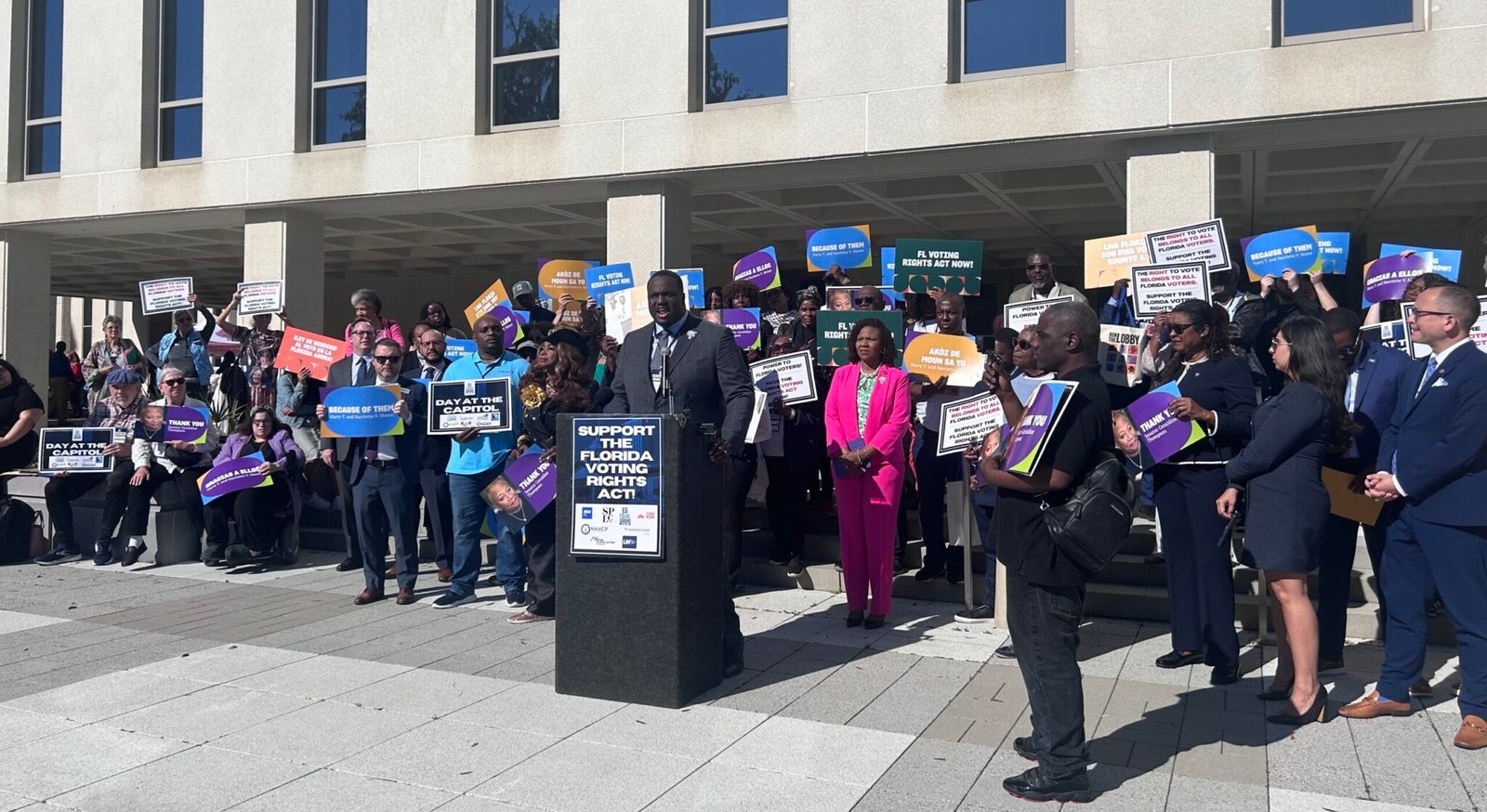
Several lawsuits have been filed in Florida, asking a court to block the state’s recently passed congressional map because it violates a voter-approved ban on partisan gerrymandering. A lawyer for the plaintiffs called the evidence of partisanship in the map’s creation “staggering.” Still, journalists like Democracy Docket’s Jen Rice and others note that “with the state Supreme Court thought to be in the pocket of Gov. Ron DeSantis (R), even that may not be enough.”
Some legal and political experts, like Human Rights attorney Qasim Rashid, have taken note of the response of some Democrats in Florida.
He observes that Democrats are running Alexander Vindman for U.S. Senate “although an extraordinary Black state rep named Angie Nixon is already running.” Meanwhile, House Democrat Debbie Wasserman Schultz has decided to run in the majority non-white District 20 despite six Black Democratic candidates already in the race.
“Both parties in Florida are telling Black people to take a back seat and it’s indefensible,” Rashid said on Instagram.
The full reach of this ruling will be seen in the next few years, observers say.
“In the long run, however, the court’s decision will turbocharge the GOP’s current gerrymandering efforts for future elections in 2027 and 2028, potentially costing Democrats up to 19 House seats, according to one study, Berman reports. “As much as 30 percent of the Congressional Black Caucus could lose their seats, according to a report by Fair Fight Action and the Black Voters Matter Fund. Nearly 200 state legislative seats held by Democrats in the South could also be wiped out.”
Berman writes that Republicans could eliminate as many as a dozen Democratic congressional seats in the South as a result, leaving no Democratic representatives or majority-minority districts in states including Tennessee, Alabama, Mississippi, South Carolina, and Louisiana — the very places where voting discrimination has historically been most prevalent.”
For those looking ahead, America is not sailing into uncharted waters. As Pulitzer Prize-winning journalist and historian Nikole Hannah-Jones reminds us, we have been here before.
“We must understand that the Voting Rights Act was not merely ensuring Black American’s rights, it was about democratizing America,” Hannah-Jones writes.
“This ruling isn’t just about a decimation of Black rights and Black American’s ability to have representation; it is a fatal blow to multiracial democracy. The Voting Rights Act is essentially dead and it’s quite possible that we will, like when a similar SCOTUS gutted Civil Right at the fall of Reconstruction, see a disappearance of much of the Black Congressional representation, especially in the most heavily Black states which was in the South.”
Hannah-Jones explains that the ruling was preceded by “racist political rhetoric, the erasure and attacks on Black history, [and] the reinstalling of Confederate names and monuments.
“All go hand-in-hand as the Court and Congress legitimize the taking of political rights and the end of multiracial democracy itself,” she writes.
“And to be clear, in case it’s not, democracy cannot and will not exist without these protections. We already see a South so heavily gerrymandered that numerical majorities cannot win elections, and where a minority holds supermajorities in state legislatures. There are people still living who fought — and watched their compatriots be murdered — for passage of this act and the attempt to democratize America. To see it completely felled in the span of their own lifetime is just absolutely devastating.”
“These are the darkest days of my lifetime. The democracy brought forth through the blood of Civil Rights martyrs is coming to an end under the most openly racist administration most of us have ever lived under.”
Independent Journalism for All
As a nonprofit newsroom, our articles are free for everyone to access. Readers like you make that possible. Can you help sustain our watchdog reporting today?



