
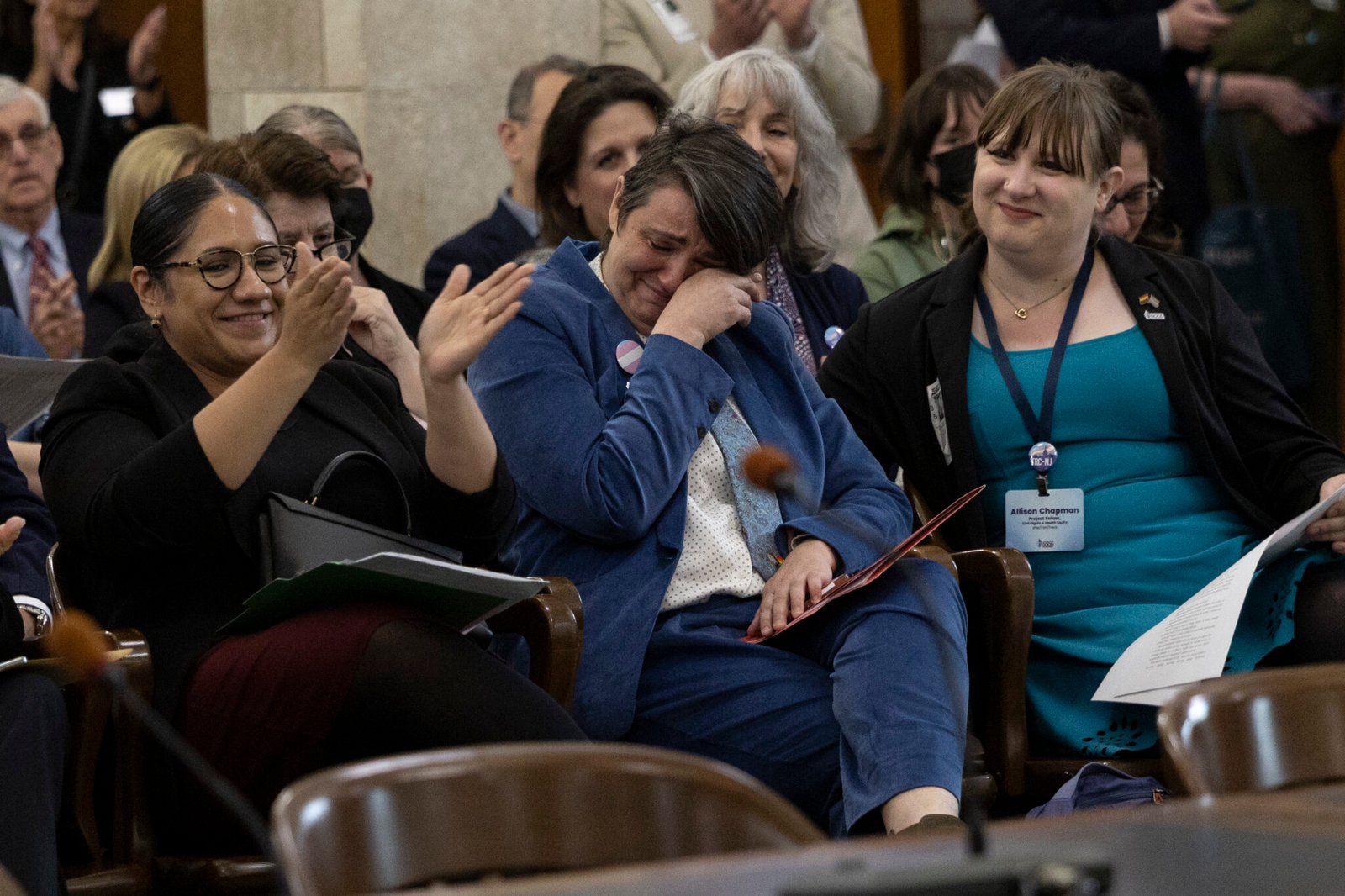
The Democratic-led bill to enshrine civil and criminal protections for those who treat and those who receive care for gender dysphoria drew hours of passionate testimony from supporters, who say the protections are essential given the Trump administration’s push to curtail access to gender-affirming care, and emotional pushback from a handful of opponents.
The measure, which would also expand protections for reproductive healthcare providers, was approved by the Senate’s health committee by a 5-2 vote.
Natalie Baker, a psychotherapist who is also parent of a transgender child, said the kinds of policies pushed by the bill “have very real impacts on families and providers.”
“Families are making difficult life decisions based on whether their children feel safe and protected. Families are paying attention to this. Providers are paying attention to this. And businesses are too,” Baker said.
According to LGBTQ advocacy group Garden State Equality, 18 states have already passed similar shield laws.
The measure is scheduled for a hearing in the Assembly health committee Thursday. It faces additional votes in both houses of the Legislature before it could go to Gov. Mikie Sherrill for her approval.
Lucy Amato, a non-binary 15-year-old, testified in favor of the bill with her mother, Indira Amato, a healthcare provider. Lucy said they have advocated for years for people who get bullied, for trans rights, and around climate justice.
“Never did I expect I would need to advocate for my own healthcare rights,” Lucy said.
Lucy testified that they receive care at Children’s Hospital of Philadelphia, which has been embroiled in a fight with the Trump administration over access to private medical records of minor patients who have been prescribed puberty blockers and hormone therapies. Lucy said the hospital has received threats.
“That kind of fear stops patients from reaching out and getting the care they need,” Lucy Amato said.
The measure, sponsored by Senate President Nick Scutari (D-Union) and Sen. Teresa Ruiz (D-Essex), would codify protections outlined in an executive order signed by former Gov. Phil Murphy in 2023.
Ruiz joined the hearing to testify and to cast her vote in favor of the bill as a substitute for one of the missing Democratic members of the health committee. Sen. Andrew Zwicker (D-Middlesex), a co-sponsor of the bill, substituted for the other absent member.
Ruiz said she never imagined New Jersey would need a law to protect doctors from doing their jobs, or to allow patients to access care.
“This bill is to protect healthcare. Not a political debate. Not a culture war talking point. Healthcare,” she said.
The bill would create a new crime of interference with reproductive health services and includes reproductive care, like abortion, and gender-affirming care, things like puberty blockers, hormone treatment, and mental health supports. It would also protect healthcare providers who might be found liable under laws in other states.
“Our law enforcement will not carry out another state’s agenda,” Ruiz said.
Opponents raised many concerns, suggesting the kind of healthcare the bill aims to protect is more harmful than helpful. They warned that additional protections would encourage families with trans youth to move to the state.
Marie Tasy, executive director of New Jersey Right to Life, raised concerns about some of the legislation’s text, which was amended in recent days with language the bill’s critics did not see.
“These are not technical adjustments,” Tasy said, but changes that “deserve honest, focused debate, not a rush.”

Sen. Holly Schepisi (R-Bergen), who joined Sen. Robert Singer (R-Ocean) in voting against advancing the bill, also raised concerns about the late changes to the bill. Schepisi said she fears the measure would harm New Jersey’s relationship with other states, and worries about unintended consequences, like protecting “bad actors” from investigations.
Schepisi said she is supportive of trans issues, but “for me the difference has always been between adults and children.”
Supporters, including several religious leaders, said the matter is urgent, especially as some healthcare providers have chosen to limit access to care. In New Jersey, several hospitals stopped accepting new patients seeking certain trans-focused treatments and procedures.
Dr. Kristyn Brandi, an obstetrician-gynecologist, said reproductive care providers face the same uncertainties, making it hard to do their jobs.
“It shows that we can no longer rely on the federal government to protect access to care here in our state,” she told the committee.
Louise Walpin, one of the plaintiffs in the case that led to same-sex marriage being legalized in New Jersey in 2013, sparked cheers when she linked that battle to those faced by her Irish-immigrant relatives.



