
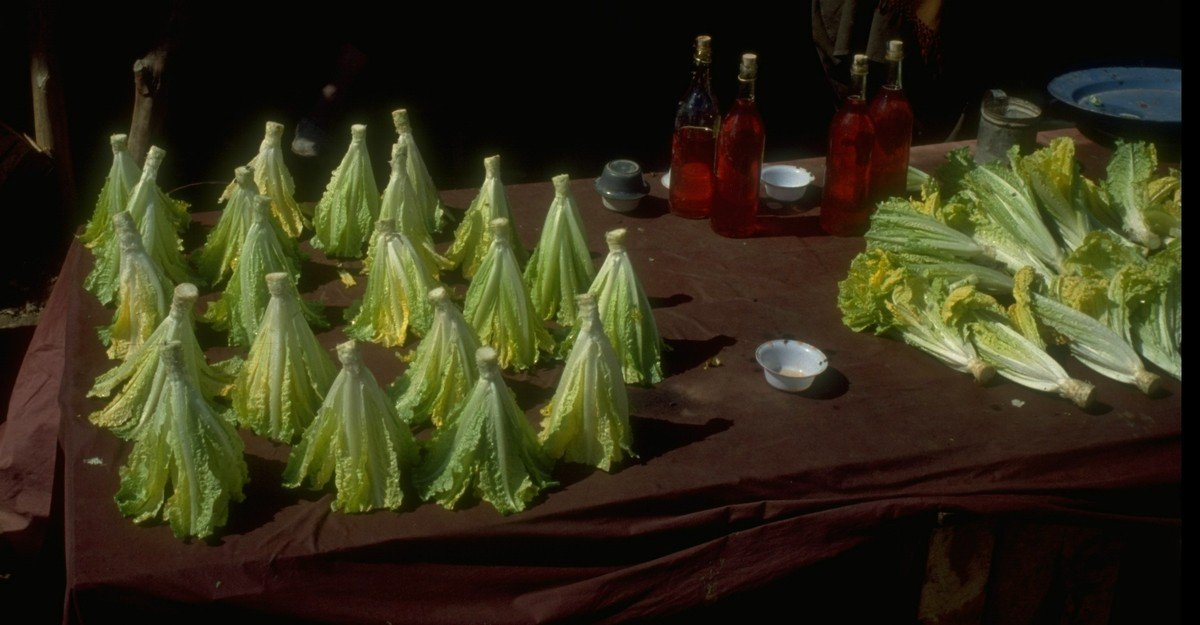
Produce lovers of the Midwest, rejoice! It seems that parents can stop fretting about serving their kids berries, Redditors can stop trying to do their own epidemiological investigations, and I can stop cooking my salads. The mystery of what food caused an outbreak of cyclosporiasis, the diarrhea-causing parasitic illness, across several midwestern states appears to be solved: It was shredded lettuce served at Taco Bell, federal health agencies announced yesterday.
As far as foodborne outbreaks go, this result is about as good as it gets. Yes, thousands of people got sick, but no one died. And the fact that regulators found not just the vegetable at issue, but also the source—a supplier in Mexico—means that they can now get to the bottom of what went wrong, and perhaps Americans can enjoy the spoils of summer produce with less fear. Even so, the nation’s collective freak-out should serve as a wake-up call to both the food industry and regulators. Behind jokes about “diarrhea lettuce” and binging on processed foods was a real fear that the system is failing to keep Americans safe.
The cyclosporiasis outbreak seemed to confirm Americans’ suspicions about our food-safety system and the people in charge of it. Trust in the safety of the U.S. food supply is at its lowest in at least 13 years, according to recent survey data from the International Food Information Council, an industry-funded group; many respondents said they believe that companies put profit over safety and that regulations aren’t strict enough. Surveys have found that confidence in the CDC and FDA is similarly in the dumps, reflecting both Americans’ longstanding issues of trust in the agencies, as well as a particular response among Democrats to the Trump administration’s changes to the agencies.
The current cyclosporiasis outbreak was handled poorly by the industry and regulators alike. Many Americans suspected that Taco Bell was the culprit after photos surfaced last week of signs posted outside Taco Bell branches announcing they weren’t serving certain toppings. But the company’s PR team failed to provide a clear explanation of what was going on and how widespread the potential problem might have been. Yesterday, Taco Bell posted on its website that it was acting “out of an abundance of caution” by removing produce from some stores but still did not explain what had gone wrong. When I reached out today to ask whether Taco Bell is confident that the issue was isolated to just midwestern states, the company directed me to a statement that did not address the question, but confirmed that it “has completed removal of affected Taylor Farms lettuce from our restaurants.”
Meanwhile, late last week, when Michigan had reported upwards of 1,500 positive tests for the bug, the CDC’s website still said that fewer than 200 cases had been identified nationwide. The delay may have stemmed from CDC officials scrutinizing preliminary data from states in an attempt to put together a true national count of confirmed cyclosporiasis cases, but from the outside it looked as if the agency had no idea what was going on.
Federal officials didn’t call a press conference until earlier this week. By that point, Michigan had announced that 3,309 people had gotten sick and publicly identified lettuce as the likely cause of the outbreak, and the lettuce-less Taco Bells had already gone viral. When NBC News asked whether officials were looking at Taco Bell as a potential culprit, the acting head of the FDA’s food center, Donald Prater, demurred: “FDA certainly is continuing its traceback investigation on multiple produce items, also including locations that are reported by the case patients before they became sick.” The first confirmation that Taco Bell was actually being investigated came not from the company or the CDC, but from anonymous sources who spoke with The Washington Post.
The advice that Americans received about how to keep themselves safe has been confusing too. Prater said during the press conference that washing produce was “very helpful in lowering the risk of this parasite.” But food-safety experts told me that they don’t know how much washing actually helps. Yesterday’s CDC advisory offers more actionable advice: “Do not eat shredded iceberg lettuce served at Taco Bell locations in Indiana, Kentucky, Michigan, Ohio, and West Virginia.” But it makes no mention of what might be causing states such as New York and North Carolina to report spikes in cyclosporiasis cases as well, or what if anything residents should do to stay safe.
Plus, news outlets are reporting that the facility in Mexico is associated with Taylor Farms, an enormous operation that supplies lettuce to restaurants and grocery stores around the country. The CDC, which made no mention of Taylor Farms in its announcement, has not communicated why it believes that the only product affected is the shredded iceberg lettuce served at specific Taco Bell locations. The brief notice Taco Bell posted on its website makes the issue seem much bigger. The company wrote that it encourages “all relevant restaurants, retailers, and foodservice operators” to take similar precautionary action. The CDC’s website also says that the FDA “is working directly with the supplier to determine if contaminated shredded iceberg lettuce went to other places.”
In a statement, Taylor Farms’ parent company, Taylor Fresh Foods, told me that although the FDA’s investigation pinpointed one “independent farm,” the company has indefinitely removed all iceberg lettuce sourced from Central Mexico. The company also said that the affected farm “represents less than 1% of the U.S.’s iceberg lettuce supply,” and “no other Taylor Fresh Foods products across the country are impacted.” The company did not respond to my follow-up questions about whether the farm had supplied iceberg lettuce to any entity other than the Taco Bell locations identified in the investigation.
Perhaps the iceberg lettuce from the farm in Mexico really did go only to Taco Bells in the Midwest. It’s possible too that the apparent spikes outside of this epicenter are not a sign of a larger outbreak. After all, cyclosporiasis cases traditionally rise in the summer, and the frenzy of news around the parasite likely prompted people who typically would have weathered the illness at home to get tested. But Americans won’t know that unless the CDC says something. When I asked today what is causing cyclosporiasis cases outside the Midwest, and why the CDC was confident that other Taylor Farms products were not affected, an agency spokesperson ignored my questions and directed me to the government’s previous statements.



