
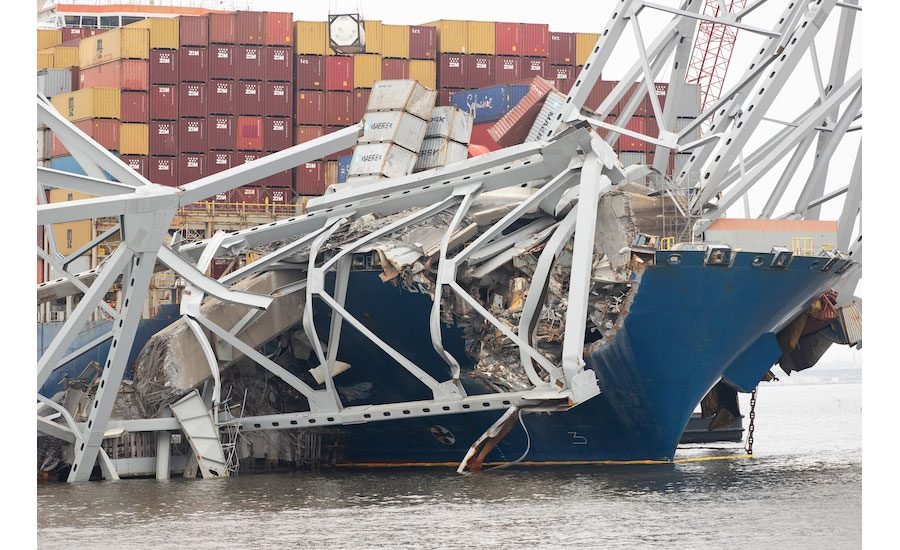
Two subsidiaries of the shipping company responsible for operating the container vessel M/V Dali face federal criminal charges for their roles in events leading up to the vessel’s deadly 2024 collision with the Francis Scott Key Bridge in Baltimore.
The federal indictment names Singapore-based Synergy Marine Pte Ltd, and Chennai, India-based Synergy Maritime Pte Ltd—both units of Synergy Global Marine, also of Singapore—and Radhakrishnan Karthik Nair, 47, an Indian national who worked for both companies as the Dali’s technical superintendent.
Citing the chain of events detailed by the National Transportation Safety Board’s 18-month investigation into the incident, the indictment alleges the defendants were responsible for making modifications to the Dali that compromised “reliable redundancies and automatic restart capabilities” originally designed as part of the vessel’s critical systems. The modifications included use of a flushing pump to supply fuel to two of the Dali’s four generators.
As the Dali was leaving the Port of Baltimore in the predawn hours of March 26, 2024, the vessel experienced a power outage that the NTSB concluded had resulted from a loose wire in a high-voltage switchboard. The Dali’s generators operated only briefly, the indictment says, because the flushing pump was not designed to automatically restart following a blackout, resulting in a second outage.
“If the Dali used the proper fuel supply pumps,” the indictment adds, “the vessel would have regained power in time to safely navigate under the Key Bridge.” Instead, the powerless vessel drifted past two 28-ft-wide dolphins, eventually striking one of the bridge’s main support pylons. Six construction workers on the bridge at the time of the impact were killed, and debris from the collapsed bridge blocked access to the Port of Baltimore for more than two months.
In addition to charges of conspiracy and willfully failing to immediately inform the U.S. Coast Guard of a known hazardous condition, the indictment accuses all three defendants with obstruction of an agency proceeding and providing false statements and documents to the NTSB, according to a U.S. Justice Dept. statement. The obstruction charges relate to, among other things, Nair’s statements to investigators that he was unaware that the flushing pump was being used to provide fuel to the generators.
The two Synergy corporations are also charged with misdemeanor violations of the Clean Water Act, Oil Pollution Act, and Refuse Act for discharge of pollutants into the Patapsco River, including shipping containers and their contents, oil and the bridge itself.
Looking for quick answers on construction and engineering topics?
Try Ask ENR, our new smart AI search tool.
Ask ENR →
A statement from Synergy Marine called the allegations “inconsistent with the clear and well-documented findings of the specialist maritime professionals involved in the NTSB investigation.” Promising a vigorous defense, the statement noted that Synergy and its employees “have fully cooperated and have been transparent at all times during the NTSB’s investigation, and any allegations to the contrary are woefully inaccurate.”
Maryland Opts for $2.25 Settlement
Just hours after Justice announced the charges, the State of Maryland announced that it had finalized a $2.5-billion settlement with Synergy Marine and the Dali’s owner, Grace Ocean Private Ltd. The settlement resolves multiple claims brought against the vessel interests by the state Attorney General on behalf of the state and several agencies seeking what some observers estimated might be several billions of dollars’ worth in damages for the destruction of the bridge, environmental harm, lost toll revenues and economic losses.
In response, Grace Ocean and Synergy Marine sought to cap their total liability at about $43.7 million, invoking the Limitation of Liability Act of 1851, a maritime law that ties a shipowner’s liability to the value of the vessel after a disaster. The trial was scheduled to begin on June 1.
“In reaching this agreement,” according to a statement from Attorney General Anthony G. Brown, “the State carefully examined the available resources of Grace Ocean and Synergy Marine, including available insurance limits, and concluded that the settlement maximizes the recovery available from the vessel interests.”
Maryland’s decision to accept a settlement may also have been influenced by NTSB’s conclusion that the disaster was entirely preventable, and that the Dali’s builder, Hyundai Heavy Industries was at fault for the ship’s initial loss of power. Brown says the state plans to pursue claims against Hyundai Heavy Industries for its fault and share of state damages.
Separately, the federal government reached its own $102-million settlement with the companies in 2024 to cover various agencies’ response and debris cleanup costs.
Meanwhile, a replacement for the Key Bridge is on hold following the Maryland Transportation Authority’s decision last month to off-ramp Kiewit Infrastructure Co. from the progressive design-build rebuild effort, citing a nearly threefold increase in estimated costs since the firm was selected in August 2024. The agency has yet to schedule a planned industry forum to begin the process of identifying a new contractor to take-on the multi-billion-dollar effort, with an eye toward having the new bridge ready in late 2030.
Source: www.enr.com



