
 Despite bipartisan calls for reform, the Legislature’s majority Democrats are once again cutting it close to a constitutional deadline to pass state government’s annual budget.
An appropriations bill must be introduced and approved by both houses of the Legislature, before the end of the month, to divvy up what’s expected to be more than $60 billion in taxpayer resources during the fiscal year that begins July 1.

Awaiting crucial decisions are everything from aid payments to K-12 public schools to allocations for direct property tax relief, including benefits provided to seniors through the Stay NJ and Senior Freeze programs.
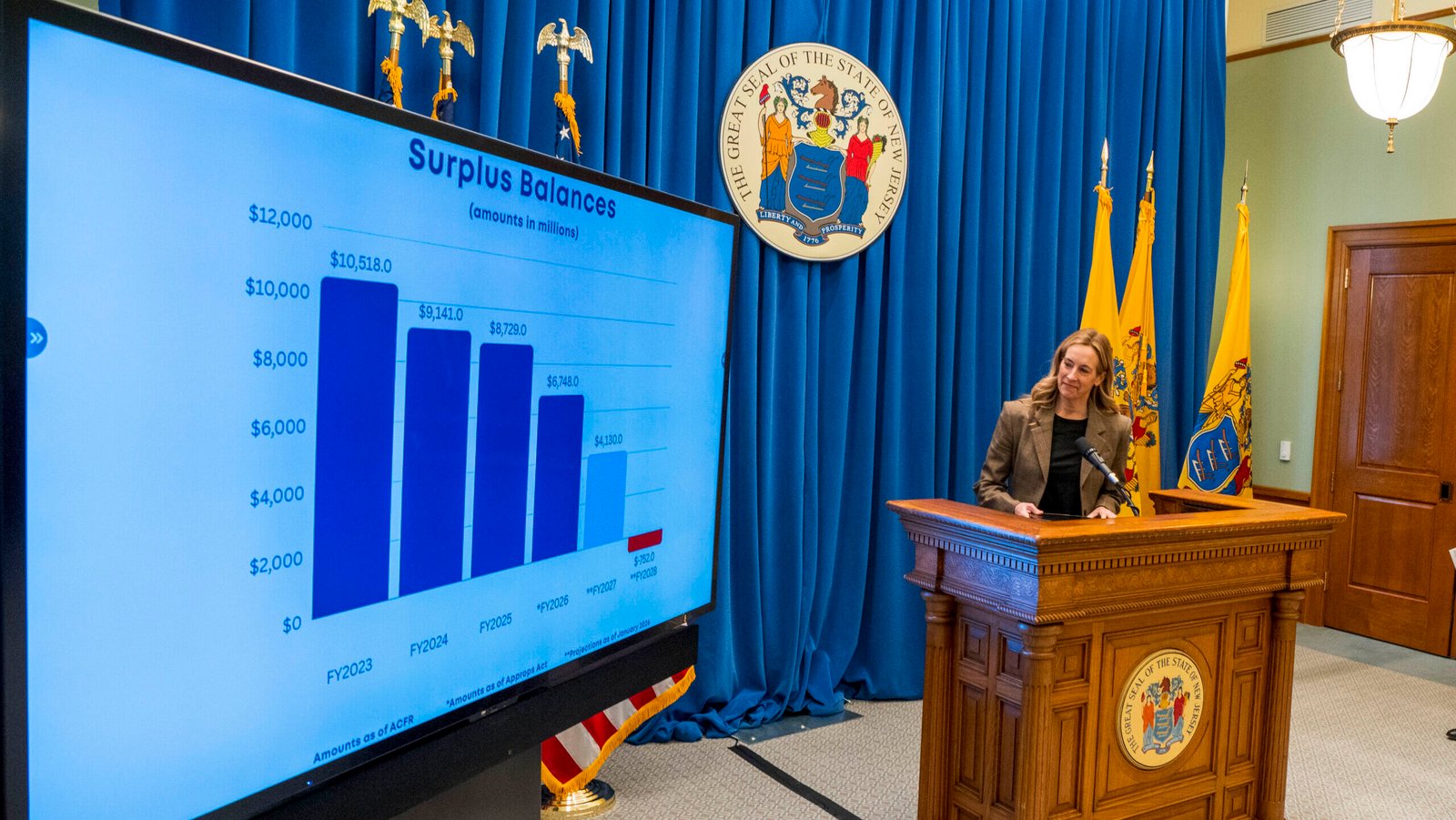
How much will be left in surplus as a hedge against potential economic turbulence also remains uncertain, as does the breadth of any last-minute attempts by lawmakers to undo spending cuts that Gov. Mikie Sherrill, a Democrat, proposed in March.
Spokespeople for the majority offices in the Assembly and Senate declined to comment this week when asked by NJ Spotlight News about the spending bill’s status.
Draft, pass, sign — or else
Under the state constitution, the governor drafts an annual budget, and lawmakers have the authority to write and pass the spending bill that ultimately dictates annual appropriations.
The constitution requires a government shutdown if a balanced budget endorsed by the governor and a legislative majority is not in place each year on July 1.
Sherrill, a former congresswoman who is a newcomer to state government, championed increased transparency and accountability during her campaign last year.
This year, she unveiled a budgeting report card as a way to track state taxpayer funding for major programs and services.
Lawmakers from both parties have drafted legislation in recent months seeking to reform a budget-approval process that often plays out at a breakneck speed in the final days, and even hours, preceding the fiscal year’s start. .
Critics have complained that this tradition often leaves the public in the dark as lawmakers rush to approve what is typically the most consequential bill of each legislative year.
Two-week delay
In response, a Republican proposal put forward this year calls for setting June 1 as a date for filing and making public last-minute legislative spending additions that often inflate the size of the annual budget.
In recent years, Democratic legislative leaders, citing vague rules , waited until well after the spending bill itself was signed into law to disclose which individual lawmakers sponsored last-minute changes through the submission of what are known as budget resolutions.
A measure sponsored by Democrats calls for establishing a two-week delay between when the final draft of the spending bill iis made public and when it can be put up for final adoption by the Legislature.
This follows the regular complaints about a lack of transparency and public oversight that have come from across the partisan divide in response to the legislative leaders’ recent habit of waiting until the very end of June to both introduce and approve the final spending bill.
‘Longer open window’
Late last year, as former Gov. Phil Murphy, a Democrat, prepared to leave office, he also raised concerns about the final stages of a legislative budget process that had been controlled by fellow Democrats throughout his eight-year tenure.
“I’d love the end of the budget process to have a longer open window,” Murphy said at the time during a lengthy interview with NJ Spotlight News.
“The budget is almost $60 billion. About 98% of it is part of the budget presentation that the governor makes in late February or early March. It’s out there for months,” Murphy said. “It’s the last sliver of it, and I’d love to see that changed,” he said.
It was nearly a month ago when state Treasurer Aaron Binder gave lawmakers the Sherrill administration’s final revenue forecasts for both the remaining weeks of the current fiscal year, as well as for the entirety of the next fiscal year.
That’s one of the last important public steps in New Jersey’s lengthy budget-making process, which this year began in early March when Sherill delivered her formal budget message to a joint session of the Legislature.
Since then, a final monthly report on state tax collections was released by state Treasury officials. It indicated total receipts were running slightly ahead of growth targets entering the final weeks of the 2026 fiscal year.
New Jersey’s most recent shutdown was in 2017, during the tenure of Gov. Chris Christie.
This story is made possible in part by the Corporation for Public Broadcasting, a private corporation funded by the American people.



