
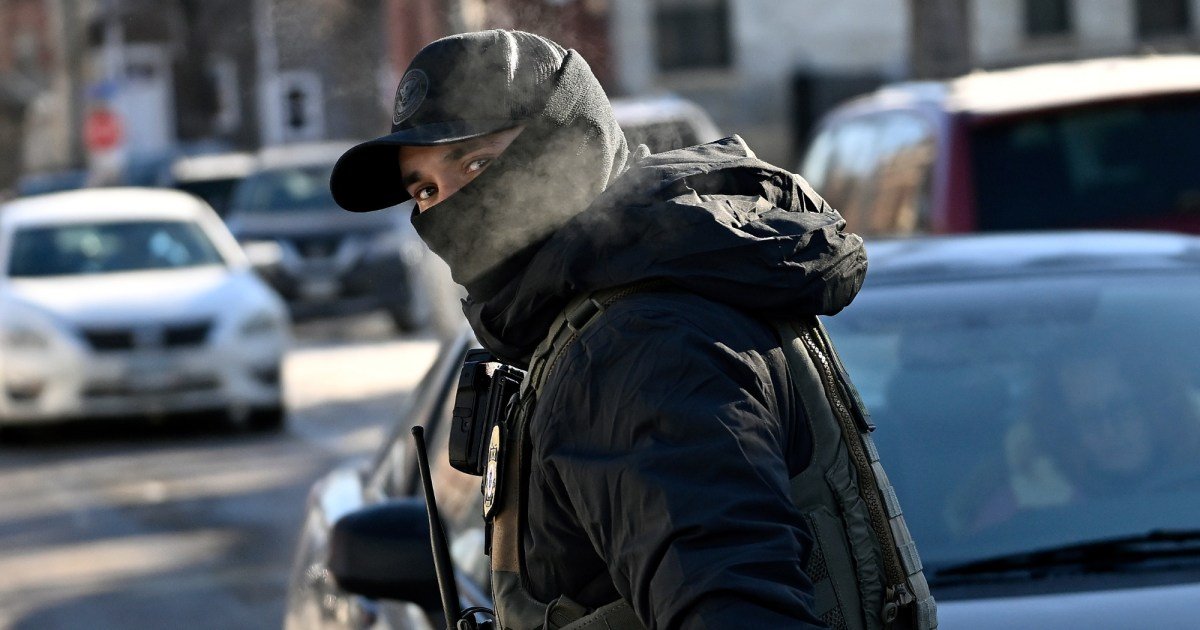
A Federal agent looks on after detaining two people at Portland Ave and 19th St. on January 29, 2026 in Minneapolis, Minnesota. Stephen Maturen/Getty
Newly released court records show the Department of Homeland Security conducted a months-long surveillance campaign against left-wing groups in Minnesota after the January killing of Alex Pretti by a federal agent. The records were released Thursday as part of an ongoing criminal case the DOJ filed against 15 Minnesota activists for “felony conspiracy to impede or injure federal officers.”
In January, the Department of Homeland Security launched “Operation Puppet Master” to investigate a “network” of anti-ICE groups the agency believed to be behind protests against the federal occupation of the Twin Cities. As part of that operation, DHS used secretive, invasive tactics: staking out apartment buildings, tracking the license plates of cars parked outside a local church, and attending boxing lessons and art club meetings undercover. At one point, an informant dropped her audio device on the floor during a boxing lesson held by the group “Left Jab,” and then had to circle back to go get it.
Federal officials also, as the New York Times reported, used administrative subpoenas to obtain years’ worth of financial records from the climate activist organization Sunrise Movement and the Communications Workers of America. They acquired years of wire transfers by the Service Employees International Union, the nation’s largest healthcare workers union. This, they said, was an inquiry into “domestic terrorist financing.” (This revealed nothing except the expected minutiae of running a union: membership payments, strike funds, retiree dues, pension expenses.)
None of the organizations investigated have faced any charges, though many of the 15 individual defendants charged in the so-called antifa case are affiliated with labor unions or activist groups.
Kevin Riach, attorney for Minnesota activist Isaac Sant, called this “an unprecedented campaign by DHS to spy on Minnesotans” in a court filing Thursday. “With no evidence, the government alleged to the grand jury that the conspiracy in this case extends far beyond the defendants to include the AFL-CIO, the Minneapolis Federation of Educators, the Minnesota Association of Professional Employees, Monarca, Veterans for Peace, and the Grease Pit bicycle repair shop, among others,” Riach wrote. In one PowerPoint slide shown to members of the grand jury, prosecutors asserted that these groups are all connected.

This is not the first time federal agents have spied on anti-ICE protesters. As my colleague Schuyler Mitchell has reported, FBI agents in Spokane secretly extracted data from protesters’ phones. Separately, Homeland Security agents systematically collected vehicle, license plate, and social media information from everyday people in Spokane last summer, and at times entered that data into a digital evidence management platform. There, as in Illinois, Texas, and Minnesota, anti-ICE activists have been targeted on conspiracy charges for basic acts of protest like blockading a road or sharing information in a group chat.
“These wild conspiracy allegations are born from the fantasies of political retribution that animate the Trump Administration,” Riach wrote.
“While federal agents repeatedly broke the law, ordinary people exercised their First Amendment rights to protect their neighbors,” said Aru Shiney-Ajay, the executive director of the Sunrise Movement, in a statement to the Times. “The Trump administration is now trying to intimidate individuals and organizations who opposed his agenda.”
The people targeted in the “Minnesota 15” trial face between six and ten years in prison for alleged “conspiracy” against federal officers.



