
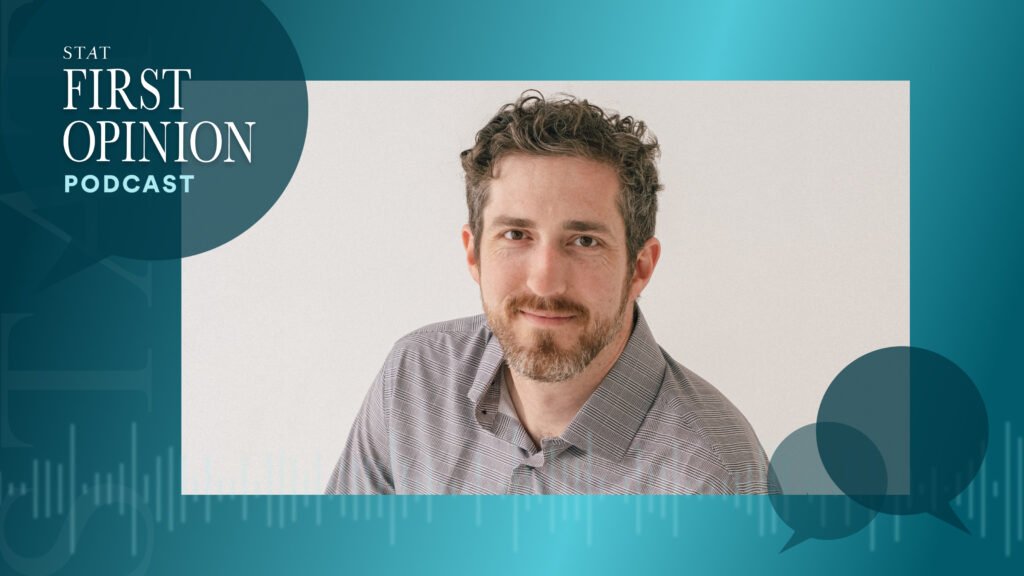
Below is a lightly edited, AI-generated transcript of the “First Opinion Podcast” interview with Will Flanary, aka Dr. Glaucomflecken. Be sure to sign up for the weekly “First Opinion Podcast” on Apple Podcasts, Spotify, or wherever you get your podcasts. Get alerts about each new episode by signing up for the “First Opinion Podcast” newsletter. And don’t forget to sign up for the First Opinion newsletter, delivered every Sunday.
Torie Bosch: Will Flanary is better known as Dr. Glaucomflecken. He is social media’s most famous comedian slash doctor, and he’s not afraid of punching up.
Welcome to the “First Opinion Podcast.” I’m Torie Bosch, the editor of First Opinion. First Opinion is STAT’s home for big, bold ideas from health care providers, researchers, patients, and others who have something to say about medicine’s most important and interesting topics. This season, we’re really focused on the intersection of medicine and culture.
Today, I’m speaking with Will Flanary, the ophthalmologist better known as Dr. Glaucomflecken. After a quick break, I’ll bring you our conversation about advocacy, doctors behaving badly on social media, and the eye surgery he just hates.
Will Flanary, aka Dr. Glaucomflecken, welcome back to the “First Opinion Podcast.”
Flanary: Oh, it’s good to be back, thank you.
Bosch: So I have to cop to a disappointment, which was that my original goal for having you on the show for a second time was to try to get someone from “Scrubs” to join us so we could just talk medical comedy —
Flanary: That’d be great.
Bosch: They rejected me, I’m very sorry about that.
Flanary: Talk about nostalgia, man. It’s exciting to see them back.
Bosch: How did you feel about the reboot?
Flanary: So far, so good. I’ve only seen one episode so far. I’m 40 now. So, you know, I grew up on “Scrubs,” and it still holds up pretty well so far, the old episodes. But also the new show, it’s sharp. It’s good.
Bosch: I fell off of “Scrubs” after a few seasons, but now I think I need to go back and watch it because the reboot captured something.
Flanary: Yeah, go back. It holds up well. It does.
Bosch: All right. So as much as I’d love to just talk about “Scrubs” for the whole time, I guess we have to talk about real things, too. So I wanted to ask you about something you’ve been spending a lot of time on, on social media, which is something that’s happening in Eugene, Oregon. So can you give us the CliffsNotes on what’s happening there and why you’re involved?
Flanary: Let’s see, I’ll try to do this as quickly as possible.
So it really starts a few years ago. I think it was 2023. So Eugene, just to set the stage here, Eugene is like the second-largest city in Oregon, and it’s where the University of Oregon is. And so that metro area is about 200,000 people. And a few years back, there had been this hospital for a long time called University District Hospital in the city center of Eugene. And PeaceHealth, which is a large hospital system in the Pacific Northwest, decided to close that hospital — I’m sure there’s a variety of reasons to do that — including the emergency department there.
And whenever news that this was gonna happen came up, there was a pretty big outcry, particularly from a lot of the staff and the emergency physicians there, because they knew. Like, “this is going to make life so much difficult over in Springfield at RiverBend Hospital, which is now like the only hospital in this area. All the patients that were going to University District are now gonna be shunted over here. And we don’t have the staff, we don’t have the equipment,” just outlining all these concerns.
Well, PeaceHealth, they did it anyway. Closed University District Hospital, and guess what happened? Exactly what these doctors had said was going to happen. Wait times, and particularly in the emergency department, wait times were skyrocketing, patient satisfaction, and everybody was just generally unhappy. There wasn’t enough staff, not enough equipment, not enough rooms. You had people boarding in the emergency department waiting to get a room in the hospital. So just a mess.
And it’s been like this for a couple years now. And late last year, the CEO of RiverBend Hospital decided that he was going to call for proposals for the emergency department contract. So for the last 35 years, the emergency department at RiverBend Hospital has been staffed by Eugene Emergency Physicians, which is a democratic, physician-owned group full of about 40 physicians. They’ve been working there, living in the community. They’re part of the community. And RiverBend decided, “OK, well, we’re not gonna go ahead and renew your contract right now, we’re gonna get some proposals. We’re gonna see if anybody we think could do a better job because we’re having all these problems.” None of which were created by the physicians, by the way.
So Eugene Emergency Physicians, they put in their proposal, and there’s a handful of other proposals. And sure enough, RiverBend went with ApolloMD, which is a corporate management group based out of Atlanta, Georgia. This is a huge deal. You’re taking, you know, local medicine run by people in the community who know the community, know the patients, know the other physicians. That’s really important in emergency medicine because there’s so much interaction with other areas of the hospital and knowing what the social services are in the area, where patients can go, what’s available to people. All that institutional knowledge, you’re just gonna like give that away?
The question is, OK, well, why did they do this? And we still don’t really know because the CEO is on record saying it’s not, it wasn’t a financial decision. OK. It wasn’t performance-based, OK. Well, then what could it be? And that all we’ve gotten is, “well, you know, ApolloMD just had a great proposal.” They’re just like, “we just liked what they had to say.”
Well, that’s enough to remove local physicians and force them to either join this corporate group out of Atlanta, Georgia, or leave the community altogether because there’s no other options.
And so this big outcry, I came upon this story through multiple different places, and it’s basically in my backyard. I’m just south of Portland. And so it’s happening in my community. It’s important to me, but where I think this is a different story versus other places around the country that this happens, because this is not a unique thing, right?
People might say, “well, you know, this is business. That’s just how it works. Sometimes you don’t get the contract, and somebody else had a better proposal.” There’s a couple of things wrong with that.
First of all, as of 2025, Oregon has a corporate practice of medicine law in place. And that’s one of the primary things that makes this a different story, because now there’s lawsuits. There’s been hearings at the Capitol building. The governor of Oregon has weighed in saying, “hey, let’s hold off on this transition because this might be in violation of now state law.” Because this new law, this corporate practice of medicine law in Oregon is specifically designed to prevent things like this from happening — where these corporate groups who don’t have any physicians licensed to practice in the state who own this company, ApolloMD, they’re coming in and practicing this in the states. So that’s what they were trying to prevent from happening with this new law.
This is not a done deal by any means, but PeaceHealth hasn’t backed down. They said, “We’re gonna go ahead with this transition. We think it’s not in violation of this law.” ApolloMD has just said, “This is what our business is. We’re just gonna take the contract” — playing kind of innocent, like, “Oh, it’s, we’re just doing what we usually do, we have nothing against these doctors or anything.” But they’re complicit in this whole process, right? The entire model that this represents, which I think is bad for health care. We want, we need to keep medicine local. I think that’s good for patients, it’s good for communities, and then the latest thing — are you with me?
Bosch: Absolutely.
Flanary: We’re good. OK. So, so that’s not even the end of the story. It gets juicier. Recently, like within the last month, there have been emails that have come out that show going back to 2023, 2024 [involving] the RiverBend CEO, who has an administrative license. That’s a very specific type of medical license that doesn’t allow you to actually make clinical decisions. He’s a physician, but he does not have an active medical license to practice medicine.
A handful of emails from different doctors, not even just emergency physicians, but you know, there’s neurologists, others, that show that the RiverBend CEO was trying to influence clinical decision-making from the C-suite office. Things like, “Are you sure this patient needs to have this MRI? Why are we doing this? Why do we admit this patient? Why did we make that decision?”
And this is coming from the CEO. And if you’re an employee, how are you going to feel comfortable going against what the CEO says? It’s your employer, right? That’s scary, you could lose your job.
And so the emergency physicians recognize that this is not OK because he’s trying to influence all this clinical decision-making. And by the way, I mean, he’s not examining these patients, right? He’s not even doing the work. And so how can you even say “this was what should be done”?
And so they pushed back. And it got to the point where some of the emergency physicians went to PeaceHealth leadership, like the overall CEO of PeaceHealth, like, “Look, we have some concerns about what’s going on with our leadership here.” Well, word trickled down to the CEO of RiverBend, PeaceHealth RiverBend. And wouldn’t you know it, a short time later, he calls for proposals for the emergency department contract.
It doesn’t take a big leap to think this might be retaliation against the emergency physicians. Again, no issues with their job, he’s on the record. No problems there, like they’re doing great work. All right, not financial. What is it? What could it be?
You know, there’s only so many options. And so that’s where we’re at now. And, you know, I hate that this is happening, but I’m really excited to just help out in whatever way I can with my platform and in this fundraiser that we have coming up.
Bosch: Yeah, so tell me about how you’ve been helping out.
Flanary: So, just making content about it. What I’ve learned is that if you make a big stink on social media about health care system-related things, you’re gonna get a lot of support. Because there’s a lot people in hospital administration, in health insurance, in private equity, doing bad things for patients and for doctors. And one unifying characteristic of every story, just like I just described, is that they don’t want people to know what’s happening. They want to keep it out of the news. They want to, keep it away from the kind of national, ’cause they don’t want this kind of scrutiny because they know this is really unpopular and that maybe this isn’t the best for patient care, but it’s maybe good for pocketbooks, maybe good for other reasons that are not as altruistic, you know? And so they try to keep it under wraps.
Insurance has been doing this for decades, right? They’ll change little policies here and there, and hope no one notices. Like in ophthalmology a few years ago, they decided to require prior authorizations for every single cataract surgery, Aetna, just on a dime. Like, “you know what we’re gonna do? Try to limit the amount of these surgeries that were happening.” And we made a big stink about it, social media and otherwise, and they reversed the decision because they don’t want people to know.
That’s what’s happening here. Again, this is just my opinion, but I would venture to guess that PeaceHealth did not want people to know most of the information that we’ve already talked about today, all right? They want to just keep it local because it’s bad press, bad whatever. And so by getting on social media with my platform at the very least and just tell them the story because it is a fascinating story and the implications that this has for the rest of the country, especially with this corporate practice of medicine law. Because if these doctors are successful in fighting this, using that law, you better believe that the other states are gonna be like, “Oh, well, maybe we should have a law like that, right?”
And there are a few others out there, but we need more. And so, there’s so much that can be done advocacy-wise and changing health care and making things better that can start just by making noise. Let everybody know what’s happening and then you get the attention of lawmakers, of the public, the community. This is the most unpopular thing that’s happened, you know, that PeaceHealth has ever done. I had to guess, just because of all the press. Yeah, that’s why I wanted to jump in.
Bosch: Do you get any pushback from your audience about this kind of advocacy?
Flanary: No. I mean if I do, it’s like, no one’s ever going to be 100% on board with anything you say on social media, right? You’re always going to find comments of people. Even when I talk about health insurance companies and the bad things they do, there’s always somebody that’s like, “well, you know, they’re just looking out for people. They’re just making sure doctors aren’t abusing their power.” Like, what are you talking about?
I’m used to it now, but at first when I saw those types of comments, I was like, “how anybody on the insurance’s side?” And so for stuff like this, we all see it. Health care workers see it, the public sees it, and they’re not surprised by it. And so, no, I get very little pushback on stuff like this — just from the people that I should be getting pushback from, which is PeaceHealth, ApolloMD. They’re not gonna be happy with what I have to say, but I don’t care. I’m right.
Bosch: “I don’t care. I’m right” is a great motto to live by, I think.
Flanary: That’s what I tell people just about, you know, medical people about social media in general. Like you can take a stand for something and if you 100% believe that you are right, that you’re doing this for the right reasons, then stand behind it, and you may still be wrong. But again, if it’s a deeply held conviction that you have and you’ve done the research, you’ve done the work, you know what’s happening, and you have a stance on it, stand behind it in the face of criticism. Because you’re gonna get some criticism, all right? It’s just going to happen on social media. But not all criticism needs to be listened to. Sometimes criticism should be listened to, but not all the times.
Bosch: Well, speaking of criticism online, I feel like there’s been a few examples recently, and we don’t have to name names — though if you wanna name names, you’re certainly very welcome to — but there’s some examples online of medical students and physicians sort of getting major backlash over content, over things that are perceived as insulting patients, things that are possibly unethical happening. Are you seeing any sort of change in the way that doctors are intersecting with social media?
Flanary: I know some of the examples that you’re discussing. I think the more important conversation is just more just generally about ethics, right? And what is it OK for doctors to do on social media? This is an evolving topic, and it’s a really hot topic right now because more and more doctors, med students, even premeds, residents are becoming quote unquote influencers. They’re getting a platform. And it is so easy to lose your integrity as a physician. And so it’s a topic that deserves a lot of attention, honestly, just because of where we are in society right now.
I think education needs to catch up with how doctors should be behaving on social media. That’s why I’ve made some content about this, about where are the lines, where should you draw the lines? And certainly we’ll start with making fun of patients. That is number one. You don’t do it.
Bosch: Just to get a little more specific, maybe, one of the examples I’m referring to here, and, again, not gonna use a name, but it’s a medical student slash very popular influencer. And I think there’s a financial component here, too, right? Which is that some of these students, residents, are paying for this enormously expensive medical school through social media influencing and more provocative content is going to help them pay those bills. But in this case, a student posted at least two videos that were widely perceived as sort of shaming women for the way their bodies work. And there’s a great deal of pushback to that.
Flanary: I saw the content, and it was clearly not OK. And it’s exactly what we’re talking about. It’s making fun of patients and patient bodies. I don’t have any patient characters for a very specific reason, because the last thing you want to do as a physician or somebody just in health care is to put out content that will undermine the public’s trust in us. I think the reason people can find themselves down this path is because there’s a lot of financial stakes here. Not just the money you’re borrowing to go to med school, but also just the money you’re making, you can make from social media.
And you have med students now who even have platforms of like 6,000 people that follow them getting offered to hawk supplements, getting thousands of dollars, which is life-changing when you’re not making any money and you’re going into a tremendous amount of debt. Like, are you kidding me? You’re telling me you’re gonna give me $5,000 to make 20 videos, promoting a supplement for gut health?
You can see how that can influence your decision on what you’re posting on social media. And then from the lens of comedy, because that’s what I’ve been doing for the last 10 years, there’s this psychological feeling like you have to keep going. That people will lose interest in you if you don’t continue to like push the envelope and get more outrageous, get funnier, just do what you can to like keep up. And it can push you into areas where you really don’t need to be going.
And so for myself, I have these ethical guardrails for myself. And one of them we’ve already talked about, nothing patient related, no HIPAA violations, none of that. It’s that old adage, you know, punch up, not punch down. I will be much meaner to insurance companies and hospital systems than I am to my fellow physicians or to med students or residents or nurses. Just keeping those hierarchies in mind is so important when you’re trying to tell jokes, you’re trying to be funny on social media. So it’s tricky. But you can certainly get yourself into trouble and in terms of, you know, how to protect yourself, you really have to just put these guardrails in place.
Bosch: And speaking of social media and maybe lack of guardrails, I’d like to talk to you about eyes.
Flanary: Oh, yes, please. Love talking about eyes.
Bosch: I am completely horrified by a documentary I saw on Netflix recently called “Caterpillar” about a man who in 2019 traveled to India to get the color of his eyes changed, which I had not realized is a thing, but apparently there’s, in fact, not just one company that will do this, but there are multiple approaches.
Flanary: And there’s ophthalmology influencers who do these and post these results, these patients that they treat on social media and get people all excited about color change surgery, eye color change surgery. And I hate it so much.
First of all, just what they’re doing is you’re not changing your eye color. You’re changing the appearance of your eye color. Your eyes are the same, but what they’re doing is they’re implanting a disk that has a color to it. And it’s basically overlaying just right on top of your iris. So you’re introducing a foreign body into the eye. Into eyes that are totally healthy, that see 20/15, perfect. You’re subjecting them to this cosmetic surgery.
Now there’s other cosmetic surgeries that have a lot more data and safety behind them, like LASIK. It’s a cosmetic surgery, and even that’s not without risks. You can have devastating injuries and outcomes from LASIK. But we have enough safety data to say this is actually OK to do from just from a safety standpoint.
We don’t have that type of data for this type of surgery. And I think it’s unethical. It should not be done. There are reasons to have iris implants. If you have a bad injury to the eye where you lose part of your iris, you need the iris because that’s what limits, what modulates the amount of light that comes into your eye. So if you didn’t have an iris, people with aniridia, no iris, they have tremendous light sensitivity because you don’t need, all the lights just coming right in, landing on the retina and it’s something that can be uncomfortable. If you have an injury where you lose part of the iris, same thing, too much light coming in. You don’t have a full functioning iris to modulate that light as the pupil opens and closes. And so for those patients, yeah, it might make sense. That’s why these things exist, all right? It’s not meant for a cosmetic procedure. There are real medical reasons why you would have these implants. And so the presence of these implants is just being abused by certain doctors. And it’s unethical. And I gotta see this documentary. It’s just gonna make me angry, though.
Bosch: Well, I would love to hear what you think about it. So these patients go to India, I don’t know if this company, it was filmed in 2019, who knows what is happening now, but the doctors at this clinic in India are saying, “well, make sure you’re getting follow-up care.” And I’m just kind of imagining what it’s like to be the ophthalmologist who walks into the room to see a patient who got an eye implant in another country and they’re asking for follow-up care.
Flanary: Yeah, I haven’t come across that issue, fortunately, yet. And hopefully I don’t. But this just underscores why we need physicians on social media, you know? I mean, not just any physician, like we need ethical physicians, people who practice evidence-based medicine, who can set the record straight on stuff like this. And you see harmful content from somebody, and you can speak out against it. And at this point, we got to be out there. We don’t really have a choice. There’s different ways to do it, right? Not everybody has to dress up in costumes and like record themselves talking to themselves alone. There’s different ways of doing it. It’s just the way I do it. There’s lots of different ways to do, it can just be to your 100 followers or just your local community on Facebook, or even just with your patients. Take the time when patients come in with questions about stuff they’ve seen on social media, like take the time and debunk it, if it’s worth debunking. So we have to stay on top of this stuff, because if we’re not there, if we don’t have ethical evidence-based people out there, then social media is just gonna continue to be overrun by wellness influencers and bad actors.
Bosch: Is there anything you’ve had to debunk for your patients a lot recently?
Flanary: The one that comes up pretty routinely is this idea that wearing glasses can make your vision worse, which is something that’s been like a wellness industry-type thing. Like, “no, you don’t want to, if you put your kid in glasses, they’ll be dependent on them. Instead you should stare at the sun three minutes every morning.” And then this gets also into like iridology. It’s basically like palm reading, but for your iris.
The whole “glasses make your vision worse,” that can be dangerous for kids. Because if you have a parent that’s been influenced by this type of rhetoric, they may not have their child wear the glasses that were prescribed by their eye doctor. And if that happens, you can end up with amblyopia and lack of development of vision in one or both eyes. And then you’re setting that kid up for less than normal vision the rest of their life.
So that’s what can happen. … It sounds benign. But that can actually cause irreversible vision loss for people and for kids. And so that’s always one that comes up every now and then. There’s just a handful of other ones, just homeopathic eye drops, no, don’t. There’s a reason like every few years we hear about somebody having some horrible Pseudomonas infection in their eye because they’re like using these unregulated eye drops. So a lot of misinformation around eye drops.
Bosch: As we start to wrap up, you know, we’ve got things happening with the health care system, rampant misinformation on social media, all of these things that you tackle. How do you keep finding the humor in medicine despite what’s going on?
Flanary: That’s a coping mechanism. That’s how it started for me. And I think at the core, that’s a big part of it still, but it’s, it’s now changed to once I realized that if you hide things in comedy, not hide them, but just like surround an idea with humor on social media, you’re much more likely to have people pay attention to it. That’s the way attention is moving. Something’s gotta be entertainment. It’s gotta to be catchy. You gotta have a hook.
In addition to, I just love making people laugh. I’ve learned how to like take these health care system things that I want changed or something, like what’s happening in Eugene, Oregon, and add a little humor to it, turn it into a skit. And all of a sudden, like people laughed at this thing, but by the end of it, they actually learned something. That’s been a challenge that I’ve really enjoyed is like, how do I make pharmacy benefit managers funny, while still letting people know what a pharmacy benefit manager is? I love that kind of stuff.
And so that’s been, again, my driving force now for a couple of years. But it changes over time, why I do this, you know? During the pandemic, it was, I had people just telling me like, “I haven’t laughed in six months, and I saw your video and it made me laugh. I was able to share a laugh with my fellow ICU doctors.” There’s only so much an ophthalmologist can do during a pandemic, a respiratory pandemic. And so if I can at least make someone laugh, who is seeing death and disease all day, that’s something. And so that kept me going for a while. So it just changes. As long as it’s still fun for me and it seems to be helping people, I’m gonna keep doing it.
Bosch: All right, well, Dr. Glaucomflecken, Will Flanary, thank you so much for coming on the “First Opinion Podcast.”
Flanary: Thank you so much.
Bosch: And thank you for listening to the “First Opinion Podcast.” It’s produced by Hyacinth Empinado. Alissa Ambrose is the senior producer, and Rick Berke is executive producer. You can share your opinion on the show by emailing me at [email protected]. And please leave a review or rating on whatever platform you use to get your podcasts.
Until next time, I’m Torie Bosch, and please don’t keep your opinions to yourself.



