
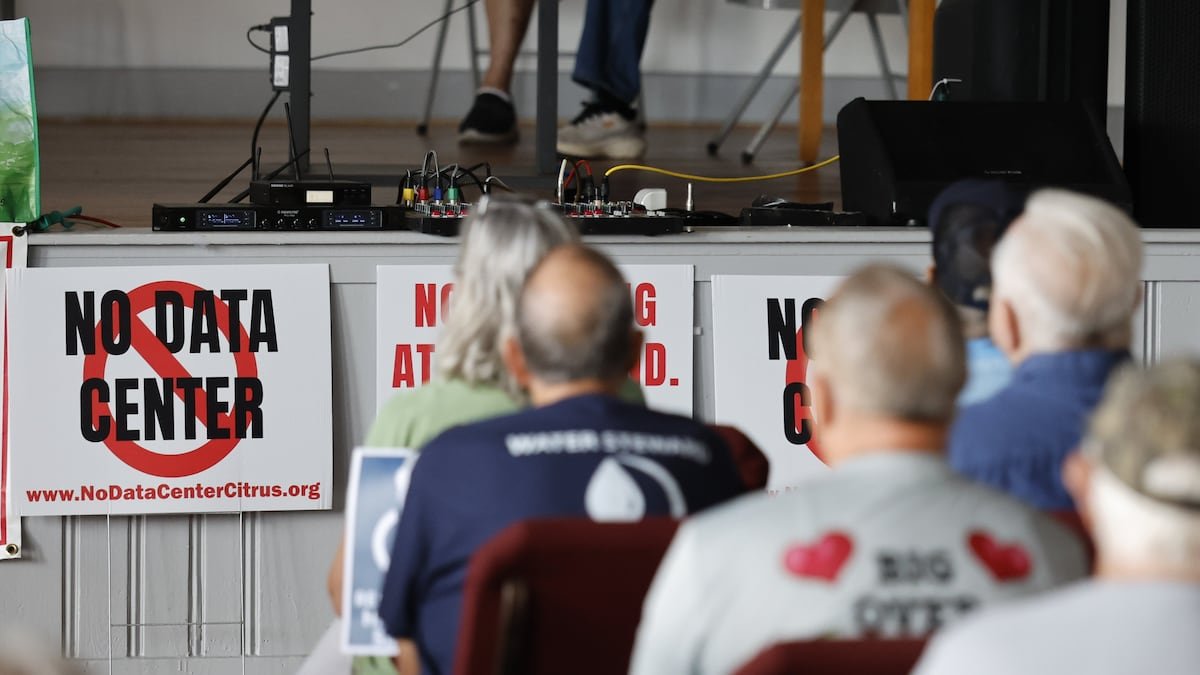
Florida’s consumer advocate accused Duke Energy of being soft on data centers, saying a proposal from the company fails to implement customer protections required by a new state law.
Under that law, which Gov. Ron DeSantis signed earlier this month, Florida utility companies must submit plans to state regulators by Oct. 1 for how they’ll regulate data centers to ensure their costs don’t bleed down to residents.
For example, if a utility has to build more transmission equipment in order to meet the power demand of a data center, the utility can require that data center to pay for it. The utilities can also set a minimum bill for data centers, so that even if they scale back their operations, they’ll continue to pay for the infrastructure they had installed.
Duke submitted its plan in April.
In it, the company opts to delay implementing any firm rates or fees specific to data centers. Duke says that for now, it would treat data centers largely like any other large corporation using their grid. The next time Duke comes to state regulators for a rate hike, it will “propose a new rate schedule … that will meet the objectives of the new legislation.”
Walt Trierweiler, the Legislature-appointed advocate for utility customers, cried foul. His office joined with Florida Rising, an affordability advocacy group, in a filing this week saying Duke’s plan does not follow the law. They asked that utility regulators dismiss Duke’s request.
The new law, previously called Senate Bill 484, “is a specifically worded consumer protection law designed to protect the general body of ratepayers,” the filing reads, adding that Duke’s proposal “seeks to bypass these requirements.”
“These facial flaws with Duke’s petition renders Duke’s proposal unlawful,” they wrote.
In response to these criticisms, Duke Energy spokesperson Ana Gibbs said the proposal follows the law and adequately requires data centers to cover their own costs. Data centers coming online can actually lower other customers’ bills, she added.
“Duke Energy Florida has an obligation to serve economic development projects locating within our service territory,” Gibbs wrote in an email. “Large load customers pay for the cost of the energy infrastructure needed to serve them and help lower costs for all customers by spreading fixed expenses over more users.”
Instead of setting across-the-board fees, Duke also proposed in its filing that it would negotiate with each data center, including to set a minimum bill between 75% and 85% percent of their projected peak demand.
In its written proposal, Duke called this plan a “reasonable, measured approach” that balanced the interests of data centers and preexisting customers.
Jordan Luebkemann, an environmental lawyer representing Florida Rising, said that granting Duke this level of discretion would put consumers at risk. Guardrails would be determined by “horse-trading” between the utility and a data center, he said. Meanwhile, utility companies like Duke want data centers built in their service areas so they can profit from the high electricity demand.
“Utilities are transparently salivating to get that (energy) load,” Luebkemann said in an interview. “It would not seem to foster an environment where the utilities are going to be driving the hardest bargain to protect their existing customers.”
Hearings in this case are scheduled for August before the Florida Public Service Commission in Tallahassee.
• • •
The Tampa Bay Times launched the Environment Hub in 2025 to focus on some of Florida’s most urgent and enduring challenges. You can contribute through our journalism fund by clicking here.



